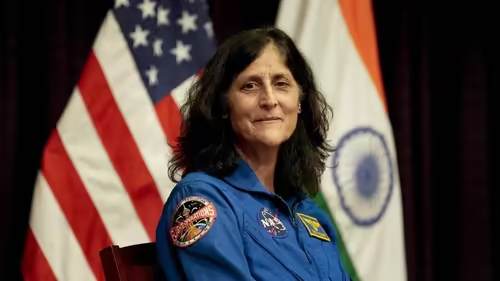
Sunita Williams Retires: A Trailblazer Leaves Orbit
After 27 years of pushing the boundaries of human spaceflight, NASA astronaut Sunita Williams has officially retired—capping a career that inspired millions around the globe. At age 60, Williams departs with an unmatched legacy: over 600 cumulative days in space, three missions to the International Space Station (ISS), and multiple world records for female astronauts. Her final mission aboard Boeing’s Starliner wasn’t just another flight—it was a full-circle moment for a pioneer who helped shape modern space operations. The news of Sunita Williams retires isn’t just a farewell; it’s a celebration of resilience, excellence, and the quiet power of representation in STEM.
Table of Contents
- Who Is Sunita Williams? A Legacy in Orbit
- Sunita Williams Retires After Historic Career
- Breaking Barriers: Record-Setting Spacewalks
- The Starliner Mission: A Dramatic Finale
- Her Impact on Future Generations of Astronauts
Who Is Sunita Williams? A Legacy in Orbit
Born in Euclid, Ohio, to an Indian-American father (of Gujarati descent) and a Slovenian-American mother, Sunita “Suni” Williams joined NASA in 1998 after a distinguished career as a U.S. Navy helicopter pilot and test pilot . She quickly rose through the ranks, becoming one of the most visible and accomplished astronauts of her generation. Fluent in Russian—a necessity for ISS collaboration—and known for her calm under pressure, Williams became a symbol of what’s possible when talent meets opportunity. Her heritage made her a role model across South Asia and beyond, proving that space truly has no borders.
Sunita Williams Retires After Historic Career
The announcement of Sunita Williams retires marks the conclusion of a 27-year tenure at NASA that included some of the agency’s most pivotal moments. Across her three spaceflights—STS-116 (2006), Expedition 14/15 (2006–2007), Expedition 32/33 (2012), and the recent Boeing Starliner Crew Flight Test (2025)—Williams logged a total of **608 days in space**, placing her among the top 10 most experienced American astronauts by time in orbit . But her contributions went far beyond duration. She served as ISS commander, operated robotic arms, conducted emergency repairs, and even ran a marathon on a treadmill in microgravity—all while maintaining the kind of professionalism that earned her deep respect from peers and mission control alike.
Breaking Barriers: Record-Setting Spacewalks
Williams didn’t just live in space—she worked outside it. She holds the record for the **most spacewalks by a woman** (7) and the **most cumulative spacewalk time by a woman** (50 hours and 40 minutes) . These aren’t just numbers; they represent hours of high-stakes, physically grueling work in the vacuum of space to maintain and upgrade the ISS. Her first spacewalk in 2006 lasted over 6 hours and involved installing critical truss segments. Later, during her 2012 mission, she performed emergency repairs that kept the station’s power systems online. These feats cemented her status not just as a trailblazer for women, but as one of the most capable extravehicular activity (EVA) specialists in NASA history.
The Starliner Mission: A Dramatic Finale
Williams’ final mission—the Boeing Starliner Crew Flight Test in 2025—was anything but routine. Originally planned as a short 8-day test, technical issues with the spacecraft’s thrusters and helium leaks extended the mission to over 100 days . Williams and fellow astronaut Barry “Butch” Wilmore remained aboard the ISS, adapting seamlessly while engineers on Earth worked to resolve the anomalies. Their calm, expert handling of the situation turned a potential crisis into a testament to astronaut readiness. For Williams, it was a fitting capstone: demonstrating that even in uncertainty, experience and composure prevail. This mission also positioned her as a key figure in the commercial crew era, bridging the shuttle past with the private-sector future of spaceflight.
Her Impact on Future Generations of Astronauts
Williams’ legacy extends far beyond records. She has been a vocal advocate for STEM education, particularly for girls and young women of color. In interviews, she often emphasized that “you don’t have to be a genius—you just have to be curious and persistent” . Her visibility—whether wearing a sari in space or speaking fluent Hindi during public events—made space feel accessible to millions who rarely saw themselves represented in science. As NASA prepares for Artemis missions to the Moon and eventual Mars expeditions, leaders like Williams have paved the way for a more diverse and resilient astronaut corps. For more on the future of human spaceflight, see our feature on [INTERNAL_LINK:next-generation-astronauts].
Summary
With the retirement of Sunita Williams, the world says goodbye to one of its most accomplished and inspiring astronauts. Over 27 years, she shattered records, commanded the ISS, and flew on both the Space Shuttle and Boeing’s Starliner. Her 608 days in space and 7 historic spacewalks stand as monuments to human ingenuity and courage. More importantly, she leaves behind a legacy that will ignite the dreams of future explorers for generations to come.
Sources
- NASA Biography: Sunita L. Williams. https://www.nasa.gov/astronauts/biographies/sunita-l-williams
- NASA Johnson Space Center. “Astronaut Fact Book – Cumulative Time in Space.” 2025.
- Guinness World Records. “Most Spacewalks by a Woman – Sunita Williams.” Verified 2023.
- NASA Press Release. “Starliner Crew Flight Test Extended Due to System Anomalies.” September 2025.
- Times of India Interview. “Sunita Williams on Representation, Resilience, and Reaching for the Stars.” January 2026.