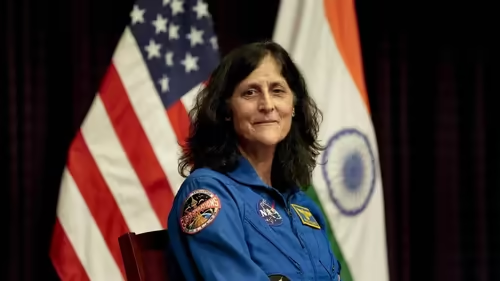
When NASA astronaut Sunita Williams stepped onto Indian soil in Delhi, she didn’t just arrive as a decorated spacefarer—she came home. In a deeply personal and widely celebrated moment, Williams described her visit as a ‘homecoming,’ a heartfelt acknowledgment of her Indian heritage through her father’s lineage. Her words resonated far beyond ceremonial diplomacy; they struck a chord with millions of young Indians dreaming of the stars.
During her public engagements, Williams didn’t just recount thrilling spacewalks or zero-gravity experiments. She offered something even more valuable: perspective. From 400 kilometers above Earth, national borders vanish, and what remains is a fragile, unified planet. That view, she said, reshaped her understanding of humanity—and it’s a message she brought straight to India’s next generation of scientists, engineers, and explorers .
Table of Contents
- Sunita Williams in India: A Homecoming with Purpose
- Life Lessons from the International Space Station
- How Williams Inspires India’s Space Ambitions
- India’s Roadmap to the Stars by 2040
- Why Her Message Matters for Young Indians
- Conclusion: A Bridge Between Two Space Powers
- Sources
Sunita Williams in India: A Homecoming with Purpose
The phrase “Sunita Williams in India” took on new meaning this week as the veteran astronaut embraced her cultural roots with visible emotion. Born in Ohio to an Indian-American father of Gujarati descent, Williams has long acknowledged her South Asian heritage—but this visit felt different. It was personal, symbolic, and strategically timed.
At a packed event in New Delhi, she told the audience, “Being here feels like a homecoming.” The statement wasn’t just poetic—it was a powerful affirmation of identity in a globalized world where diaspora contributions are increasingly vital to national progress. Her presence also comes at a pivotal moment for India’s space program, which is rapidly transitioning from regional player to interplanetary contender .
Life Lessons from the International Space Station
Williams didn’t just talk about rockets and orbits. She shared philosophical insights forged in the silence of space:
- Unity Over Borders: “From space, you don’t see countries. You see one Earth. That changes everything.”
- Teamwork is Non-Negotiable: On the ISS, astronauts from rival nations work side by side. Survival depends on trust, not politics.
- Preparation Meets Opportunity: “Every second in space is backed by years of training. Dreams need discipline.”
- Resilience in Isolation: Months in a metal tube orbiting Earth teach you to find calm in chaos—a lesson applicable to life on the ground.
These aren’t just astronaut tips—they’re life principles that resonate with students, entrepreneurs, and leaders across India .
How Williams Inspires India’s Space Ambitions
Williams’ visit is more than nostalgic—it’s aspirational. She openly praised the Indian Space Research Organisation (ISRO) for its cost-effective innovation and historic achievements like Chandrayaan-3. But she also highlighted the road ahead.
India has announced plans to build its own space station by 2035 and land an astronaut on the Moon by 2040. Williams, who holds records for longest spaceflight by a woman and most spacewalks by a female astronaut, serves as a living blueprint of what’s possible. Her journey—from a U.S. Navy pilot to a global space icon with Indian roots—shows young Indians that their heritage and ambition can coexist on the world stage .
India’s Roadmap to the Stars by 2040
India’s space vision is no longer theoretical. The government has committed serious funding and political will to the following milestones:
- Gaganyaan Mission (2025): India’s first crewed orbital flight, sending three astronauts to space.
- Bharatiya Antariksha Station (2035): A 20-ton modular space station for microgravity research.
- Chandrayaan-4 & Lunar Landing (2040): A crewed mission to the Moon’s surface, making India the fourth nation to achieve this feat.
Williams’ endorsement adds international credibility to these goals. As she noted, “When you see someone who looks like you among the stars, it makes the impossible feel within reach” .
Why Her Message Matters for Young Indians
In classrooms from Chennai to Chandigarh, Williams’ story is already being used to ignite STEM interest. Her blend of humility, excellence, and cultural pride offers a rare role model—one who excels globally without losing touch with her roots.
For a generation navigating identity in a digital age, her message is clear: your background isn’t a limitation—it’s your launchpad. And as India invests billions in space, it’s also investing in the dreams of millions who now see themselves in heroes like Sunita Williams .
Conclusion: A Bridge Between Two Space Powers
Sunita Williams in India was never just a ceremonial stop. It was a strategic, emotional, and inspirational convergence of past, present, and future. By calling India her “homecoming,” she reminded the world that space exploration isn’t just about technology—it’s about humanity. And as India races toward its own space station and lunar dreams, Williams stands as a symbol of what’s possible when talent, heritage, and vision align.
Sources
- Times of India: Sunita Williams in Delhi: NASA astronaut calls being in India ‘homecoming’
- NASA Official Biography: Sunita L. Williams – NASA Astronaut
- ISRO Future Programs: Indian Space Research Organisation (ISRO)
- [INTERNAL_LINK:india-gaganyaan-mission-updates]
- [INTERNAL_LINK:top-indian-origin-nasa-astronauts]