Introduction
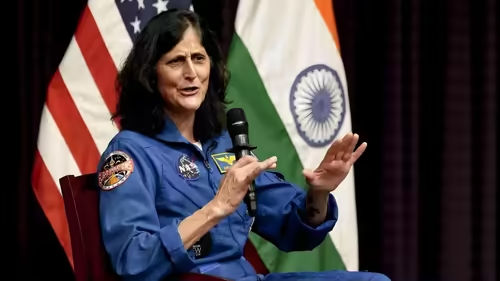
She didn’t just reach for the stars—she lived among them. Sunita Williams, the Indian-American astronaut with roots in Gujarat and a heart full of American grit, has officially closed the final chapter of her 27-year NASA career. And what a chapter it was: over 600 days in space, two long-duration missions aboard the International Space Station (ISS), and a record-setting number of spacewalks that redefined what’s possible for women in orbit .
Her last mission wasn’t even planned—it turned into an unexpected 286-day residency when technical issues delayed her return. Yet, true to form, Williams didn’t just endure; she excelled. Now, as she steps away from active duty, the world reflects on how her journey has inspired generations of dreamers, especially young girls who once looked up and saw themselves in her.
Table of Contents
- Who Is Sunita Williams?
- Sunita Williams 600 Days in Space: A Career Timeline
- Record-Breaking Spacewalks and ISS Missions
- The Unplanned 286-Day Mission
- Impact on Women and Indian-American Youth
- What’s Next for Williams?
- Conclusion: A Legacy Written in the Stars
- Sources
Who Is Sunita Williams?
Born in Euclid, Ohio, to an Indian father (Dr. Deepak Pandya, a neuroanatomist) and a Slovenian-American mother, Sunita “Suni” Williams grew up with a unique blend of cultures. She graduated from the U.S. Naval Academy in 1987 and became a naval aviator, flying helicopters and jets before being selected by NASA in 1998 .
Her heritage made her a symbol of possibility for millions in India and the diaspora. She carried not just scientific instruments into space—but also the hopes of a global community watching her soar.
Sunita Williams 600 Days in Space: A Career Timeline
Williams’ cosmic journey unfolded across two landmark missions:
- 2006–2007 (Expedition 14/15): Spent 195 days on the ISS. Conducted 4 spacewalks totaling 29 hours and 17 minutes.
- 2012 (Expedition 32/33): Another 127 days in orbit, adding 3 more spacewalks.
- 2024–2025 (Unplanned Extended Stay): Stranded due to Boeing Starliner propulsion issues, she stayed an additional 286 days—pushing her total to over 600 days in space [[1], [3]].
This places her among the top 10 astronauts worldwide for cumulative time in space—and the most experienced female astronaut in U.S. history by duration.
Record-Breaking Spacewalks and ISS Missions
Williams didn’t just float—she worked. Hard. Her seven career spacewalks totaled over 50 hours outside the ISS, setting a record for the most spacewalk time by a woman until 2023 .
She performed critical repairs, installed new modules, and even ran a marathon on a treadmill aboard the station—proving that human endurance knows no gravity.
During her missions, she also became known for her calm under pressure, technical precision, and ability to explain complex science in relatable terms during live broadcasts—a skill that made her a beloved public face of NASA.
The Unplanned 286-Day Mission
What was supposed to be an 8-day test flight aboard Boeing’s Starliner in 2024 turned into a months-long stay when helium leaks and thruster malfunctions grounded the spacecraft . Rather than panic, Williams and fellow astronaut Butch Wilmore adapted seamlessly.
They transitioned from short-term visitors to full-time crew members—conducting experiments, maintaining station systems, and mentoring new arrivals. NASA later called their flexibility “instrumental to ISS operations during a critical period.”
Impact on Women and Indian-American Youth
Williams’ influence extends far beyond orbital mechanics. She became a global icon for:
- Girls in STEM: Schools across India and the U.S. use her story to encourage science education.
- Diaspora pride: She wore a saree in space videos and celebrated Diwali on the ISS—bridging cultures.
- Military-to-space pipeline: As a former Navy officer, she showed that service can lead to the stars.
“If Suni can do it, so can I,” has become a common refrain in classrooms from Mumbai to Miami [[INTERNAL_LINK:women-in-stem-role-models]].
What’s Next for Williams?
Though retired from active flight duty, Williams remains a senior advisor at NASA and continues to advocate for commercial spaceflight safety and youth STEM programs. She’s also rumored to be writing a memoir—tentatively titled *Orbiting Home*—which promises intimate insights into life beyond Earth.
Conclusion: A Legacy Written in the Stars
Sunita Williams’ 600 days in space weren’t just about breaking records—they were about building bridges: between nations, genders, and generations. In an era where space is becoming more accessible, her career stands as a beacon of excellence, resilience, and humility. As she once said, “Space doesn’t care about your background—it only cares if you’re ready to work.” And Williams? She was always ready.
Sources
- Times of India: How Sunita Williams’ 600 days in space inspired the world
- NASA Biography: Sunita L. Williams – NASA Official Profile
- Boeing Starliner Mission Update (NASA, 2025): Mission Status Reports
- Smithsonian National Air and Space Museum: Women in Space History Archive