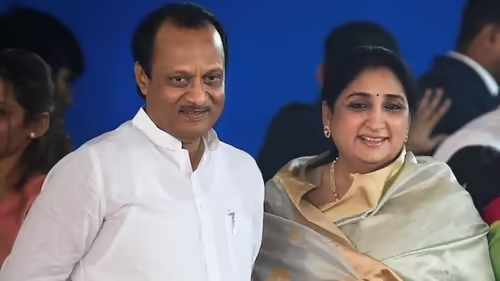
Even with a clean chit from Maharashtra’s Economic Offences Wing (EOW), Deputy Chief Minister Sunetra Pawar finds herself squarely in the crosshairs of the Enforcement Directorate (ED) over her alleged involvement in the sprawling MSCB scam—a financial scandal that has shaken the foundations of India’s cooperative banking sector. Valued at a staggering ₹25,000 crore, this case isn’t just about irregular loans; it’s become a litmus test for political accountability, regulatory failure, and the reach of anti-money laundering laws in India.
Table of Contents
- What Is the MSCB Scam?
- Sunetra Pawar’s Role and the EOW Clean Chit
- Why the ED Is Still Investigating
- The Benami Properties Angle
- Political Fallout in Maharashtra
- Broader Implications for Cooperative Banking
- Conclusion: A Case Far From Closed
- Sources
What Is the MSCB Scam?
The MSCB scam centers on the Maharashtra State Cooperative Bank (MSCB), one of India’s oldest and largest urban cooperative banks. Between 2010 and 2022, the bank allegedly disbursed massive loans—totaling approximately ₹25,000 crore—to cooperative sugar factories without proper due diligence or collateral [[1]].
These disbursements reportedly violated Reserve Bank of India (RBI) norms and internal lending guidelines. Many of the beneficiary sugar mills were either non-performing or politically connected, raising serious concerns about favoritism and systemic corruption. The scale of the irregularity led to severe liquidity stress at MSCB, prompting the RBI to place it under directions in 2022 to prevent a collapse [[2]].
Sunetra Pawar’s Role and the EOW Clean Chit
Sunetra Pawar, who served as a director on the board of MSCB during part of the period under scrutiny, has consistently denied any wrongdoing. In late 2025, Maharashtra’s EOW concluded its probe and gave her a clean chit, stating there was insufficient evidence to establish criminal intent or direct involvement in loan sanctioning [[3]].
However, legal experts caution that an EOW clearance doesn’t equate to exoneration in financial crime cases. The EOW primarily investigates under the Indian Penal Code and state-level economic offences acts, whereas the ED operates under the stringent Prevention of Money Laundering Act (PMLA)—a law with a much broader investigative scope and lower evidentiary thresholds for attachment of assets [[4]].
Why the ED Is Still Investigating
The Enforcement Directorate has formally objected to the EOW’s clean chit, arguing that the probe overlooked critical financial trails and potential money laundering linkages. According to ED sources, funds from the dubious loans may have been routed through shell companies and converted into real estate, luxury assets, and foreign holdings [[5]].
Under PMLA, the burden of proof often shifts to the accused to demonstrate that their assets are legally sourced—a significant legal hurdle. The ED’s continued scrutiny suggests they believe Sunetra Pawar’s financial footprint warrants deeper examination, regardless of the EOW’s findings.
The Benami Properties Angle
Adding another layer of complexity, both Sunetra and her husband, Deputy CM Ajit Pawar, were previously investigated under the Prohibition of Benami Property Transactions Act (PBPTA). In 2023, the ED attached properties worth nearly ₹1,000 crore allegedly held in their names through proxies [[6]].
While a special PMLA court later granted them relief—citing lack of conclusive evidence linking the properties directly to the MSCB scam—the episode underscores the persistent shadow of suspicion. The fact that such high-value assets were flagged at all raises legitimate public questions about transparency and wealth accumulation among political elites.
Political Fallout in Maharashtra
The ongoing investigation has become a potent weapon for opposition parties in Maharashtra. The BJP and Shiv Sena have repeatedly demanded Sunetra Pawar’s resignation, framing the case as emblematic of “cooperative empire” corruption that has long plagued the state’s sugar belt—a region dominated by the NCP and its allies [[7]].
For the ruling Maha Vikas Aghadi (MVA) coalition, the case is a delicate balancing act. While Ajit Pawar wields considerable influence, the scandal threatens to erode public trust, especially among urban voters increasingly skeptical of dynastic politics and opaque financial dealings.
Broader Implications for Cooperative Banking
Beyond the political drama, the MSCB scam exposes deep structural flaws in India’s cooperative banking system. With over 1,500 urban cooperative banks and more than 95,000 rural ones, the sector serves millions but suffers from weak governance, political interference, and inadequate regulatory oversight [[8]].
The RBI has since pushed for greater consolidation and digitization, but the MSCB case highlights how deeply entrenched patronage networks can subvert even basic banking norms. Without systemic reform, similar scandals are likely to recur.
Conclusion: A Case Far From Closed
Despite the EOW’s clean chit, the MSCB scam remains very much alive in the eyes of the Enforcement Directorate. For Sunetra Pawar, the legal battle is far from over—and the political cost continues to mount. This case is not just about one individual; it’s a stark reminder of the urgent need for transparency, accountability, and institutional integrity in both public finance and cooperative banking. As the ED’s investigation unfolds, all eyes will be on whether justice can pierce the veil of political power.
Sources
- Times of India. “Sunetra still facing scrutiny in ₹25k cr bank scam despite EOW clean chit.” https://timesofindia.indiatimes.com/…
- Reserve Bank of India. “Directions issued to Maharashtra State Cooperative Bank.” https://www.rbi.org.in/…
- Indian Express. “ED attaches ₹1,000 crore assets in NCP leaders’ benami case.” https://indianexpress.com/…
- Ministry of Finance, Government of India. “Prevention of Money Laundering Act (PMLA), 2002.” https://www.incometaxindia.gov.in/…
- Economic Times. “How cooperative banks became conduits for political patronage in Maharashtra.” https://economictimes.indiatimes.com/…
- [INTERNAL_LINK:ajit-pawar-political-career]
- [INTERNAL_LINK:cooperative-banking-reforms-india]