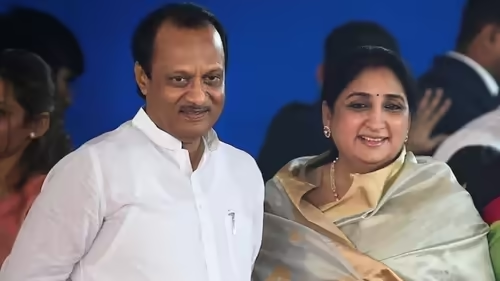
Maharashtra is on the cusp of a historic political moment. On Saturday, January 31, 2026, Sunetra Pawar, the widow of the late Deputy Chief Minister Ajit Pawar, is expected to be sworn in as his successor, making her the first woman ever to hold the post of Deputy Chief Minister in the state’s history [[1]]. This unprecedented move, coming just weeks after her husband’s tragic passing, sends a powerful message about political legacy, dynastic succession, and the evolving role of women in India’s most powerful state assemblies.
The decision, backed by the ruling Mahayuti alliance, is not just a tribute to Ajit Pawar’s legacy but also a strategic masterstroke to retain control of the crucial Baramati stronghold. However, this swift transition comes with its own set of complex political challenges, chief among them being the looming Baramati by-election that her elevation may trigger.
Table of Contents
- The Historic Appointment of Sunetra Pawar
- From Rajya Sabha to Deputy CM Office
- The Baramati By-Election Challenge
- Political Strategy Behind the Move
- What This Means for Women in Maharashtra Politics
- Conclusion: A New Chapter for the Pawar Family
- Sources
The Historic Appointment of Sunetra Pawar
Maharashtra has had powerful women leaders before—think of former Chief Minister Prithviraj Chavan’s cabinet ministers or prominent MLAs—but the second-highest executive office in the state has remained an exclusively male domain. The elevation of Sunetra Pawar shatters that glass ceiling in dramatic fashion [[2]].
Her appointment is a direct response to the sudden vacuum created by the demise of her husband, Ajit Pawar, a towering figure in state politics who held the Deputy CM post for multiple terms. The ruling coalition, led by Chief Minister Eknath Shinde, has moved swiftly to ensure that the influential Pawar family’s political clout in Western Maharashtra remains firmly within the alliance’s fold.
From Rajya Sabha to Deputy CM Office
Prior to this appointment, Sunetra Pawar was a member of the Rajya Sabha, the upper house of the Indian Parliament. To become a minister in the state government, she must first resign from her national post and get elected to the Maharashtra Legislative Assembly within six months of her swearing-in [[3]].
This requirement is where the political chess game intensifies. Her current path to the assembly is through a by-election in the Baramati constituency, the long-time bastion of the Pawar family. Winning this seat is seen as a formality by many, given the family’s deep-rooted influence there. However, any electoral contest, no matter how predictable, carries an element of risk in today’s volatile political climate.
The Baramati By-Election Challenge
The Baramati seat is more than just a constituency; it’s the symbolic heart of the Pawar political empire. For decades, it has been represented by either Sharad Pawar or his nephew, Ajit Pawar. Now, the mantle appears to be passing to the next generation—or, in this case, to the family matriarch.
A successful by-election win for Sunetra Pawar would solidify her position and validate the party’s decision. However, a misstep could embolden rivals within the NCP (Sharad Pawar faction) and other opposition parties, who might see an opportunity to challenge the family’s dominance. The campaign will be closely watched as a barometer of the Pawar family’s enduring popularity in their home turf.
Political Strategy Behind the Move
This appointment is a classic example of political realpolitik. By installing Sunetra Pawar, the ruling alliance achieves several key objectives:
- Secures the Pawar Vote Bank: It reassures the vast Maratha community and the Pawar loyalists that their interests are still being represented at the highest level of government.
- Prevents Internal Revolt: It staves off a potential leadership struggle within the Ajit Pawar-led NCP faction by presenting a unifying, non-controversial figure from the family.
- Maintains Coalition Stability: It ensures that the delicate balance of power within the Mahayuti alliance remains intact, preventing any defections or instability.
In essence, Sunetra Pawar’s candidacy is less about her individual political experience and more about the immense symbolic weight of her name and lineage.
What This Means for Women in Maharashtra Politics
While the circumstances of her appointment are unique and rooted in dynastic politics, the mere fact that a woman is now occupying the Deputy CM’s chair is a significant milestone. It provides a powerful role model for aspiring women politicians across the state and challenges the entrenched patriarchal norms of Indian political life [[4]].
Her success in the role, however, will be judged not just by her lineage but by her performance. Can she move beyond being a placeholder and carve out her own identity as a leader? The answer to that question will have far-reaching implications for the future of women’s representation in Maharashtra’s power corridors.
Conclusion: A New Chapter for the Pawar Family
The swearing-in of Sunetra Pawar as Maharashtra’s first woman Deputy Chief Minister marks the beginning of a new, uncertain chapter for one of the state’s most formidable political families. It is a move born of both grief and strategy, designed to honor a legacy while securing a future. As she takes the oath of office, all eyes will be on Baramati, where her formal entry into the state assembly—and her true test as a political leader—awaits.
Sources
[INTERNAL_LINK:maharashtra-political-dynasties-explained]
[INTERNAL_LINK:women-in-indian-politics-milestones]
Times of India: Ajit Pawar’s widow Sunetra set to replace him [[1]]
Government of Maharashtra: Office of the Deputy Chief Minister [[2]]
Constitution of India: Article 164 on Ministers [[3]]
The Hindu: Sunetra Pawar poised to make history in Maharashtra [[4]]