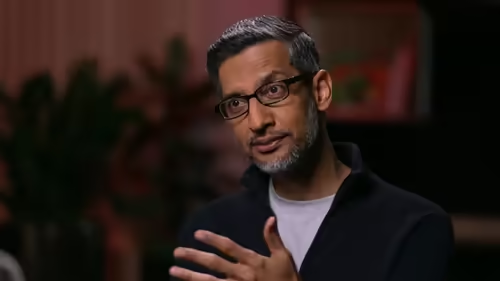
Big news from Silicon Valley: Google CEO Sundar Pichai has sold shares worth $10.6 million—but before you hit ‘sell’ on your own Alphabet stock, there’s crucial context you need to understand. This wasn’t a sudden move or a vote of no confidence. In fact, it’s a textbook example of how top executives manage their portfolios responsibly.
On January 21, 2026, Pichai sold more than 30,000 shares of Alphabet Class C stock (GOOG) at an average price near $353 per share. While the headline number sounds dramatic, the transaction was executed under a pre-established Rule 10b5-1 trading plan—a legal mechanism designed to prevent insider trading and ensure transparency. So what does this Sundar Pichai stock sale really mean for investors, employees, and the future of Google?
Table of Contents
- What Is a Rule 10b5-1 Trading Plan?
- Details of Pichai’s Latest Share Sale
- Why CEOs Sell Shares (Even When They’re Confident)
- Google’s Strong 2025 and the AI Boom
- How Much Does Pichai Still Own?
- What This Means for Alphabet Investors
- Conclusion: No Cause for Alarm
- Sources
What Is a Rule 10b5-1 Trading Plan?
A Rule 10b5-1 trading plan is a formal agreement filed with the SEC that allows corporate insiders—like CEOs, CFOs, and board members—to buy or sell company stock according to a preset schedule, even during blackout periods when they might possess material non-public information.
Key features include:
- Pre-approval: The plan must be created when the insider is not in possession of material non-public information.
- Automatic execution: Trades happen automatically based on predetermined criteria (e.g., date, price), removing discretion.
- Transparency: All transactions are publicly disclosed via SEC Form 4 filings.
In short, these plans are a sign of good governance—not a red flag. Major tech leaders like Satya Nadella (Microsoft) and Tim Cook (Apple) use them regularly .
Details of Pichai’s Latest Share Sale
According to SEC filings, Pichai’s January 21, 2026 transaction involved:
- Shares sold: 30,078 Class C shares
- Total value: Approximately $10.6 million
- Average price: ~$352.40 per share
- Trading mechanism: Rule 10b5-1 plan established months in advance
This sale is consistent with Pichai’s past behavior. He has routinely sold small portions of his holdings through similar plans, often to cover tax obligations or diversify his personal portfolio—standard practice for executives whose wealth is heavily tied to one company.
Why CEOs Sell Shares (Even When They’re Confident)
Many investors mistakenly assume that any executive stock sale signals trouble. But the reality is far more nuanced. Common reasons include:
- Wealth diversification: It’s financially unwise for anyone—even a CEO—to have nearly all their net worth in a single stock.
- Tax planning: Stock awards and options often trigger large tax bills that require liquidating some shares.
- Personal expenses: Buying a home, funding education, or other major life events.
- Pre-set financial goals: Many executives set long-term liquidity targets as part of their overall financial strategy.
Crucially, Pichai has not sold his entire stake—and he remains deeply invested in Alphabet’s success.
Google’s Strong 2025 and the AI Boom
The timing of this sale comes on the heels of a stellar year for Alphabet. In 2025, Google’s stock surged over 40%, driven by:
- Rapid integration of AI into Search, Ads, and Cloud
- Strong revenue from YouTube and Google Cloud
- Successful launch of Gemini-powered enterprise tools
- A market valuation exceeding $2 trillion
Far from retreating, Pichai has been aggressively steering Google into the AI era. His recent public statements emphasize long-term bets on generative AI, quantum computing, and responsible innovation . If he were losing faith, this wouldn’t be the backdrop for a routine share sale.
How Much Does Pichai Still Own?
After this $10.6 million transaction, Pichai still holds a significant stake in Alphabet. While exact post-sale figures vary slightly due to vesting schedules, estimates suggest he retains well over 100,000 shares—worth more than $35 million at current prices. His economic interest remains tightly aligned with shareholders.
For perspective, his total compensation package in 2025 included a $2 million salary and over $200 million in stock awards—most of which are subject to multi-year vesting conditions . This structure ensures his incentives are long-term, not short-term.
What This Means for Alphabet Investors
For everyday investors, this Sundar Pichai stock sale should be viewed as a non-event—routine portfolio management, not a strategic shift. What matters far more are:
- Google’s continued dominance in digital advertising
- Growth trajectory of Google Cloud (now profitable and gaining market share)
- Execution of its AI roadmap against competitors like Microsoft and OpenAI
- Regulatory challenges in the U.S. and EU
If anything, the fact that Pichai continues to hold the vast majority of his shares is a quiet vote of confidence in Alphabet’s future.
Conclusion: No Cause for Alarm
Headlines about a CEO selling millions in stock can sound alarming—but context is everything. Sundar Pichai’s $10.6 million share sale was a planned, transparent, and legally compliant transaction under a Rule 10b5-1 plan. It reflects prudent financial management, not a lack of belief in Google’s mission.
With Alphabet riding high on AI momentum and strong financials, Pichai remains fully committed to steering the company into its next chapter. For investors, the real story isn’t this sale—it’s Google’s ability to turn AI breakthroughs into sustainable growth. Stay focused on the fundamentals, not the noise.
For more insights on tech leadership and market trends, check out our deep dive on [INTERNAL_LINK:google-ai-strategy-2026].
Sources
- Times of India: Google CEO Sundar Pichai sells shares worth $10.6 million
- U.S. Securities and Exchange Commission (SEC): https://www.sec.gov/ (for Rule 10b5-1 details and Form 4 filings)
- Alphabet Inc. Investor Relations: https://abc.xyz/investor/