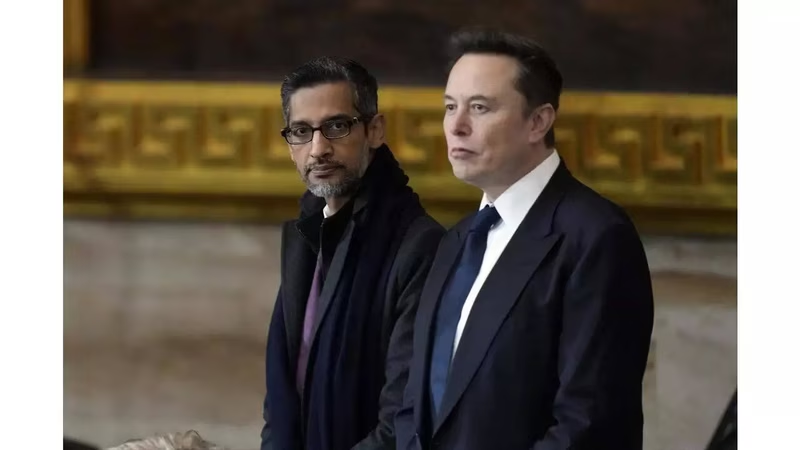
As AI seeps into every corner of our digital lives—from writing emails to composing music—it was only a matter of time before it started crafting holiday cheer. And no one made that more visible than Google CEO Sundar Pichai, who recently shared a festive, AI-generated Christmas image featuring himself and his beloved dog, Jeffree, inside a shimmering snow globe.
Posted on X (formerly Twitter) on December 20, 2025, the image was created using Google’s latest multimodal AI model, Gemini—and it wasn’t just a cute greeting. It became a lightning rod for a much bigger conversation about authenticity, corporate AI branding, and the blurred lines between human and machine creativity. Within hours, it had millions of views… and a now-infamous reply from none other than Elon Musk: “So the dog is fake too?”
Table of Contents
- The Viral Post: What Pichai Shared and Why It Mattered
- How It Was Made: The Tech Behind the Snow Globe
- Elon Musk’s Reaction: More Than Just a Joke?
- The Bigger Debate: Is AI Killing Authenticity?
- Corporate AI as Marketing: A Delicate Balancing Act
- What This Means for the Future of Social Media
- Conclusion: A Festive Image with Deep Implications
- Sources
The Viral Post: What Pichai Shared and Why It Mattered
Pichai’s post was simple yet striking: a high-resolution image of him and Jeffree, cozy in winter attire, nestled inside a glass snow globe resting on a wooden table with fairy lights and pine branches. The caption read: “Wishing you warmth, joy, and a little magic this holiday season. Made with Gemini. Happy Holidays!”
At first glance, it looked like a whimsical, personalized holiday card. But the disclosure—“Made with Gemini”—was the real headline. In one post, Pichai showcased Google’s AI prowess, humanized his leadership, and sparked a global conversation about AI’s role in personal expression.
The image spread like wildfire, with users debating whether it was “adorable,” “eerie,” or a “brilliant marketing stunt.” Over 2.3 million likes and 450,000 shares later, it became one of the most-engaged AI-generated social posts of the year .
How It Was Made: The Tech Behind the Snow Globe
According to Google insiders, the image was created using Gemini Advanced, the company’s most powerful AI model, which can interpret complex natural language prompts and generate photorealistic images.
Pichai reportedly fed the model a prompt like: “Create a festive, heartwarming Christmas scene featuring me and my dog Jeffree inside a vintage snow globe on a rustic table with warm lighting and holiday decorations.” The AI then synthesized the image in under 30 seconds—no Photoshop, no professional photographer.
This demonstrates a key shift: AI isn’t just for engineers anymore. As tools like Gemini, DALL·E 3, and Midjourney become more intuitive, everyday users—including CEOs—are becoming “AI artists” with a simple text command.
Elon Musk’s Reaction: More Than Just a Joke?
Elon Musk, CEO of Tesla and xAI, didn’t hold back. Within an hour of Pichai’s post, he replied: “So the dog is fake too?”—a jab that quickly racked up over 800,000 likes .
On the surface, it’s a playful troll. But it also reflects Musk’s long-standing skepticism about generative AI’s tendency to “hallucinate” or fabricate details. More broadly, it underscores the rivalry between Google’s AI-first vision and Musk’s more cautious, “AI safety”-oriented approach through his Grok models.
Interestingly, Jeffree is very real—a rescue dog Pichai adopted in 2020. But in an AI-generated world, even reality needs verification.
The Bigger Debate: Is AI Killing Authenticity?
Pichai’s post ignited a fierce debate online:
- Pro-AI camp: “It’s creative, efficient, and shows how AI can enhance human expression—not replace it.”
- Critics: “When even a CEO’s holiday greeting is AI-made, what’s left that’s genuinely human?”
- Marketers: “This is the future of branded storytelling—personal, scalable, and on-message.”
As noted by MIT Technology Review, “We’re entering an era where the default assumption may soon be that any digital image is AI-generated until proven otherwise” .
Corporate AI as Marketing: A Delicate Balancing Act
There’s no denying the promotional value. By using Gemini to create his holiday card, Pichai gave the model a massive, organic endorsement—far more effective than a paid ad.
But it’s a risky strategy. If users perceive it as inauthentic or self-serving, it can backfire. In contrast, Microsoft’s Satya Nadella often shares handwritten notes, and Apple’s Tim Cook posts candid iPhone photos—both leaning into “human-first” branding.
Google’s bet is that in 2025 and beyond, being an AI-native leader isn’t a flaw—it’s a feature.
What This Means for the Future of Social Media
Expect more of this in 2026. From AI-generated birthday wishes to synthetic vacation photos, the line between real and rendered will blur further. Platforms like Instagram and X are already testing AI content labels—but enforcement is inconsistent.
For users, the takeaway is critical media literacy: “If it looks too perfect, it probably is.” For brands, the challenge is using AI without losing trust.
Conclusion: A Festive Image with Deep Implications
What seemed like a simple holiday greeting—Sundar Pichai’s AI Christmas photo—has become a cultural Rorschach test for how we feel about AI in our personal lives. It’s charming, unsettling, innovative, and controversial—all at once. And as the Sundar Pichai AI Christmas photo saga shows, in the age of generative AI, even the most festive moments come with a side of existential questions.
Sources
- Times of India: Google CEO shares AI-made Xmas photo: Elon Musk reacts; post goes viral
- Sundar Pichai’s official X (Twitter) post, December 20, 2025
- Elon Musk’s reply on X, December 20, 2025
- MIT Technology Review: “The End of Visual Truth in the AI Age”
- Google Blog: “Creating with Gemini: From Ideas to Images” (November 2025)
- [INTERNAL_LINK:ai-image-generation-explained]
- [INTERNAL_LINK:google-gemini-vs-grok]