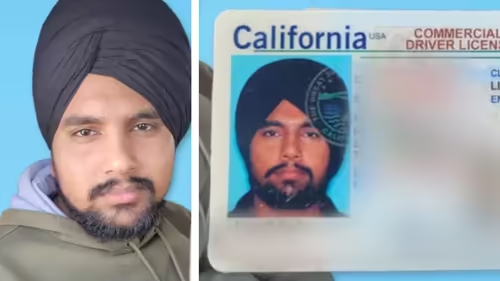
It started with a split-second decision at an intersection in Georgia. Sukhdeep Singh, a 35-year-old Indian truck driver, ran a red light. It was a minor traffic infraction—something millions of drivers do without life-altering consequences. But for Singh, who has lived in the United States for over a decade without legal status, that one mistake opened the door to **deportation proceedings**.
What makes his case especially jarring? Singh held a valid Georgia driver’s license—a document issued by the state despite his undocumented status. He paid taxes, worked long hours hauling freight across state lines, and stayed out of serious trouble. Yet, a routine traffic stop turned into an encounter with federal immigration authorities, and now he’s facing removal from the only home his children have ever known .
Table of Contents
- Who Is Sukhdeep Singh? The Man Behind the Headline
- Sukhdeep Singh Deportation: How a Red Light Triggered ICE
- The Contradiction: Driving Legally While Living Illegally
- Broader Implications for Undocumented Immigrants in the U.S.
- What Can Be Done? Legal Options and Community Response
- Conclusion: A Cautionary Tale for Thousands
- Sources
Who Is Sukhdeep Singh? The Man Behind the Headline
Sukhdeep Singh isn’t a criminal. He’s a father of two U.S.-born children and a long-haul trucker who’s been part of America’s essential logistics workforce for years. Originally from Punjab, India, he entered the U.S. on a tourist visa in the early 2010s and overstayed after it expired—a common path for many of the estimated 11 million undocumented immigrants in the country .
Like many others, Singh tried to live as normally as possible within the constraints of his status. He obtained a Georgia driver’s license under a state policy that allows undocumented residents to drive legally if they meet certain requirements—a move aimed at improving road safety and integrating immigrant communities .
Sukhdeep Singh Deportation: How a Red Light Triggered ICE
The trouble began during a routine traffic stop in Gwinnett County. After being pulled over for running a red light, local police ran Singh’s information through their system. Although his license was valid, his immigration status flagged in federal databases.
Under current U.S. immigration protocols, local law enforcement often shares data with U.S. Immigration and Customs Enforcement (ICE). In Singh’s case, that data transfer led to an ICE detainer—and his immediate transfer to immigration custody.
“He thought he was just getting a ticket,” said a family spokesperson. “He had no idea this would lead to detention and a deportation hearing.”
The Contradiction: Driving Legally While Living Illegally
Singh’s situation highlights a deep contradiction in U.S. policy. On one hand, states like Georgia, California, New York, and Illinois allow undocumented immigrants to obtain driver’s licenses—recognizing that unlicensed drivers pose a greater risk on the roads. On the other hand, any interaction with law enforcement, no matter how minor, can expose them to federal immigration enforcement.
This creates a precarious existence: follow state rules to be a responsible driver, but risk federal consequences for simply existing in public space. For truckers like Singh, whose jobs require constant travel and frequent roadside checks, the danger is amplified.
Broader Implications for Undocumented Immigrants in the U.S.
Singh’s case is not isolated. Across the country, undocumented individuals face similar fates after minor infractions:
- A mother in Texas was detained after a school drop-off traffic violation.
- A construction worker in Florida was deported following a broken taillight stop.
- In New Jersey, a student lost DACA eligibility after a misdemeanor arrest.
These incidents underscore a critical truth: under current U.S. immigration law, **any non-citizen without lawful status is deportable—even for non-criminal offenses**. As the American Immigration Council notes, “Traffic stops are a primary pipeline into the deportation system” .
What Can Be Done? Legal Options and Community Response
Singh’s legal team is now pursuing several avenues:
- Cancellation of Removal: If he can prove exceptional hardship to his U.S.-citizen children, he may qualify to stay.
- Prosecutorial Discretion: Advocates are urging ICE to deprioritize his case given his clean record and community ties.
- Public Campaign: Local immigrant rights groups have launched a petition and media campaign to pressure officials for leniency.
Meanwhile, [INTERNAL_LINK:immigration-law-resources] offers guidance for others in similar situations—emphasizing the importance of knowing your rights during police encounters.
Conclusion: A Cautionary Tale for Thousands
The story of **Sukhdeep Singh deportation** is more than just one man’s legal battle. It’s a stark reminder of the fragile existence faced by millions of undocumented immigrants who contribute to American society every day. They pay taxes, work essential jobs, and raise families—but live one traffic stop away from losing everything.
Until comprehensive immigration reform addresses these contradictions, cases like Singh’s will continue to emerge—not as anomalies, but as predictable outcomes of a broken system.