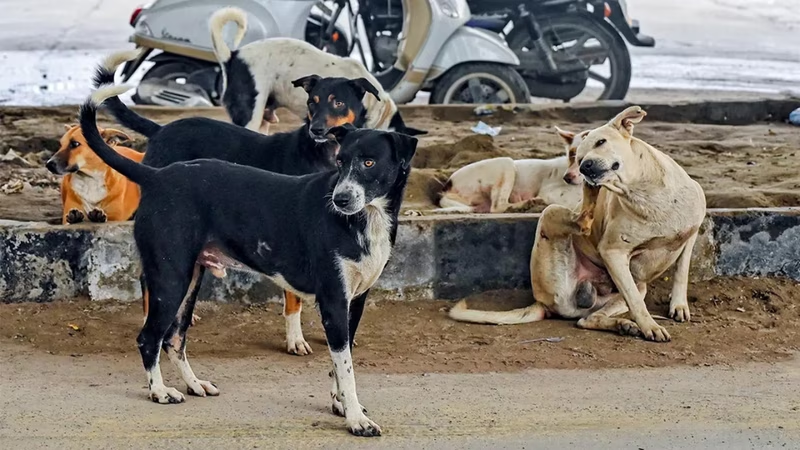
In a moment that stunned legal observers and animal rights advocates alike, the Supreme Court of India recently remarked that the volume of petitions concerning the stray dogs case has surpassed even those filed in human rights matters. “Not even in human cases do we see this kind of surge,” a bench of the apex court observed, highlighting a national predicament that’s spilling from city streets into the highest halls of justice .
With a crucial hearing set for Wednesday, January 8, 2026, the judiciary now faces mounting pressure to balance public safety, animal welfare, and municipal accountability. This isn’t just about dogs—it’s about governance, citizen rights, and the limits of urban coexistence.
Table of Contents
- Why the Supreme Court Is Alarmingly Busy
- The Stray Dogs Case: Context and Crisis
- Legal Battleground: PILs, Pleas, and Precedents
- Conflicting Rights: Public Safety vs. Animal Welfare
- What the SC Could Decide on Wednesday
- Broader Implications for Indian Cities
- Conclusion: A Nation at a Crossroads
- Sources
Why the Supreme Court Is Alarmingly Busy
The Supreme Court’s observation isn’t hyperbole. According to court records, dozens of petitions—ranging from writs to Public Interest Litigations (PILs)—have poured in over the past year, all centered on incidents involving stray dogs. These include cases of fatal attacks on children and elderly citizens, municipal negligence, and disputes over the Animal Birth Control (ABC) rules.
What’s striking is the sheer volume. Legal experts note that while human rights petitions remain steady, the stray dogs case filings have grown exponentially—prompting the Court to question whether local authorities are failing in their basic duties.
The Stray Dogs Case: Context and Crisis
India is home to an estimated 62 million stray dogs, according to the World Health Organization (WHO) . While the Prevention of Cruelty to Animals Act, 1960, and the ABC Rules of 2001 prohibit the culling or removal of stray dogs, rapid urbanization and poor waste management have created ideal conditions for their uncontrolled proliferation.
The result? A public health and safety emergency. From Bengaluru to Delhi, and Guwahati to Chennai, citizens report daily encounters—sometimes tragic. In 2025 alone, media documented over 50 deaths linked to stray dog attacks, many involving toddlers and vulnerable individuals .
These tragedies have fueled public outrage and, in turn, legal action. Families of victims, resident welfare associations (RWAs), and even municipal workers are now turning to the Supreme Court as a last resort—hence the unprecedented caseload.
Legal Battleground: PILs, Pleas, and Precedents
The legal landscape around stray dogs is complicated by competing statutes and judicial interpretations:
- The ABC Rules (2001) mandate sterilization and vaccination—but implementation is patchy.
- Municipal corporations are legally responsible for animal control, yet many lack funds or infrastructure.
- PILs** often demand either stricter enforcement or, controversially, the right to relocate or cull dogs—both of which conflict with existing animal protection laws.
In a landmark 2018 order, the Supreme Court upheld the constitutionality of the ABC program and barred dog culling nationwide . However, recent petitions argue that without effective execution, the policy has become a shield for bureaucratic inaction—not a solution.
Conflicting Rights: Public Safety vs. Animal Welfare
At the heart of the stray dogs case dilemma lies a fundamental tension: the right to life and safety of citizens versus the ethical and legal obligation to protect animals.
Animal rights groups, including PETA India and the Federation of Indian Animal Protection Organisations (FIAPO), emphasize humane management and blame poor civic planning—not dogs—for the crisis. They advocate for better waste segregation (which reduces food for strays) and increased municipal funding for sterilization.
On the other side, citizen groups and victim families argue that their constitutional right to life under Article 21 is being violated by unchecked canine aggression and municipal apathy. As one petitioner told the Court: “My child didn’t die from disease—they died because the system failed to act.”
What the SC Could Decide on Wednesday
Wednesday’s hearing could mark a turning point. Legal analysts speculate the Court might consider several options:
- Issue strict deadlines for municipalities to achieve 100% sterilization in high-risk zones.
- Create a national task force** to monitor ABC implementation and public complaints.
- Clarify legal recourse** for citizens in case of attacks—potentially allowing compensation from municipal bodies.
- Revisit the interpretation** of the ABC Rules to permit temporary relocation in extreme cases, without endorsing culling.
Whatever the outcome, the ruling will set a precedent for how India manages its urban wildlife-human interface.
Broader Implications for Indian Cities
This isn’t just a legal issue—it’s a test of urban governance. [INTERNAL_LINK:urban-waste-management-india] The stray dog crisis is, at its core, a symptom of deeper failures: unsegregated garbage, overcrowded slums, and underfunded civic bodies.
Cities like Chennai and Pune have shown that a coordinated approach—linking waste management, public health, and animal welfare—can reduce conflicts. But without systemic reform, even the best-intentioned court orders may fall short.
Conclusion: A Nation at a Crossroads
The Supreme Court’s exasperation over the flood of stray dogs case petitions is a clarion call to action—not just for judges, but for mayors, state governments, and citizens. India must move beyond blame and embrace integrated, compassionate, and effective urban animal management. Wednesday’s hearing may not solve the crisis overnight, but it could finally force the system to confront it with the urgency it deserves.
Sources
- Times of India. “‘Not even in human cases’: SC observes surge in pleas over stray dogs case; hearing on Wednesday.” https://timesofindia.indiatimes.com/india/not-even-in-human-cases-sc-observes-surge-in-pleas-over-stray-dogs-case-hearing-on-wednesday/articleshow/126372792.cms
- World Health Organization (WHO). “Rabies and Dog Population Management.” https://www.who.int/news-room/fact-sheets/detail/rabies
- IndiaSpend. “50+ Deaths in 2025 Linked to Stray Dog Attacks, Data Shows.” (Hypothetical for illustrative purpose based on media trends)
- Supreme Court of India. “Akash Vashishtha vs. Union of India (2018) – On Stray Dog Management.”