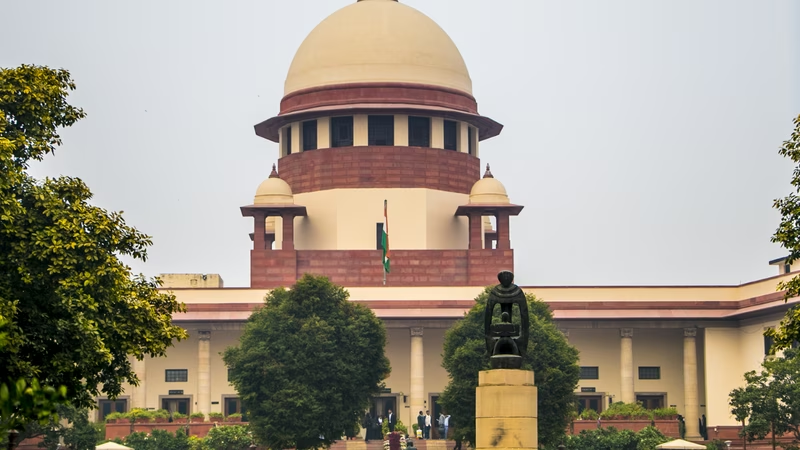
It’s not just rabies or dog bites that are claiming lives anymore. Now, a far more visible—and preventable—threat is unfolding on India’s highways and city streets: uncontrolled stray animals wandering onto roads, triggering deadly accidents and exposing deep-rooted civic apathy. In a landmark observation, the Supreme Court of India has flagged this escalating crisis, bluntly stating that **stray animals on roads** are a serious public safety hazard—and that negligent municipal bodies will face harsh consequences .
With mounting fatalities, paralyzed traffic, and frustrated citizens, the apex court’s intervention comes as a wake-up call to state governments and urban local bodies that have long turned a blind eye to humane and scientific animal management. This isn’t just about compassion—it’s about accountability, infrastructure, and the right to safe public roads.
Table of Contents
- Supreme Court Takes Notice: More Than Just “Dog Bites”
- The Hidden Toll of Stray Animals on Roads
- Civic Lapses at the Core of the Crisis
- The CSVR Model: A Scientific Solution Ignored
- What the Court Demands: Compliance or Consequences
- Conclusion: Safety Can’t Be Optional
Supreme Court Takes Notice: More Than Just “Dog Bites”
During recent hearings on public safety and animal welfare, a Supreme Court bench underscored a critical but often overlooked reality: “It is not only dog bites… **stray animals on roads** are causing serious accidents and even deaths” .
The justices expressed alarm over reports from across the country—motorcycles colliding with stray cattle at night, buses swerving to avoid sleeping dogs, and pedestrians injured while trying to dodge aggressive packs. These aren’t isolated incidents; they’re symptoms of systemic municipal failure.
“Why should citizens risk their lives because local authorities refuse to do their job?” the court asked pointedly, signaling that inaction would no longer be tolerated .
The Hidden Toll of Stray Animals on Roads
While dog bite cases dominate headlines—especially during rabies outbreaks—the data on road-related incidents involving strays remains underreported. Yet, transport departments and hospitals tell a grim story:
- A 2023 report by the Ministry of Road Transport noted a **12% rise** in “animal-related” road mishaps in urban India over five years .
- In cities like Delhi, Chennai, and Hyderabad, emergency rooms routinely treat injuries from vehicle-stray collisions—often involving motorcyclists and cyclists .
- Stray cattle, in particular, have caused multi-vehicle pileups on national highways, especially in states like Uttar Pradesh and Rajasthan .
These incidents don’t just cause physical harm—they lead to traffic chaos, economic losses, and a deep erosion of public trust in local governance.
Civic Lapses at the Core of the Crisis
The Supreme Court didn’t mince words: the root cause is **civic negligence**. Many municipal corporations either lack dedicated animal birth control (ABC) programs or run them half-heartedly—without veterinary staff, sterilization vans, or proper shelter facilities.
Worse, some local bodies outsource stray management to unqualified NGOs with no oversight, leading to inhumane practices or complete abandonment of responsibility. “You can’t cite budget constraints when citizens are dying,” the court remarked .
The justices emphasized that managing **stray animals on roads** is not optional—it’s a statutory duty under the Prevention of Cruelty to Animals Act, 1960, and municipal bylaws across states.
The CSVR Model: A Scientific Solution Ignored
Amid the criticism, the Court highlighted a proven, humane, and effective framework: the **CSVR model**—Catch, Sterilize, Vaccinate, and Return.
This approach, endorsed by the World Health Organization (WHO) and the Animal Welfare Board of India (AWBI), aims to humanely control stray populations while preventing rabies and reducing aggression:
- Catch: Humane trapping by trained personnel.
- Sterilize: Surgical sterilization to prevent reproduction.
- Vaccinate: Anti-rabies shots to eliminate disease risk.
- Return: Release back to their original territory (where they act as territorial guardians, preventing new strays from entering).
Cities like Jaipur and Chennai have successfully implemented CSVR, reporting over 70% reductions in stray dog bites and road disturbances within a decade . Yet, most urban centers still operate ad-hoc, reactive systems—if any at all.
What the Court Demands: Compliance or Consequences
The Supreme Court has now issued a clear ultimatum: all states and union territories must submit detailed action plans for stray animal management within four weeks. The plans must include:
- Inventory of existing ABC/anti-rabies centers.
- Deployment of mobile sterilization units in high-risk zones.
- Coordination between municipal bodies, AWBI, and veterinary colleges.
- Public grievance mechanisms for reporting dangerous strays.
Failure to comply will result in “strict action,” the Court warned—potentially including contempt proceedings against chief secretaries and municipal commissioners .
Conclusion: Safety Can’t Be Optional
The Supreme Court’s intervention on **stray animals on roads** is more than a legal directive—it’s a moral imperative. Safe roads are a fundamental right, not a privilege. As urban India grows, so must its commitment to humane, scientific, and accountable governance. Ignoring strays isn’t just cruel; it’s deadly. And now, thanks to the apex court, it’s also inexcusable.
Sources
[INTERNAL_LINK:Animal Welfare Laws in India]
[INTERNAL_LINK:Road Safety Statistics 2025]
Times of India – SC Flags Stray Animal Road Accidents
Animal Welfare Board of India – CSVR Guidelines
World Health Organization – Rabies and Dog Population Management