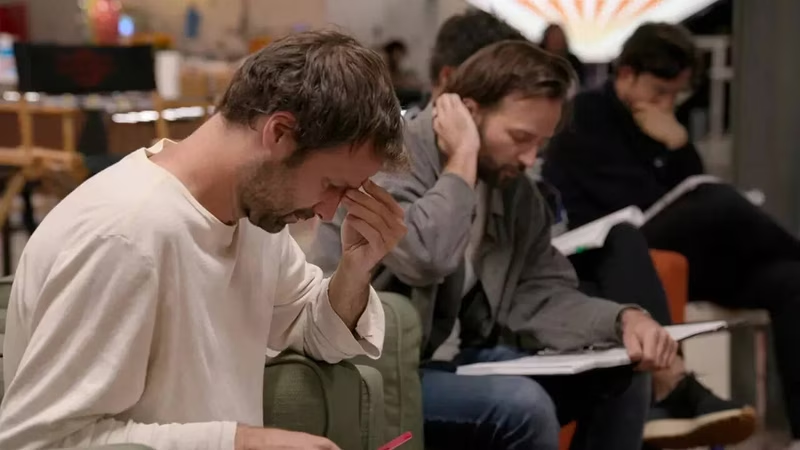
Did artificial intelligence really help craft the emotional climax of one of Netflix’s biggest hits? That’s the question fans were asking after a recent Stranger Things behind-the-scenes documentary seemingly showed a ChatGPT browser tab open on a production laptop. The internet exploded with theories that the beloved series’ final moments might have been shaped by AI—not human creativity.
But now, the speculation has been officially put to rest. Documentary director **Martina Radwan** has stepped forward to set the record straight, emphatically denying any involvement of **ChatGPT** or other AI tools in the writing, production, or creative decisions behind the **Stranger Things finale**. In her words, the episode was the result of “heartfelt human collaboration”—not algorithms.
Table of Contents
- The ChatGPT Tab That Sparked a Firestorm
- Stranger Things Finale Director Shuts Down AI Rumors
- Why Fans Were Concerned About AI in Storytelling
- The Dangers of Misinterpreting Documentary Footage
- What This Means for the Future of TV Production
- Conclusion: Human Creativity Still Reigns
- Sources
The ChatGPT Tab That Sparked a Firestorm
During a brief moment in Netflix’s official making-of documentary for *Stranger Things*, viewers spotted what appeared to be a browser window with the ChatGPT logo clearly visible on a writer’s or editor’s computer screen. In today’s climate—where AI tools are increasingly scrutinized in creative industries—that single frame was enough to ignite a wildfire of speculation.
Social media platforms like X (formerly Twitter) and Reddit lit up with posts questioning the authenticity of the show’s emotional payoff. “If the Duffer Brothers used AI to write Hopper’s final speech, I’m done,” one user lamented. Others expressed broader concerns about the future of storytelling if studios begin outsourcing narrative decisions to large language models.
While the context of the tab was never explained in the documentary, the visual alone was potent enough to fuel a full-blown controversy—despite zero evidence linking the tool to the actual scriptwriting process.
Stranger Things Finale Director Shuts Down AI Rumors
Enter **Martina Radwan**, the acclaimed director of the documentary itself. In a recent statement reported by the Times of India, Radwan addressed the rumors head-on: “There is absolutely no proof that artificial intelligence was used in the creation of the Stranger Things finale.” She emphasized that the scene in question was simply ambient footage from a busy writers’ room—a space where dozens of apps, research tabs, and communication tools are often open simultaneously.
“That ChatGPT tab could have been for anything—an unrelated personal query, a quick fact-check, or even just left over from earlier browsing,” Radwan explained. “It does not mean it was used to generate dialogue, plot points, or character arcs.” She went on to praise the Duffer Brothers and their writing team for their years-long dedication to crafting a finale that honors the show’s legacy and its characters.
This clarification aligns with Netflix’s long-standing public stance on AI: while the company uses machine learning for recommendation algorithms and content tagging, it has repeatedly stated that **creative decisions remain firmly in human hands** .
Why Fans Were Concerned About AI in Storytelling
The reaction to the rumored AI involvement speaks volumes about the current cultural moment. Audiences are increasingly wary of AI encroaching on art forms they hold dear. A 2025 Pew Research study found that **68% of entertainment consumers** believe AI-generated content lacks emotional depth and originality .
For a show like Stranger Things—which built its identity on nostalgia, character-driven drama, and heartfelt relationships—the idea that its climax might be algorithmically assembled felt like a betrayal. Fans didn’t just watch the show; they grew up with Eleven, Mike, Dustin, and Max. Their investment is deeply personal.
Key concerns included:
- Loss of authenticity: Can an AI truly understand grief, friendship, or sacrifice?
- Creative integrity: Would studios cut costs by replacing writers with AI?
- Emotional resonance: Human stories require human experience—something AI can’t replicate.
The Dangers of Misinterpreting Documentary Footage
This incident highlights a growing challenge in the digital age: the tendency to extract meaning from out-of-context visuals. Documentary filmmaking often captures candid, unscripted moments. A laptop screen showing multiple tabs is standard in any modern creative workspace—it doesn’t imply every open app is being used for the project at hand.
Radwan’s team likely included the shot to convey the intensity and chaos of the writers’ room, not to document specific software usage. Yet in an era of deepfakes and AI anxiety, audiences are primed to see hidden meanings—even where none exist.
For more on how documentaries shape public perception, see our analysis on [INTERNAL_LINK:ethics-of-behind-the-scenes-documentaries].
What This Means for the Future of TV Production
While AI tools like ChatGPT are undeniably present in many offices—including those in Hollywood—they are currently used as assistants, not auteurs. Writers might use them for brainstorming prompts, summarizing research, or checking grammar, but **core storytelling remains a human endeavor**.
The Writers Guild of America (WGA) has already negotiated strict guidelines in its 2023 contract to prevent studios from using AI to replace or undermine human writers . Shows like Stranger Things, with their intricate lore and emotional arcs, are particularly resistant to automation. As Radwan put it: “You can’t algorithm your way into making someone cry at the right moment.”
Conclusion: Human Creativity Still Reigns
The rumor that AI helped write the Stranger Things finale was just that—a rumor. Thanks to Martina Radwan’s clear and timely response, fans can rest assured that the show’s powerful conclusion was born from years of human effort, passion, and collaboration. While AI may be a tool in the modern creator’s toolkit, it is not the author. And in the world of Hawkins, Indiana, that’s exactly how it should be.