Why Shut Down a $4 Trillion Market for a Local Election?
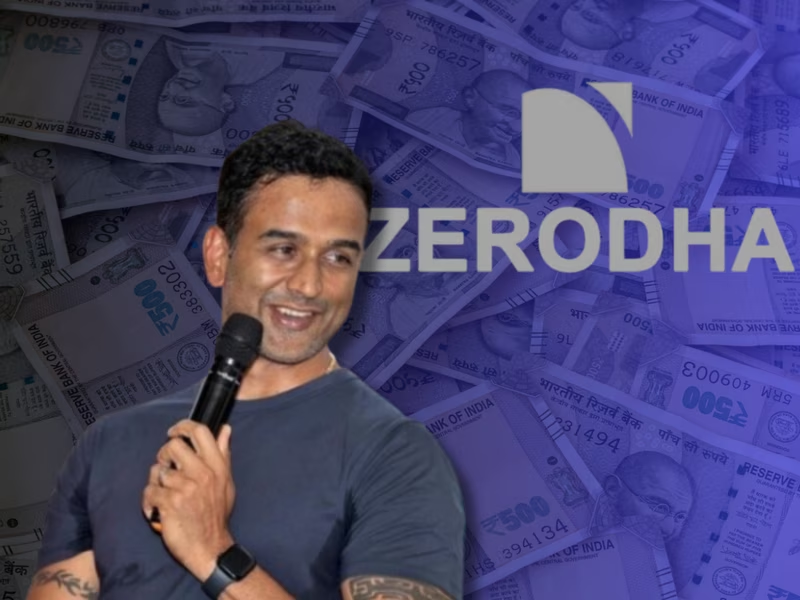
On January 15, 2026, India’s stock markets fell silent—not due to a crash, but because of a civic election in one city. The Bombay Stock Exchange (BSE) and National Stock Exchange (NSE) were closed for Mumbai’s Brihanmumbai Municipal Corporation (BMC) polls, a decision that has ignited fierce criticism from industry leaders. At the forefront is Zerodha co-founder Nithin Kamath, who called the move “poor planning” and a sign of “serious lack of appreciation” for how financial markets operate in a globalized economy .
While local elections are vital to democracy, shutting down the entire national equity market—a system that serves millions of investors and influences pension funds, startups, and international capital flows—has raised urgent questions about policy coherence, economic prioritization, and India’s image as an investment destination.
Table of Contents
- Nithin Kamath’s Scathing Critique
- Why Were Markets Closed for BMC Polls?
- stock market closure BMC polls: What It Signals to Global Investors
- Has This Happened Before? A Look at Past Election Holidays
- Better Alternatives Exist—Here’s How Other Countries Handle It
- The Real Cost to Retail Investors
- Conclusion: Democracy vs. Market Efficiency—Must We Choose?
- Sources
Nithin Kamath’s Scathing Critique
In a widely shared social media post, Kamath didn’t mince words: “Closing the stock market for a municipal election shows a fundamental misunderstanding of second-order effects,” he wrote. “It’s not just a ‘day off’—it’s a signal to the world that our institutions prioritize optics over economic rationality” .
He emphasized that in today’s hyper-connected markets, even a single unscheduled holiday can disrupt algorithmic trading, delay settlements, and create arbitrage opportunities that hurt small investors. “Global fund managers track reliability as closely as returns,” he added. “Unnecessary closures erode trust.”
Why Were Markets Closed for BMC Polls?
Historically, Indian stock exchanges have shut on days when voting occurs in major metropolitan areas like Mumbai, Delhi, or Kolkata. The official rationale is logistical: many exchange staff, brokers, and support personnel reside in these cities and may be needed as polling agents or face travel restrictions.
However, critics argue this reasoning is outdated. With remote work infrastructure, electronic trading, and decentralized operations, the need for a full market shutdown is questionable. The Securities and Exchange Board of India (SEBI) and exchanges have faced repeated calls to reassess this practice—but inertia persists.
stock market closure BMC polls: What It Signals to Global Investors
For foreign institutional investors (FIIs), market predictability is non-negotiable. Unplanned or politically driven closures send a troubling message:
- Policy unpredictability: If markets close for local polls, what’s next? State elections? Protests?
- Operational inefficiency: Mature markets like the U.S., UK, and Japan rarely close for sub-national elections.
- Competitive disadvantage: Singapore and Dubai—rival financial hubs—operate 365-day digital trading infrastructures.
As India vies for a larger slice of global capital, such decisions risk reinforcing stereotypes of bureaucratic caprice over market discipline.
Has This Happened Before? A Look at Past Election Holidays
Yes—and frequently. In recent years, markets have closed for:
- Mumbai civic elections (2022, 2027 cycle)
- Delhi Assembly polls (2020)
- Kolkata municipal elections (2015)
Each time, brokerages and fintech firms like Zerodha, Groww, and Upstox have voiced frustration. Yet, the tradition continues, rooted in legacy practices from the pre-digital era when physical presence was essential.
Better Alternatives Exist—Here’s How Other Countries Handle It
Globally, most nations avoid closing national exchanges for local elections:
- United States: NYSE and Nasdaq remain open during state and local elections—even presidential voting days.
- United Kingdom: London Stock Exchange operates normally during council elections.
- Brazil: B3 exchange stays open during municipal polls; only federal election days may see adjustments.
India could adopt similar models: allow remote operations, stagger staff shifts, or limit closures to extreme scenarios (e.g., city-wide curfews).
The Real Cost to Retail Investors
Over 10 crore Indians now invest in equities—many through SIPs and intraday trades. A forced holiday means:
- Missed opportunities to react to global news (e.g., Fed announcements, oil price swings).
- Delayed exit from volatile positions, increasing risk exposure.
- Psychological frustration: “Why should my portfolio suffer because of a local vote?”
For new investors, such disruptions can breed distrust in the system—exactly the opposite of what India’s financial inclusion goals aim to achieve.
Conclusion: Democracy vs. Market Efficiency—Must We Choose?
The stock market closure BMC polls debate isn’t about opposing democracy—it’s about aligning democratic processes with 21st-century economic realities. As Nithin Kamath rightly points out, good governance means minimizing collateral damage. India can—and must—find smarter ways to conduct elections without halting the engine of its financial future. Otherwise, every unnecessary holiday chips away at the credibility we’ve worked so hard to build.
Sources
- Times of India: Original Article
- Securities and Exchange Board of India (SEBI): Official Guidelines on Market Holidays
- World Federation of Exchanges: Global Trading Practices Report
- Zerodha Blog: Commentary on Market Infrastructure