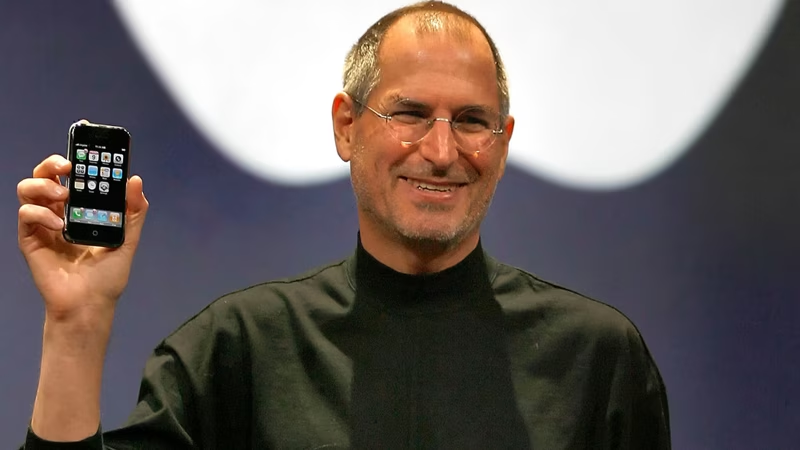
Imagine a world without swipe-to-unlock, app stores, or even pinch-to-zoom. Hard to picture, right? That was reality before January 9, 2007—the day Steve Jobs stepped onto the stage at Macworld Expo in San Francisco and dropped a bombshell that would echo through tech history.
“Today,” he declared with quiet confidence, “Apple is going to reinvent the phone.”
That Steve Jobs iPhone quote wasn’t just marketing flair. It was a promise—and one Apple delivered on with breathtaking audacity. Despite internal panic over unfinished software and last-minute bugs, Jobs unveiled a device so ahead of its time that rivals wouldn’t catch up for years. Today, with over 2 billion iPhones sold globally, that moment stands as one of the most pivotal in technological history .
Table of Contents
- The Iconic Steve Jobs iPhone Quote and Its Context
- What Made the First iPhone So Revolutionary?
- The Secret Struggle Behind the Scenes
- Industry Reaction and Skepticism
- How the iPhone Changed Everything
- Legacy of the 2007 Announcement
- Conclusion: More Than a Phone—A Paradigm Shift
- Sources
The Iconic Steve Jobs iPhone quote and Its Context
Jobs didn’t just announce a new gadget. He framed it as the convergence of three revolutionary products:
- A widescreen iPod with touch controls
- A mobile phone
- An internet communicator
“Are you getting it?” he asked the audience after listing them separately. “These are not three separate devices. This is one device.” Then came the mic-drop line: “We are calling it iPhone.”
The crowd erupted. But few grasped the full magnitude. At the time, smartphones ran on clunky styluses (BlackBerry, Palm) or resistive touchscreens that required pressure. The iPhone’s capacitive multi-touch screen—responsive to finger gestures—was pure science fiction made real .
What Made the First iPhone So Revolutionary?
Beyond the touchscreen, the original iPhone shattered norms in subtle but profound ways:
- No physical keyboard: A radical move when QWERTY was king.
- Visual voicemail: Skip messages instead of listening sequentially.
- Safari browser: Real desktop-class web browsing on mobile.
- Accelerometer: Auto-rotate based on orientation—a novelty then, standard now.
Most importantly, it prioritized user experience over specs. There was no 3G, no GPS, and no App Store at launch—but it felt magical. As tech historian Walter Isaacson later noted, Jobs cared less about features and more about “how it made you feel” .
The Secret Struggle Behind the Scenes
What the public didn’t see was chaos backstage. According to insiders, the iPhone’s operating system was riddled with bugs weeks before launch. Engineers worked 90-hour weeks. Some demos during rehearsals crashed repeatedly .
Jobs himself was anxious. In his biography, he admitted, “We were building the plane while flying it.” Yet, he refused to delay. Why? Because he knew if they waited for perfection, someone else might steal the future.
[INTERNAL_LINK:apple-product-development-secrets] This “ship it” philosophy became core to Apple’s DNA—a blend of obsession and urgency.
Industry Reaction and Skepticism
Not everyone was impressed initially. Microsoft CEO Steve Ballmer laughed: “Five hundred dollars? For a phone? That’s the most expensive phone in the world!”
Analysts doubted its lack of a keyboard and enterprise features. Competitors dismissed it as a “toy.” But consumers voted with their wallets. The iPhone sold 1.4 million units in its first six months—proving that elegance and simplicity could trump utility alone.
How the iPhone Changed Everything
The ripple effects were seismic:
- App economy born: The 2008 App Store unleashed a $100B+ developer ecosystem.
- Mobile internet exploded: By 2012, more people accessed the web via phones than desktops.
- Camera culture shifted: Suddenly, everyone was a photographer.
- New industries emerged: Uber, Instagram, TikTok—all built on smartphone ubiquity.
Even Apple’s rivals were forced to copy. Android adopted multi-touch. BlackBerry added touchscreens (too late). Nokia’s Symbian collapsed under the weight of irrelevance.
Legacy of the 2007 Announcement
Today, the iPhone is more than a product—it’s a cultural artifact. Museums display it. Documentaries dissect it. And that Steve Jobs iPhone quote is etched into Silicon Valley lore.
With over 2 billion units sold, the iPhone has generated an estimated $2 trillion in revenue for Apple—making it the most profitable product in human history . But its true legacy isn’t financial. It’s the way it redefined human-computer interaction, turning technology from a tool into an extension of ourselves.
Conclusion: More Than a Phone—A Paradigm Shift
Steve Jobs didn’t just introduce a phone in 2007. He introduced a new way of living. The Steve Jobs iPhone quote was the opening line of a revolution—one that continues to unfold in every swipe, tap, and notification we experience today. In an age of incremental updates, it’s worth remembering: real innovation isn’t about adding features. It’s about reimagining what’s possible.
Sources
- Times of India. “Quote of the day by Steve Jobs: What Apple founder said when he introduced iPhone.” January 11, 2026. https://timesofindia.indiatimes.com/…
- Apple Inc. “iPhone Introduction – Steve Jobs Keynote (2007).” Archived video. https://www.apple.com
- Statista. “Total number of iPhones sold worldwide from 2007 to 2025.” https://www.statista.com
- Isaacson, Walter. Steve Jobs. Simon & Schuster, 2011.
- Lashinsky, Adam. Inside Apple. Business Plus, 2012.
- CNBC. “Steve Ballmer laughs at iPhone price in 2007 clip.” (Archival footage).