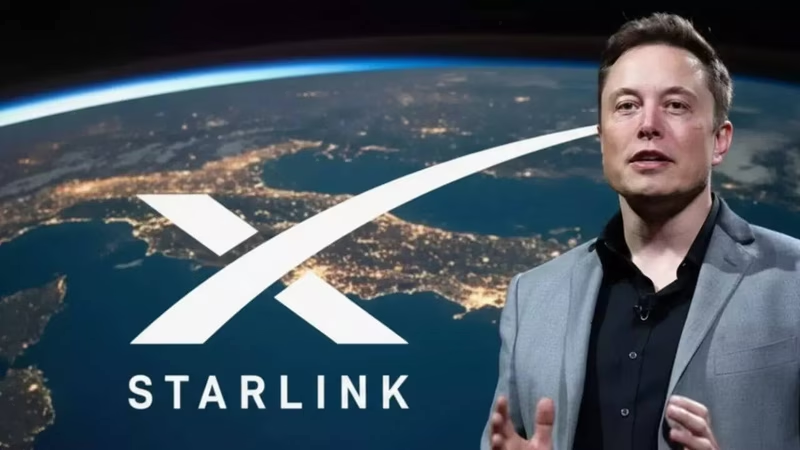
In the shadow of one of the world’s most aggressive digital crackdowns, a small, white satellite dish has become a symbol of resistance. Starlink in Iran—Elon Musk’s satellite internet service—is emerging as a clandestine lifeline for protesters, journalists, and ordinary citizens desperate to stay connected as the government plunges entire cities into digital darkness.
Officially, Starlink doesn’t operate in Iran. SpaceX has no license from the Iranian government, and importing or using its terminals violates both local laws and U.S. sanctions. Yet, through informal smuggling networks and underground tech markets, these devices are finding their way into the hands of those who need them most—fueling a silent but intense technological war between freedom of information and state control.
Table of Contents
- The Iran Internet Blackout Crisis
- How Starlink in Iran Works (Underground)
- Why Starlink Is a Game-Changer for Protesters
- The Real Risks Users Face
- Government Countermeasures: Jamming and Tracking
- The Legal and Ethical Gray Zone
- Conclusion: A Beacon of Hope in Digital Darkness
- Sources
The Iran Internet Blackout Crisis
Iran has long been known for its sophisticated internet censorship apparatus. But during periods of civil unrest—such as the 2022 “Woman, Life, Freedom” protests and ongoing demonstrations in 2026—the government escalates to near-total internet shutdowns. Mobile data is cut, social media platforms are blocked, and even landline services are disrupted in protest hotspots .
This strategy is designed to isolate communities, prevent real-time documentation of state violence, and hinder coordination among activists. In such an environment, any tool that can restore connectivity becomes not just useful—it becomes essential for survival and truth-telling.
How Starlink in Iran Works (Underground)
Despite the ban, Starlink in Iran is thriving through informal channels. Terminals are often purchased in neighboring countries like Turkey, Armenia, or the UAE, then smuggled across borders by trusted couriers. Once inside Iran, they’re sold on the black market at inflated prices—sometimes triple the retail cost—but demand remains high.
Technically, activating a Starlink terminal in Iran is tricky. The service relies on geolocation, and SpaceX’s system is designed to deactivate units in sanctioned regions. However, users have found workarounds, including using virtual private networks (VPNs) to mask their location during setup or modifying firmware—a risky move that can brick the device.
Key Steps in the Underground Supply Chain:
- Procurement: Terminals bought in non-sanctioned countries with active service coverage.
- Smuggling: Transported via land or air routes, often hidden in cargo or personal luggage.
- Distribution: Sold through encrypted messaging apps like Telegram or Signal to avoid detection.
- Activation: Users attempt to bypass geofencing using technical hacks or temporary location spoofing.
Why Starlink Is a Game-Changer for Protesters
Unlike traditional mobile networks or even some VPNs, Starlink connects directly to low-Earth orbit satellites. This means it doesn’t rely on ground-based infrastructure—which the government can easily shut down. For journalists documenting human rights abuses or medics coordinating emergency aid, this independence is revolutionary.
One verified report from late 2025 described how a single Starlink terminal in a Tehran apartment allowed a group of citizen journalists to livestream security forces’ actions during a nighttime raid—footage that later went viral globally and was cited by international human rights organizations . Without that connection, the world might never have seen what happened.
The Real Risks Users Face
Using Starlink in Iran is not without extreme danger. The Iranian government has explicitly criminalized possession of unauthorized satellite communication devices. Those caught face charges of “collaborating with hostile foreign entities,” which can carry prison sentences of up to 10 years—or worse.
Beyond legal consequences, there’s a physical risk. Authorities are actively hunting for active terminals using signal-detection vans and aerial surveillance. Once a signal is triangulated, security forces can raid the location within hours. Several users have reportedly been arrested after their Starlink dishes were discovered during home searches.
Government Countermeasures: Jamming and Tracking
The Islamic Revolutionary Guard Corps (IRGC) has reportedly invested heavily in electronic warfare capabilities to combat Starlink. While fully jamming satellite signals is technically difficult due to their high frequency and orbital speed, localized disruption is possible.
More effectively, Iranian intelligence agencies are using radio-frequency (RF) detection equipment to pinpoint the exact location of transmitting dishes. This has turned the use of Starlink into a high-stakes game of hide-and-seek—users must constantly move their terminals, limit transmission time, and shield signals to avoid detection.
For a deeper look at global internet shutdown trends, see the authoritative annual report by Access Now’s #KeepItOn campaign, which documents state-sponsored internet disruptions worldwide.
The Legal and Ethical Gray Zone
Elon Musk and SpaceX have remained largely silent on the use of Starlink in Iran. Legally, they cannot officially support or enable service in a sanctioned country without violating U.S. Treasury Department rules. Yet, the humanitarian implications are undeniable.
This creates a moral dilemma: Should a private company facilitate access to information in authoritarian regimes, even if it breaks laws? Some argue that internet access is a fundamental human right—as affirmed by the United Nations—and that tools like Starlink should be treated as modern-day lifelines, akin to food or medicine. Others caution that unregulated tech can also be exploited by bad actors.
For more on the evolving role of tech in global activism, explore our analysis on [INTERNAL_LINK:tech-tools-for-human-rights-activists].
Conclusion: A Beacon of Hope in Digital Darkness
Starlink in Iran represents more than just a technological workaround—it’s a testament to human ingenuity in the face of oppression. While the risks are immense and the battle far from won, these small dishes offer something priceless: a voice. In a country where silence is enforced by law, the ability to connect, share, and bear witness is itself an act of defiance. As long as the blackout continues, so too will the quiet hum of satellites overhead—and the courage of those who dare to listen.
Sources
- Times of India: Explained: How Elon Musk’s Starlink became Iran protesters’ lifeline as internet blackout deepens
- Access Now: #KeepItOn Campaign – Internet Shutdowns Tracker
- United Nations Human Rights Council: Internet access is a key enabler of human rights
- [INTERNAL_LINK:how-satellite-internet-works]
- [INTERNAL_LINK:global-internet-censorship-map-2026]