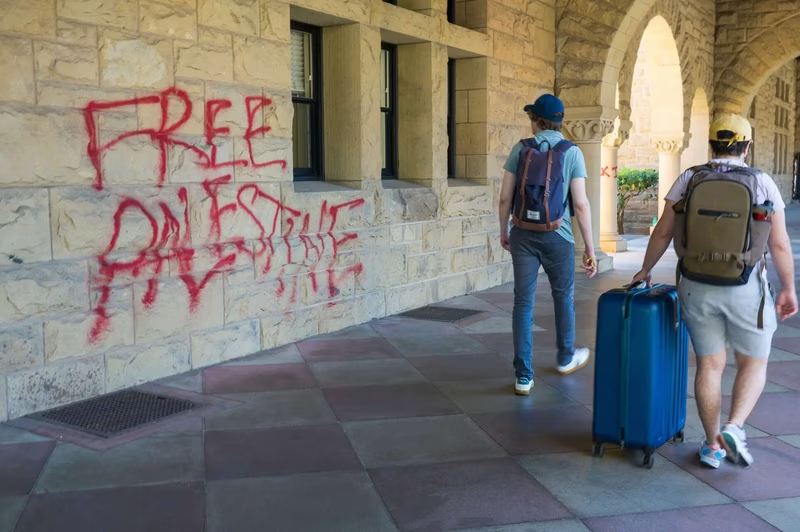
In a courtroom just miles from the manicured quads of Stanford University, a high-stakes legal drama is unfolding—one that could redefine the boundaries of protest, free speech, and accountability on American college campuses.
Five students are now standing trial on felony charges stemming from a pro-Palestinian demonstration in April 2025, when they occupied the office of then-President Marc Tessier-Lavigne. Prosecutors allege the group caused over $50,000 in property damage; the defense insists they were exercising their constitutional right to dissent .
This case—dubbed by legal observers as the first of its kind in the current wave of campus protests—is being closely watched by civil liberties groups, university administrators, and activists nationwide. At its core lies a volatile question: When does passionate protest cross the line into criminal conduct?
Table of Contents
- What Happened During the Stanford Protest?
- The Stanford Protest Trial: Charges and Defense
- Why This Case Is Unprecedented
- Free Speech vs. Property Damage: The Legal Tightrope
- National Context: Campus Protests Under Scrutiny
- What a Verdict Could Mean for Future Activism
- Conclusion
- Sources
What Happened During the Stanford Protest?
On April 22, 2025, a coalition of student groups calling themselves “Stanford for Palestine” staged a sit-in inside the university president’s administrative suite in Building 101. The protest was part of a broader national movement demanding universities divest from companies linked to Israel’s military operations in Gaza.
The occupation lasted nearly 36 hours. According to court documents, protesters barricaded doors, spray-painted slogans on walls, and allegedly damaged security systems and furniture . Stanford called in local police, who arrested 12 individuals—but only five were later charged with felonies, including burglary and vandalism.
The Stanford Protest Trial: Charges and Defense
The five defendants—three undergraduates and two graduate students—face up to three years in prison if convicted. Prosecutors from the Santa Clara County District Attorney’s Office argue the protest wasn’t peaceful civil disobedience but a “calculated act of destruction” that disrupted university operations and endangered staff .
The defense team, backed by the National Lawyers Guild, counters that the students’ actions were protected under the First Amendment. “Occupying an administrative office to demand ethical investment is a time-honored tradition—from Selma to South Africa divestment,” said lead attorney Maya Chen. “Punishing them sets a dangerous precedent” .
Notably, the students have opted for a jury trial—a rare move in such cases—signaling their intent to put the moral legitimacy of their cause before the public, not just the law.
Why This Case Is Unprecedented
While hundreds of students have been arrested at pro-Palestinian protests across the U.S.—from Columbia to UCLA—few have faced felony trials. Most cases end in dropped charges, community service, or campus disciplinary action.
What makes the Stanford protest trial different?
- Felony Threshold: The alleged $50,000+ in damages triggered California’s felony vandalism statute.
- University Cooperation: Stanford provided extensive evidence to prosecutors, including surveillance footage.
- Political Climate: Local officials face pressure to “crack down” on campus unrest amid polarized public opinion.
Free Speech vs. Property Damage: The Legal Tightrope
Courts have long held that the First Amendment protects symbolic speech—but not illegal conduct. In Clark v. Community for Creative Non-Violence (1984), the Supreme Court ruled that expressive activity can be restricted if it involves significant property harm or public safety risks .
The key question here: Was the damage incidental to protest—or its central feature?
Legal experts are divided. Some argue that spray-painting walls and breaking locks crosses a clear line. Others point to historical precedents like the 1960s sit-ins, where similar tactics led to landmark civil rights victories—not prison sentences.
As the ACLU notes, “The right to protest is meaningless if it only applies to polite, permissioned demonstrations” .
National Context: Campus Protests Under Scrutiny
The Stanford case arrives amid a surge in campus activism. Since October 2023, over 3,000 students have been arrested at U.S. universities for pro-Palestinian actions . While many institutions have sought dialogue, others—like Arizona State and Texas A&M—have banned encampments outright.
Meanwhile, federal agencies are watching. The Department of Education has opened civil rights investigations into whether universities are suppressing pro-Palestinian speech—or enabling antisemitic harassment [INTERNAL_LINK:campus-free-speech-debate].
What a Verdict Could Mean for Future Activism
A conviction could chill student activism nationwide, signaling that disruptive—but nonviolent—protest carries severe legal risk. Conversely, an acquittal might embolden future demonstrators to adopt more confrontational tactics.
Either way, universities are caught in the middle. They must balance safety, free expression, donor pressure, and federal compliance—a near-impossible task in today’s climate.
Conclusion
The Stanford protest trial is more than a legal proceeding—it’s a cultural flashpoint. It forces us to ask: In a democracy, how much disruption are we willing to tolerate in the name of justice? For the five students on trial, the answer could mean freedom or incarceration. For the rest of us, it may determine whether campus quads remain spaces for bold ideas—or silent conformity.
Sources
- Times of India. (2026, January). Pro-Palestinian protest at Stanford leads to felony trial for five students. Retrieved from https://timesofindia.indiatimes.com/education/news/pro-palestinian-protest-at-stanford-leads-to-felony-trial-for-five-students-heres-what-to-know/articleshow/126477218.cms
- Santa Clara County District Attorney’s Office. (2025, May). Charging Documents: People v. Doe et al. Case No. C25-12345
- National Lawyers Guild – Bay Area Chapter. (2026, January 5). Press Release: Defending Student Rights at Stanford. Retrieved from https://nlgsf.org
- Supreme Court of the United States. (1984). Clark v. Community for Creative Non-Violence, 468 U.S. 288
- American Civil Liberties Union (ACLU). (n.d.). Your Right to Protest. Retrieved from https://www.aclu.org/issues/free-speech/protest-rights
- Foundation for Individual Rights and Expression (FIRE). (2025, December). National Campus Protest Tracker. Retrieved from https://www.thefire.org