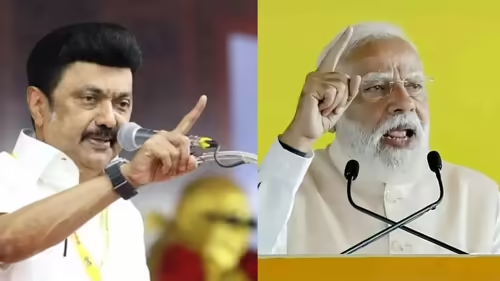
The political battle for Tamil Nadu has officially ignited. In a direct and forceful rebuttal to Prime Minister Narendra Modi’s recent campaign push, Chief Minister M.K. Stalin has declared that the much-touted double engine government—a central and state government run by the same party—simply “won’t run” in his state . This isn’t just a policy disagreement; it’s a fundamental clash of ideologies, regional pride, and a fierce defense of Tamil Nadu’s independent path to development.
Table of Contents
- Stalin’s Defiant Stance Against Delhi’s ‘Arrogance’
- Modi’s Double Engine Pitch and the ‘CMC’ Charge
- The Proof is in the Numbers: Tamil Nadu’s Growth Story
- Beyond the Rhetoric: What Does a Double Engine Government Mean for Voters?
- Conclusion: A Battle for Tamil Nadu’s Soul
- Sources
Stalin’s Defiant Stance Against Delhi’s ‘Arrogance’
Stalin’s rejection was sharp and unambiguous. He framed the BJP’s push for a double engine government not as a promise of progress, but as an attempt to impose Delhi’s will on a state with a proud history of self-determination. He accused the BJP-led central government of “betraying” Tamil Nadu, pointing to what he sees as a pattern of non-cooperation and neglect on key state issues .
His core argument is simple: Tamil Nadu doesn’t need a political alignment with the Centre to succeed. He proudly points to the state’s achievements under the Dravidian model of governance, which has historically been at odds with the BJP’s national ideology. For Stalin, accepting a double engine would be a surrender of the state’s autonomy and a betrayal of its political legacy .
Modi’s Double Engine Pitch and the ‘CMC’ Charge
Prime Minister Modi’s strategy in Tamil Nadu is clear: paint the current DMK government as a failure and offer his party as the solution. At a major NDA rally, he launched a scathing attack, coining a new and damaging acronym for the DMK regime: “CMC”—standing for Corruption, Mafia, and Crime [[9], [14]].
He argued that this alleged misgovernance is the reason why Tamil Nadu needs a double engine government to unlock its true potential, promising a more efficient and corruption-free administration if the BJP comes to power in the state . This narrative is a classic political tactic, attempting to shift the focus from ideological differences to administrative competence and security.
The Proof is in the Numbers: Tamil Nadu’s Growth Story
Stalin’s confidence isn’t just bluster; it’s backed by impressive economic data. Recent statistics show that Tamil Nadu has been one of India’s top-performing states economically. For the 2024-25 fiscal year, the state recorded a remarkable economic growth rate of 9.69%, leading the nation . Other reports place its growth at a robust 39% in certain sectors, second only to Assam .
This strong performance, achieved without a double engine government, forms the bedrock of Stalin’s argument. He uses these figures to demonstrate that good governance and economic success are possible through a state-centric model that prioritizes local needs over central diktats. This data directly challenges the BJP’s core premise that political alignment is a prerequisite for development.
Beyond the Rhetoric: What Does a Double Engine Government Mean for Voters?
The debate between Stalin and Modi transcends their personal rivalry. It forces voters to consider a fundamental question: what kind of relationship should their state have with the Union government?
Proponents of the double engine model argue:
- Faster project approvals and fund disbursements from the Centre.
- Better coordination on law and order and national security.
- A unified vision for development without political gridlock.
Opponents, like Stalin, counter that:
- It can lead to a loss of state autonomy and federal balance.
- Development should be based on competence, not political loyalty.
- States like Tamil Nadu have proven they can excel independently, as seen in their top-tier economic growth .
This is not just a Tamil Nadu issue. It’s a reflection of the larger tension between India’s federal structure and the growing centralization of power under the current national administration.
Conclusion: A Battle for Tamil Nadu’s Soul
The clash between M.K. Stalin and Narendra Modi over the double engine government is far more than a pre-election skirmish. It is a profound ideological contest over the future of Tamil Nadu. Stalin champions a vision of a self-reliant, assertive state that charts its own course, while Modi offers a vision of seamless integration with a powerful Centre. As the election season heats up, voters in Tamil Nadu will have to decide which path they believe will best serve their interests and uphold their state’s unique identity. The outcome will send a powerful message about the health of India’s federal democracy.
Sources
- Times of India: “Not double but dummy engine: Stalin says Tamil Nadu won”
- Reports on Stalin criticizing the BJP government for non-cooperation.
- [[9], [10], [14], [15]] Coverage of PM Modi’s “CMC (Corruption, Mafia, Crime)” accusation against the DMK government at the NDA rally.
- Economic growth data showing Tamil Nadu at 39%.
- RBI’s Handbook of Statistics confirming Tamil Nadu’s 9.69% economic growth for 2024-25.