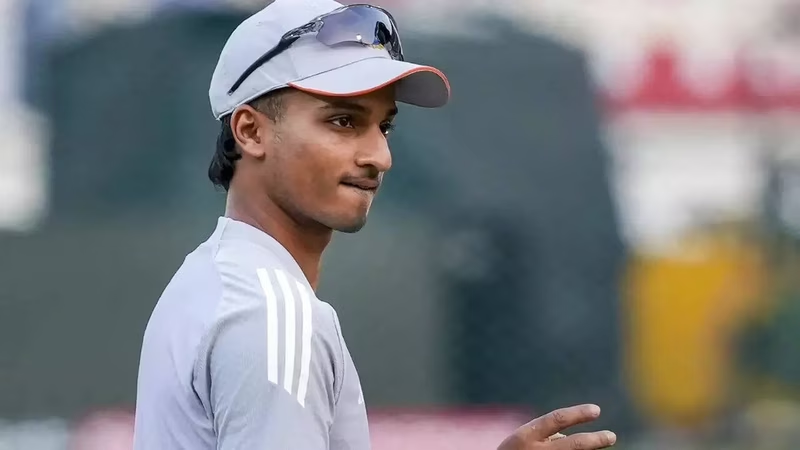
Indian cricket is once again embroiled in a heated selection debate—this time over the surprise inclusion of Delhi all-rounder Ayush Badoni in the ODI squad for the ongoing series against New Zealand. The appointment, made as a replacement for the injured Washington Sundar, has drawn fierce criticism from former chief selector and 1983 World Cup hero Krishnamachari Srikkanth, who didn’t mince words: “What rubbish is this?” His explosive remarks, laced with accusations of inconsistent standards and possible favoritism, have ignited a national conversation about transparency, merit, and the influence of personal relationships in Team India’s selection room .
Table of Contents
- Srikkanth’s Scathing Critique: “What Rubbish Is This?”
- The Official Defense: Why Badoni Was Chosen
- Who Is Ayush Badoni? Beyond the Headlines
- Favoritism Allegations: The Gambhir Connection
- Historical Selection Inconsistencies: A Pattern?
- What This Means for Team India’s Future
- Conclusion: Merit vs. Perception in Modern Cricket
- Sources
Srikkanth’s Scathing Critique: “What Rubbish Is This?”
In a now-viral video posted on his social media, Srikkanth expressed disbelief at Badoni’s inclusion, particularly his classification as an all-rounder. “He’s not even a proper all-rounder,” Srikkanth argued, pointing out that Badoni’s bowling is more of a part-time option than a genuine sixth-bowling resource . More damningly, he questioned the selection committee’s criteria: “Why him? What yardstick are they using? Other players with far better domestic records have been ignored for years.” His frustration wasn’t just about one player—it was a broader indictment of what he sees as a lack of clear, consistent selection principles.
The Official Defense: Why Badoni Was Chosen
Team India’s camp has pushed back firmly. With Washington Sundar ruled out due to a rib injury sustained in the first ODI, the management needed a like-for-like replacement to maintain balance. Badoni, they argue, offers the ideal blend: a middle-order batsman capable of quick runs and a handy off-spin option who can bowl 4–6 overs in the middle phase—critical in modern ODI strategy . Batting coach Sitanshu Kotak later clarified that Badoni’s consistent performances for India A and in the IPL made him a “logical choice” under the circumstances .
Who Is Ayush Badoni? Beyond the Headlines
To understand the controversy, it’s essential to look at Badoni’s actual record:
- IPL Career: 56 matches, 963 runs at a strike rate of 138.56, with 12 wickets for Lucknow Super Giants .
- List A (Domestic 50-over): Over 1,200 runs at an average above 40, plus 25+ wickets—proving utility in the format .
- India A Caps: Regular member across formats, indicating long-term monitoring by selectors .
While not a household name, Badoni isn’t an unknown quantity. His selection, therefore, may be less about favoritism and more about format-specific suitability.
Favoritism Allegations: The Gambhir Connection
Srikkanth’s most pointed remark came when he said, “He was the mentor there”—a clear reference to new head coach Gautam Gambhir, who mentored Badoni at the Lucknow Super Giants. This has fueled speculation that personal rapport influenced the decision. Critics argue that if pure merit were the goal, players like Shahrukh Khan or Riyan Parag—with stronger recent white-ball stats—might have been preferred. However, insiders counter that Gambhir’s familiarity with Badoni’s temperament and tactical awareness under pressure gives him an edge that stats alone can’t capture. For a deeper look at how coaching relationships impact selections, see our analysis on [INTERNAL_LINK:how-head-coaches-influence-team-composition].
Historical Selection Inconsistencies: A Pattern?
Srikkanth’s anger stems from a longer pattern. In recent years, selectors have flip-flopped on criteria—sometimes prioritizing IPL form, other times domestic consistency, and occasionally “future potential.” Players like Deepak Hooda and Suryakumar Yadav waited years despite stellar records, while others received quick call-ups. This inconsistency erodes trust in the system. As noted by ESPNcricinfo, “When the rules change with every vacancy, fans and legends alike lose faith” .
What This Means for Team India’s Future
The Badoni call-up may seem minor, but it reflects a larger tension in Indian cricket: balancing immediate tactical needs with long-term meritocracy. If Badoni performs—scoring crucial runs or breaking partnerships—the controversy will fade. But if he struggles, it could validate Srikkanth’s critique and intensify calls for greater transparency, such as public selection rubrics or post-announcement briefings.
Conclusion: Merit vs. Perception in Modern Cricket
The uproar over the Ayush Badoni ODI call-up isn’t really about one player—it’s about the credibility of the entire selection ecosystem. Srikkanth’s outburst resonates because it voices a widespread concern: that personal networks may be overshadowing objective benchmarks. Whether this is fair or not, the onus is now on Badoni to let his bat—and ball—do the talking. And on the selectors to prove that their decisions are rooted in strategy, not sentiment.
Sources
- Times of India: ‘What rubbish is this?’ – Ex-WC winner explodes over Badoni call-up
- BCCI: India Squad Announcement for NZ ODIs
- ESPNcricinfo: Ayush Badoni Player Profile & Stats
- IPL Official Site: Badoni’s IPL Record