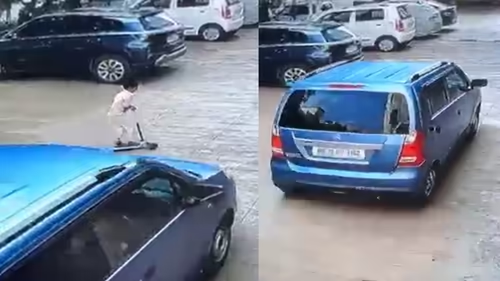
The laughter of children playing is supposed to be the soundtrack of a safe, happy neighborhood. But in Pune’s Joy Nest Society, that sound was replaced by a chilling silence on January 19, 2026, after a speeding car kills child in a horrific and entirely preventable tragedy. The victim, five-year-old Nishkarsh Ashwat Swami, was simply enjoying a moment of childhood freedom on his skating cycle when his life was cut short .
Newly emerged CCTV footage of the incident has sent shockwaves across social media, not just for its raw horror, but for the stark reminder it serves: our residential spaces are not as safe for our children as we believe them to be . This isn’t just a story about a single accident; it’s a wake-up call for every housing society, parent, and driver in the country.
Table of Contents
- The Horror in Joy Nest Society
- Why Did This ‘Speeding Car Kills Child’ Tragedy Happen?
- The Critical State of Child Safety in Indian Residential Societies
- What Must Change: A Call for Action
- Conclusion: A Tragedy That Must Not Be In Vain
- Sources
The Horror in Joy Nest Society
According to police reports and multiple news sources, the incident occurred around 3:30 PM on a Monday afternoon . Little Nishkarsh was riding his skating cycle near the entrance of the Joy Nest Society in Loni Kalbhor, a common and seemingly safe activity for a child in his own home environment .
A vehicle, reportedly being driven at a high speed, entered the society premises to drop off a passenger. In a matter of seconds, the driver lost control or failed to notice the child, leading to the fatal collision . The driver, realizing the gravity of the situation, immediately rushed Nishkarsh to a nearby hospital, but the young boy was pronounced dead on arrival .
The subsequent release of the CCTV footage has been described as “chilling” and “horrifying,” showing the terrifying final moments before the impact [[1], [22]]. This visual evidence has transformed a local tragedy into a national point of reckoning.
Why Did This ‘Speeding Car Kills Child’ Tragedy Happen?
While the immediate cause appears to be excessive speed and a lack of attention from the driver, the root causes run much deeper. This incident is a symptom of a systemic failure in how we design and manage our living spaces.
A Culture of Complacency
Many residential societies operate under a false sense of security. The assumption is that because these are private, gated communities, they are inherently safe. This leads to a dangerous complacency where basic traffic rules—like speed limits—are ignored. Drivers often treat society roads as extensions of their personal driveways, forgetting that these are shared public spaces where children play.
Inadequate Infrastructure and Enforcement
How many societies have clearly marked speed breakers, designated play areas away from vehicle paths, or even simple signage reminding drivers to slow down? The answer, in far too many cases, is none. Even when such infrastructure exists, there is often a complete lack of enforcement by the resident welfare associations (RWAs). Without consistent monitoring and consequences, rules become meaningless suggestions.
The Critical State of Child Safety in Indian Residential Societies
This Pune tragedy is not an isolated event. It’s a recurring nightmare that plays out in cities across India. Our residential complexes are often designed with cars in mind first, and people—especially children—second.
While comprehensive national guidelines specifically for child safety within private societies are still evolving, the principles are clear. The Government of Odisha, for example, has notified specific Guidelines for ensuring a child safe environment in institutions, which can serve as a model for residential settings . These guidelines emphasize creating physical environments that minimize risk.
Furthermore, general child protection laws in India, like the Juvenile Justice (Care and Protection of Children) Act, 2015, establish a framework for child safety, but their application within private residential zones remains a grey area . The onus, therefore, falls heavily on RWAs and individual residents to create a culture of safety.
What Must Change: A Call for Action
Honoring Nishkarsh’s memory requires more than just grief; it demands concrete action. Here’s what needs to happen, starting today:
- Mandatory Low-Speed Zones: Every residential society must enforce a strict 10-15 km/h speed limit. This should be non-negotiable.
- Physical Traffic Calming Measures: Install properly designed speed breakers, rumble strips, and chicane bends at all entry and exit points and throughout the complex.
- Dedicated, Safe Play Areas: Create fenced-off play zones that are completely separate from any vehicle pathways. This is a fundamental requirement, not a luxury.
- Active RWA Oversight: Resident Welfare Associations must take their responsibility seriously. This includes regular patrols, installing and monitoring CCTV at key junctions, and imposing fines for reckless driving.
- Community Awareness Drives: Organize workshops for both adults and children on road safety within the society. Drivers need to be reminded that they are guests in a space where children live and play.
For parents, it’s also crucial to have open conversations with children about the dangers of vehicles, even in familiar places. Resources from authoritative bodies like the NSW Government’s Communities and Justice department offer valuable tips on keeping children safe in various environments, including at play .
Conclusion: A Tragedy That Must Not Be In Vain
The image of a child playing in his own society should evoke peace, not panic. The fact that a speeding car kills child in such a setting is a profound societal failure. The CCTV footage from Pune’s Joy Nest Society is a grim testament to what happens when we prioritize convenience over caution.
This incident must serve as a catalyst for change. It’s time for RWAs to move beyond collecting maintenance fees and start actively safeguarding the lives of their youngest residents. It’s time for drivers to understand that a residential society is not a racetrack. And it’s time for all of us to demand safer spaces for our children, because their right to play safely in their own home should never be a privilege, but a guarantee.
Sources
- Times of India: Pune: Chilling CCTV visuals emerge as 5-year-old boy dies after being hit by car in resident society
- Pune First: Pune Tragedy: 5-Year-Old Dies After Speeding Car Runs Over Him Inside Society Premises
- Government of Odisha: Guidelines for ensuring a child safe environment in institutions
- NSW Government – Communities and Justice: Safety inside and outside the house