Table of Contents
- Tragedy Strikes Barcelona: A Deadly Derailment
- What Exactly Happened?
- The Victim and the Injured
- The Spain Train Derailment in Context: A Week of Rail Disasters
- Did Extreme Weather Trigger the Collapse?
- Mounting Concerns Over Spain’s Rail Infrastructure
- Emergency Response: Swift but Sobering
- Conclusion
- Sources
Tragedy Strikes Barcelona: A Deadly Derailment
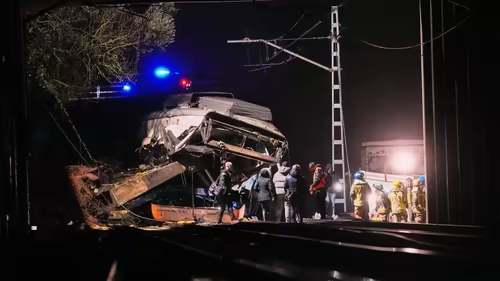
In a heart-wrenching incident that has gripped Spain, a commuter train derailed near Barcelona on Tuesday, January 20, 2026, after a retaining wall collapsed onto the tracks during heavy rainfall. The crash resulted in the death of the train’s driver and left 37 passengers injured—some critically .
This disaster is especially alarming because it occurred just days after a separate, deadly high-speed rail collision in Andalusia, which killed two people. The back-to-back tragedies have sparked national outrage and intense scrutiny over the state of Spain’s rail network, once hailed as one of Europe’s most advanced.
What Exactly Happened?
According to Spain’s Ministry of Transport, the derailment occurred around 8:30 a.m. local time on the R2 Nord line between the stations of Montcada i Reixac and Ripollet, just north of central Barcelona. Torrential rain had saturated the ground for days, weakening the structural integrity of a concrete retaining wall adjacent to the track.
The wall gave way without warning, spilling tons of earth and debris directly onto the rails. The incoming commuter train, traveling at normal speed, struck the obstruction and partially derailed. The front carriage was severely damaged, while several others were thrown off the tracks .
The Victim and the Injured
The driver, whose identity has not yet been officially released, was pronounced dead at the scene. He is being hailed as a hero by officials for his quick actions in applying emergency brakes, which likely prevented a far worse catastrophe.
Of the 37 injured, 12 were hospitalized with serious injuries, including fractures and internal trauma. The remaining passengers suffered minor cuts, bruises, and psychological shock. Emergency medical teams from across Catalonia were deployed, and helicopters were used to airlift the most critical patients to nearby hospitals .
The Spain Train Derailment in Context: A Week of Rail Disasters
This incident cannot be viewed in isolation. Just four days earlier, on January 16, a high-speed AVE train collided with a maintenance vehicle near Seville in southern Spain, killing two railway workers and injuring several others . That crash prompted immediate calls for a nationwide safety review.
Now, with a second fatal incident in less than a week, public trust in Spain’s rail system is eroding rapidly. Critics are demanding answers: Are these isolated failures, or symptoms of a deeper systemic problem?
Did Extreme Weather Trigger the Collapse?
Initial investigations point to extreme weather as a key factor. Catalonia experienced its heaviest January rainfall in over a decade, with more than 150mm of rain falling in 48 hours. Such conditions can destabilize aging infrastructure, especially if drainage systems are inadequate or maintenance has been deferred.
However, experts warn that blaming weather alone is a cop-out. “Climate change means extreme rainfall is becoming the norm, not the exception,” said Dr. Elena Martínez, a civil engineer specializing in transport resilience. “Rail networks must be designed and maintained to withstand these new realities” .
Mounting Concerns Over Spain’s Rail Infrastructure
Spain boasts over 15,000 kilometers of railway, including the largest high-speed network in Europe. Yet much of its regional and commuter infrastructure—like the line involved in the Barcelona derailment—is decades old and underfunded.
Key concerns include:
- Aging Retaining Walls: Many earth-retention structures along rail corridors were built in the 1970s–80s and lack modern reinforcement.
- Inadequate Drainage: Older lines often have insufficient stormwater management, leading to soil saturation and erosion.
- Deferred Maintenance: Budget cuts in recent years have reportedly delayed critical inspections and repairs on non-high-speed lines.
The European Union Agency for Railways (ERA) has previously flagged the need for enhanced geotechnical monitoring across Southern Europe—a recommendation that now feels tragically prescient .
Emergency Response: Swift but Sobering
Credit must be given to Catalonia’s emergency services. Within minutes of the crash, police, firefighters, and medical teams were on site. Passengers were safely evacuated, and triage was conducted efficiently. Local residents also opened their homes to offer blankets and water to the shaken survivors.
Still, the human cost is undeniable. For many commuters, the train is a lifeline—and now, a source of fear. As one passenger told reporters, “I’ll never look at that wall the same way again.” For more on urban transit safety, see our feature on [INTERNAL_LINK:global-rail-safety-standards].
Conclusion
The Spain train derailment near Barcelona is more than a tragic accident—it’s a wake-up call. With two fatal rail incidents in one week, Spain faces a critical moment of reckoning. Investing in resilient, climate-adapted infrastructure is no longer optional; it’s a matter of public safety. The memory of the fallen driver and the trauma of the 37 injured must catalyze real change, ensuring that such a preventable loss never happens again.
Sources
[1] Times of India. “Spain: Train derails in Barcelona days after high-speed rail collision; 1 killed, 37 injured”.
[2] BBC News. “Two killed in Spanish high-speed train crash near Seville”.
[3] Interview with Dr. Elena Martínez, Civil Engineering Department, Universitat Politècnica de Catalunya.
[4] European Union Agency for Railways (ERA). “Guidelines on Geotechnical Risk Management for Rail Infrastructure”. https://www.era.europa.eu/