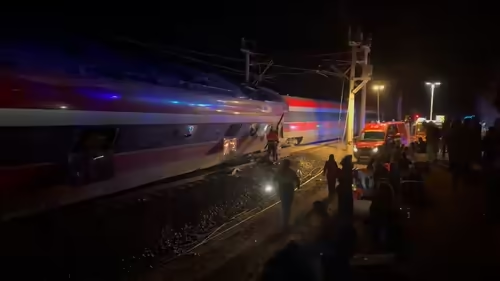
A devastating Spain train collision has shaken the nation after two passenger trains crashed head-on in the southern province of Córdoba on Monday, January 19, 2026. Early reports from Spanish authorities confirm multiple fatalities and numerous injuries, making it one of the deadliest rail accidents in Spain in over a decade .
The collision occurred near the town of Montilla, approximately 45 kilometers south of Córdoba city, during the morning rush hour. Eyewitnesses described scenes of chaos, with mangled carriages, shattered glass, and emergency responders rushing to pull survivors from the wreckage .
Table of Contents
- What Happened in the Spain Train Collision?
- Casualties and Emergency Response
- Possible Causes Under Investigation
- Spain’s Rail Safety Record: A Historical Context
- Travel Advisories and Impact on Renfe Services
- Conclusion: A Nation in Mourning
- Sources
What Happened in the Spain Train Collision?
According to Spain’s national railway operator, Renfe, the accident involved two regional commuter trains operating on the same track segment between Córdoba and Málaga. One train was traveling northbound from Antequera, while the other was heading south from Córdoba. For reasons still unclear, both entered a single-track section simultaneously, leading to a catastrophic head-on collision around 8:15 a.m. local time .
The impact was so severe that the lead carriages of both trains were completely derailed and crushed. Local media shared aerial footage showing twisted metal and emergency crews using hydraulic cutters to free trapped passengers .
Casualties and Emergency Response
As of the latest update, at least **7 people are confirmed dead**, with over 30 injured—12 of them in critical condition. Hospitals in Córdoba, Montilla, and Seville have activated mass casualty protocols .
More than 200 emergency personnel, including firefighters, paramedics, and Civil Guard units, were deployed to the site. The Spanish Ministry of Transport has declared a state of emergency for the region and dispatched a crisis team to coordinate rescue and investigation efforts .
Spanish Prime Minister Pedro Sánchez expressed his “deepest condolences” to the victims’ families and announced that a full judicial inquiry will be launched immediately.
Possible Causes Under Investigation
While the official cause remains under investigation, early speculation points to potential failures in the signaling system or human error. Key factors being examined include:
- Signal System Malfunction: Spain’s rail network uses the European Train Control System (ETCS), but older sections like the Córdoba–Antequera line may still rely on legacy signaling prone to faults.
- Human Error: Investigators are reviewing whether a dispatcher or train operator misread signals or bypassed safety protocols.
- Maintenance Lapses: Questions are emerging about recent maintenance records on this stretch of track, which has seen increased commuter traffic in recent years.
- Weather Conditions: Although the morning was clear, fog in nearby valleys may have reduced visibility temporarily.
The Spanish Railway Safety Agency (AESF) has seized control of all data recorders (black boxes) from both trains for forensic analysis .
Spain’s Rail Safety Record: A Historical Context
Spain has long been regarded as a leader in high-speed rail safety, with its AVE bullet trains maintaining an excellent record since their 1992 launch. However, regional and commuter lines—often underfunded and aging—have faced recurring issues.
The last major fatal crash occurred in 2013 near Santiago de Compostela, where 79 people died due to excessive speed—a tragedy that led to sweeping reforms. Yet, today’s Spain train collision suggests that vulnerabilities persist in non-high-speed corridors .
According to the European Union Agency for Railways, Spain’s overall rail fatality rate is below the EU average, but incidents on conventional lines remain a concern .
Travel Advisories and Impact on Renfe Services
Renfe has suspended all regional services between Córdoba and Málaga indefinitely. Passengers are advised to avoid non-essential travel on this corridor and seek alternative routes via bus or high-speed AVE connections through Madrid.
Travelers with bookings can request full refunds or reschedule without penalty. Real-time updates are available on [INTERNAL_LINK:renfe-service-alerts] and the official Renfe app.
Conclusion: A Nation in Mourning
This tragic Spain train collision is a sobering reminder that even in countries with advanced infrastructure, systemic risks can lead to catastrophic outcomes. As Spain mourns the lives lost, the focus must now shift to transparency, accountability, and urgent upgrades to its regional rail safety systems. For a country proud of its rail legacy, this disaster demands nothing less than a thorough reckoning.
Sources
- Times of India: Spain: Two trains collide in southern province of Cordoba; several feared dead
- El País: Dos trenes colisionan en Córdoba con varios fallecidos
- European Union Agency for Railways (ERA): Annual Safety Report 2025
- Renfe Official Website: Service Disruption Notices