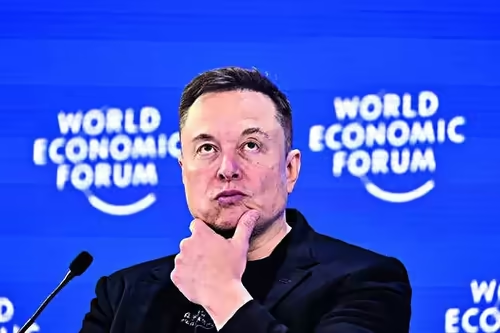
In a move that could send shockwaves through the global tech and finance sectors, Elon Musk is orchestrating a high-stakes corporate chess game. The billionaire visionary is reportedly deep in talks to merge two of his three crown jewels: SpaceX, the undisputed leader in private spaceflight; Tesla, the electric vehicle and clean energy pioneer; and xAI, his ambitious artificial intelligence startup. This isn’t just a simple corporate reshuffle—it’s a strategic maneuver designed to create an unprecedented technological powerhouse, perfectly timed for SpaceX’s planned $1.5 trillion IPO later this year [[12]].
The question on everyone’s mind is: which path will Musk take? Will he fuse the raw computational power of xAI with SpaceX’s orbital ambitions to build a space-based AI infrastructure? Or will he combine Tesla’s vast energy and manufacturing capabilities with SpaceX’s Starship to create a true Earth-to-Mars industrial conglomerate? Recent filings suggest the answer may be closer than we think.
Table of Contents
- The Merger Blueprint: Nevada Filings Reveal All
- Scenario 1: The SpaceX-xAI Merger for a Space-Based AI Empire
- Scenario 2: The Tesla-SpaceX Merger for an Energy and Exploration Powerhouse
- Why Now? The Strategic Timing of the SpaceX Merger
- What This Means for Investors and the Future of Tech
The Merger Blueprint: Nevada Filings Reveal All
The first concrete evidence of these SpaceX merger talks emerged from an unlikely source: corporate registration documents in Nevada. On January 21, 2026, two new entities were quietly established: K2 Merger Sub Inc. and K2 Merger Sub 2 LLC [[1]]. These aren’t just random shell companies; they are classic legal vehicles used to facilitate complex mergers and acquisitions. Their creation signals that planning has moved far beyond the theoretical stage and into active execution.
This level of preparation strongly suggests that Musk and his team have already mapped out the financial, legal, and operational frameworks for at least one of the potential merger scenarios. The use of Nevada as the jurisdiction is also a strategic choice, known for its business-friendly laws and privacy protections, which is typical for high-profile, sensitive transactions of this magnitude.
Scenario 1: The SpaceX-xAI Merger for a Space-Based AI Empire
The most talked-about possibility is a merger between SpaceX and xAI. This combination would be a direct play on the future of artificial intelligence, aiming to solve one of its biggest bottlenecks: data and compute infrastructure. xAI’s Grok models, particularly the latest iterations like Grok-4, are trained on massive supercomputer clusters like “Colossus,” which reportedly houses up to 200,000 NVIDIA GPUs [[19]].
By merging with SpaceX, xAI could gain access to a revolutionary new platform: space itself. Imagine deploying AI data centers in orbit, powered by solar energy and cooled by the vacuum of space. This would provide near-limitless, clean power for training ever-larger AI models while avoiding the terrestrial constraints of land, power grids, and cooling. Furthermore, SpaceX’s Starlink satellite network could provide the ultra-low-latency, global connectivity needed to feed these orbital AIs with real-time data from every corner of the planet. This synergy creates a compelling narrative for investors: a company that doesn’t just build AI, but builds the entire off-world infrastructure for its future.
Scenario 2: The Tesla-SpaceX Merger for an Energy and Exploration Powerhouse
The alternative—and perhaps more immediately synergistic—option is a merger between Tesla and SpaceX. On the surface, cars and rockets seem worlds apart, but their underlying technologies are deeply intertwined. Both are masters of advanced manufacturing, battery technology, and autonomous systems.
A combined Tesla-SpaceX entity would be an industrial titan. Tesla’s expertise in large-scale battery production (Megapacks) and solar energy could directly power SpaceX’s launch facilities and future Martian colonies. Conversely, SpaceX’s experience with lightweight, high-strength materials and life-support systems could accelerate Tesla’s development of next-generation vehicles and even its long-rumored robotics projects. This merger would create a single, vertically integrated company capable of managing the entire energy and transportation chain from Earth to other planets—a true realization of Musk’s multi-planetary vision. It would also present a more diversified and stable investment profile for the upcoming IPO, combining Tesla’s established revenue streams with SpaceX’s high-growth potential.
Why Now? The Strategic Timing of the SpaceX Merger
The timing of these SpaceX merger talks is no coincidence. They are directly tied to SpaceX’s planned initial public offering (IPO) in mid-2026, which is targeting a staggering $1.5 trillion valuation—the largest in history [[13]]. To justify such a monumental price tag, SpaceX needs a story that goes beyond just launching satellites and sending tourists to space.
A merger provides that story. By combining with either xAI or Tesla, SpaceX can offer investors a much larger, more defensible, and future-proofed market opportunity. An AI-focused merger taps into the explosive growth of the generative AI market, while an energy-exploration merger leverages the global push towards sustainable energy and the burgeoning space economy. In either case, the merger is a strategic tool to maximize shareholder value at the moment of the company’s public debut.
What This Means for Investors and the Future of Tech
For investors, the potential SpaceX merger represents a once-in-a-generation opportunity to buy into a company that could dominate multiple trillion-dollar markets. However, it also comes with significant risk. Merging complex, high-growth companies is notoriously difficult and can lead to cultural clashes and operational inefficiencies.
For the broader tech landscape, this move could set a new precedent. If successful, it would validate the idea of creating mega-conglomerates that span multiple frontier technologies. It would also intensify the competition in both the AI and space sectors, forcing rivals like Google, Amazon, and Blue Origin to rethink their own strategies. Ultimately, Musk’s decision will not only shape the fate of his own companies but could also chart the course for the next era of technological innovation. One thing is certain: the world will be watching closely as this high-stakes drama unfolds. For more on the future of AI, check out our deep dive on [INTERNAL_LINK:grok-ai-vs-chatgpt].
Conclusion
Elon Musk’s potential consolidation of SpaceX, Tesla, and xAI is more than a financial maneuver; it’s a bold statement about the future he wants to build. Whether he chooses to forge a space-based AI empire or an integrated energy and exploration giant, the resulting entity will be a force to be reckoned with. As the June 2026 IPO date approaches, the mystery of the SpaceX merger will undoubtedly be one of the most closely watched stories in business and technology.
Sources
- Founded. (2026, January 30). Inside Elon Musk’s reported talks to merge SpaceX, Tesla, and xAI. Retrieved from https://www.founded.com/inside-elon-musks-reported-talks-to-merge-spacex-tesla-and-xai/
- IDN Financials. (2026, January 28). SpaceX explores giant IPO, targeting US$1.5 trillion valuation. Retrieved from https://idnfinancials.com/news/60848/spacex-explores-giant-ipo-targeting-us1-5-trillion-valuation
- Gupta, D. (2025, January 17). The Complete Grok AI Guide: Architecture, Applications. Retrieved from https://guptadeepak.com/the-comprehensive-guide-to-understanding-grok-ai-architecture-applications-and-implications/
- Chadha, A. (2026, January 30). Inside Grok 4: Engineering Intelligence from First Principles. Medium. Retrieved from https://ashishchadha11944.medium.com/grok-4-inside-grok-4-engineering-intelligence-from-first-principles-60bfbdb5a68e
- Financial Times. (2026, January 28). SpaceX eyes June IPO at $1.5 trillion valuation. RTE. Retrieved from https://www.rte.ie/news/business/2026/0128/1555506-spacexs-ipo/