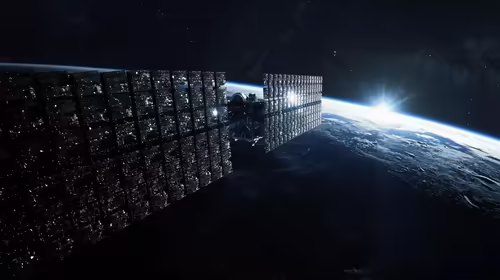
Imagine a world where true darkness no longer exists—not even in the most remote corners of the planet. That’s not science fiction. It’s a very real possibility scientists are warning about right now, thanks to a bold (and deeply controversial) plan to launch thousands of giant space mirrors into low Earth orbit.
A California-based startup called Reflect Orbital is spearheading this initiative, promising “sunlight on demand” for everything from disaster relief to extended solar power generation . But astronomers and environmental experts are sounding the alarm: if deployed, these 4,000 reflective satellites could permanently alter the night sky, disrupt ecosystems, and drown out the stars forever .
Table of Contents
- What Are Space Mirrors and How Do They Work?
- Why Scientists Fear for Earth’s Darkness
- The Astronomical Nightmare of Orbital Light Pollution
- Ecological Impact on Wildlife and Human Health
- The Company Behind the Plan: Reflect Orbital
- Global Pushback and Regulatory Challenges
- Conclusion: Is Our Night Sky for Sale?
- Sources
What Are Space Mirrors and How Do They Work?
The concept is deceptively simple: deploy large, ultra-thin reflective satellites—essentially orbital mirrors—into low Earth orbit. These mirrors would catch sunlight and redirect it toward specific locations on Earth, even after sunset .
Proponents argue this “sunlight on demand” could revolutionize renewable energy by allowing solar farms to operate at night, aid in search-and-rescue operations during disasters, or provide temporary lighting for remote communities . Each mirror is designed to be lightweight and maneuverable, capable of focusing a beam of reflected light onto a target area roughly the size of a city.
Why Scientists Fear for Earth’s Darkness
But the unintended consequences could be catastrophic. As one astronomer bluntly put it, “From an astronomical perspective, that’s pretty catastrophic” . The core issue? Earth’s darkness—a natural resource we’ve long taken for granted—is now under direct threat from artificial light originating not from the ground, but from space itself.
Unlike traditional light pollution from streetlights or buildings, which can be mitigated with better urban planning, orbital light pollution would be global, uncontrollable, and persistent. Even areas currently designated as International Dark Sky Places could lose their pristine night conditions .
The Astronomical Nightmare of Orbital Light Pollution
Modern astronomy relies on extremely sensitive instruments that capture faint light from distant galaxies, exoplanets, and cosmic phenomena. A 2025 forecast already showed that satellite trails are contaminating images from space-based telescopes designed to avoid terrestrial light pollution .
Adding 4,000 highly reflective objects to the mix would exponentially worsen this problem. Ground-based observatories in Chile, Hawaii, and the Canary Islands—some of the last sanctuaries for clear, dark skies—could become nearly useless for deep-sky observation. As one expert warned, the plan is “horrifying” for the future of observational astronomy .
Ecological Impact on Wildlife and Human Health
The damage wouldn’t stop at stargazing. Natural darkness is a critical component of Earth’s circadian rhythms—for humans and wildlife alike. Nocturnal animals rely on darkness for hunting, navigation, and reproduction. Artificial skyglow can disorient migrating birds, disrupt insect populations (including vital pollinators), and interfere with sea turtle hatchlings finding the ocean .
For humans, chronic exposure to artificial light at night has been linked to sleep disorders, depression, and even increased cancer risk. Introducing a new, unpredictable source of nighttime illumination from space could undermine decades of public health research on light hygiene.
The Company Behind the Plan: Reflect Orbital
Reflect Orbital, the startup driving this initiative, frames its mission as humanitarian and sustainable. They envision their sunlight on demand technology as a tool for climate resilience and energy equity . However, critics argue the company is prioritizing profit over planetary well-being, with little regard for the irreversible ecological and scientific costs.
Moreover, the physical risks are significant. Large mirrors in low Earth orbit face high rates of micro-meteoroid impacts, which could generate dangerous debris fields and increase the risk of catastrophic collisions—a growing concern in an already congested orbital environment .
Global Pushback and Regulatory Challenges
Organizations like DarkSky International have publicly opposed the project, calling it a threat to the “shared human heritage of the night sky” . Yet, current international space law offers little protection against such commercial ventures. The Outer Space Treaty prohibits weapons in space but says nothing about light pollution or celestial aesthetics.
This regulatory gap means companies like Reflect Orbital can move forward with minimal oversight—unless governments act swiftly to establish new norms for preserving the natural night.
Conclusion: Is Our Night Sky for Sale?
The debate over space mirrors isn’t just about technology—it’s about values. Do we want a future where the night sky is a commodity, engineered and sold by private corporations? Or do we recognize darkness as a vital, irreplaceable part of our planet’s ecosystem and cultural heritage?
As the first launches are slated for 2026 , the window for public awareness and policy intervention is closing fast. The stars may be free, but without urgent action, they might soon be invisible.
Sources
- Times of India: Scientists warn! Earth’s darkness is at risk from thousands of space mirrors
- DarkSky International. (2025). Statement on Reflect Orbital’s Proposed Mirror Constellation. https://www.darksky.org
- NASA Orbital Debris Program Office. (2025). Risks of Large Structures in Low Earth Orbit.
- [INTERNAL_LINK:light-pollution-effects]
- [INTERNAL_LINK:future-of-astronomy]