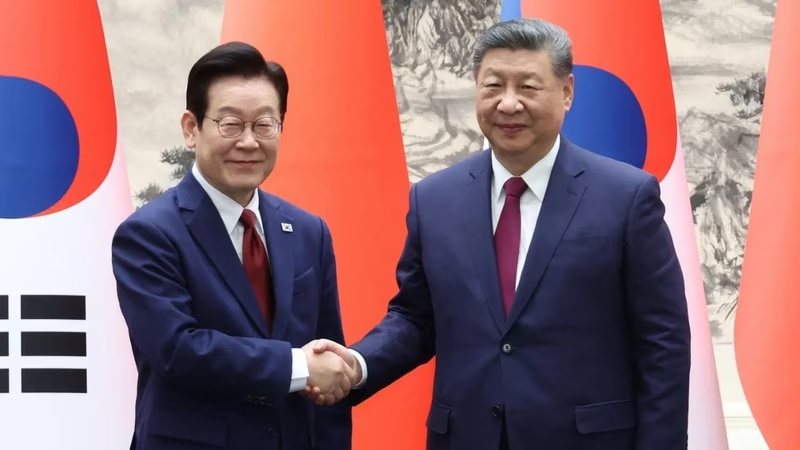
The air on the Korean Peninsula is thick with tension, and South Korea’s leader is making a bold, some might say desperate, gambit for peace. In a landmark meeting in Beijing on January 5, 2026, President Lee Jae Myung personally appealed to Chinese President Xi Jinping to step in as a mediator to resolve the escalating North Korea nuclear crisis . This direct request underscores a stark reality: official communication channels between Seoul and Pyongyang are effectively frozen, leaving South Korea with few options to de-escalate a situation that grows more precarious by the day.
Table of Contents
- A Pledge for Peace: Lee’s Direct Appeal to Xi
- China’s Cautious Response and Strategic Calculations
- Why China Holds the Keys to the Peninsula
- The Evolving Nature of the North Korea Nuclear Crisis
- Can This Mediation Strategy Actually Work?
- Conclusion: A Fragile Hope for a New Path Forward
- Sources
A Pledge for Peace: Lee’s Direct Appeal to Xi
During their summit at Beijing’s Great Hall of the People, President Lee was unequivocal. He reportedly told President Xi, “I would like (China) to play the role of a mediator on Korean Peninsula issues, including on the North Korean nuclear issue” . This is not a casual request; it’s a formal diplomatic strategy born out of necessity. With the North’s leader, Kim Jong-un, having declared 2025 a “crucial year” for its nuclear forces, the threat is not just theoretical—it’s actively evolving .
Lee’s visit was framed as an effort to mark 2026 as the year for the “full-scale restoration of South Korea-China relations” . While economic and cultural cooperation were on the agenda, the shadow of the North Korea nuclear crisis dominated the high-level talks. The South’s strategy is clear: if it can’t talk to Pyongyang, it must talk to Pyongyang’s most powerful ally.
China’s Cautious Response and Strategic Calculations
President Xi’s response, as is typical in such delicate matters, was measured. He stressed the need for “patience” and “restraint” from all parties involved . This careful wording reflects Beijing’s complex position. On one hand, an unstable North Korea is a direct security threat to China’s border, and a nuclear-armed Pyongyang undermines regional stability, a key Chinese interest.
On the other hand, China has its own strategic calculus. It views a fully denuclearized North Korea potentially leading to a US-allied unified Korea on its doorstep as an unacceptable security risk. Historically, China was a strong proponent of denuclearization, but analysts have noted a subtle shift in its official stance in recent years . Beijing is unlikely to apply the full pressure Seoul hopes for if it believes such actions could destabilize the North Korean regime.
Why China Holds the Keys to the Peninsula
South Korea’s request is based on a simple, undeniable fact: China is North Korea’s primary economic lifeline and its only major diplomatic partner. Estimates suggest China accounts for over 90% of North Korea’s external trade. This gives Beijing an unparalleled level of influence that no other nation possesses. The key leverage points include:
- Economic Dependence: North Korea relies on China for food, fuel, and other critical imports.
- Diplomatic Shield: China often acts as North Korea’s protector in international forums like the UN Security Council.
- Geopolitical Proximity: Their shared land border makes China the most immediate and affected neighbor to any conflict or collapse in the North.
The Evolving Nature of the North Korea Nuclear Crisis
The current North Korea nuclear crisis is not the same stalemate of a decade ago. It has entered a new, more dangerous phase. North Korea has shifted from testing and demonstrating its capabilities to a policy of active deployment and tactical use. Its recent legal codification of its nuclear status and its declaration of a “no-first-use” policy with significant caveats have raised the stakes immensely .
This evolution makes traditional diplomatic avenues, like the Six-Party Talks, seem almost archaic. The situation demands a new, more agile approach, which is why Seoul is looking towards Beijing. For the public, the threat may feel abstract, but for regional leaders, the potential for miscalculation is a constant, terrifying reality. This context is crucial for understanding the urgency behind Lee’s plea.
Can This Mediation Strategy Actually Work?
The success of South Korea’s mediation strategy hinges on one critical question: Is China willing to use its leverage in a way that genuinely pressures North Korea back to the negotiating table with a serious denuclearization framework?
The outlook is mixed. While both Lee and Xi agreed on the importance of freezing North Korea’s nuclear and missile programs , their end goals may differ. Seoul and its ally, the United States, seek complete, verifiable denuclearization. Beijing’s primary goal is stability. It may be content with a freeze that halts further testing without requiring North Korea to give up its existing arsenal—a concept known as “freeze-for-freeze.”
Furthermore, this strategy puts immense pressure on the South Korea-China relationship. Lee has cast his visit as a turning point for bilateral ties , but if China is seen as failing to act or even enabling Pyongyang, this fragile diplomatic bridge could quickly crumble. It’s a high-risk, high-reward play that could either pave the way for a new era of peace or lead to a deeper regional divide.
Conclusion: A Fragile Hope for a New Path Forward
President Lee Jae Myung’s direct request for Chinese mediation is a stark admission of the current deadlock and a signal of South Korea’s deep concern over the North Korea nuclear crisis. It represents a pragmatic, if risky, shift in diplomatic strategy, moving from direct engagement with the North—which is currently impossible—to engaging its most powerful patron. The world will now be watching to see if President Xi Jinping, a leader known for his strategic patience, is ready to step into the role of an active peace broker or if he will continue to prioritize stability over a potentially destabilizing push for denuclearization. The future of peace on the Korean Peninsula may well depend on his next move.
Sources
- Lee’s direct quote to Xi: Channel News Asia
- Context on Kim Jong-un’s 2025 declaration: International Institute for Strategic Studies (IISS)
- Details of the January 5, 2026 summit: The State Council of the People’s Republic of China
- Analysis of China’s policy shift: The Brookings Institution
- [INTERNAL_LINK:history-of-korean-peace-talks]
- [INTERNAL_LINK:impact-of-north-korean-missiles-on-asia]