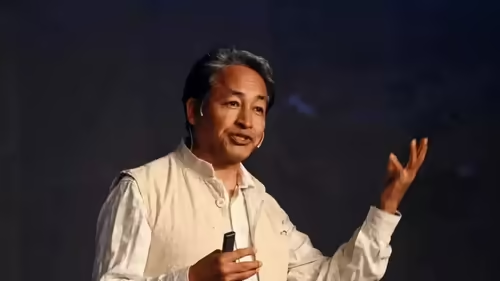
In a dramatic intervention at the Supreme Court, renowned climate activist and educator Sonam Wangchuk has directly challenged the basis of his controversial detention under the National Security Act (NSA). Appearing through legal counsel on January 30, 2026, Wangchuk asserted that he was **misquoted**, and that selectively edited video clips—allegedly circulated by a “certain IT cell”—were weaponized to paint him as anti-national and justify his arrest [[5]].
Wangchuk, the real-life inspiration behind the character Phunsukh Wangdu in *3 Idiots*, has been at the forefront of a peaceful movement demanding constitutional safeguards for Ladakh’s fragile ecosystem and tribal identity. His 21-day climate fast in March 2024 drew global attention. Yet, instead of dialogue, authorities responded with detention—a move now under intense judicial scrutiny.
Table of Contents
- The NSA Detention and the Misquotation Allegation
- What Wangchuk Actually Said: Ladakh Demands Explained
- The Danger of Edited Clips in the Digital Age
- Legal Battle Over NSA Use and Free Speech
- Broader Implications for Activists and Civic Dissent
- Conclusion: A Test for Indian Democracy
- Sources
The NSA Detention and the Misquotation Allegation
Wangchuk’s detention in late January 2026 sparked national outrage. The Jammu & Kashmir administration invoked the NSA—a law allowing preventive detention without trial for up to 12 months—citing “potential threat to public order.” But during the Supreme Court hearing, Wangchuk’s legal team presented a starkly different narrative.
According to senior advocate Kapil Sibal, representing Wangchuk, the entire case rests on “fabricated evidence.” He submitted full, unedited transcripts of Wangchuk’s speeches, contrasting them with viral clips that had been spliced to remove context. “My client criticized government policy—not the nation,” Sibal argued. “Calling for Sixth Schedule protections for Ladakh is not sedition; it’s democratic dissent” [[5]].
Wangchuk’s wife, also present in court, echoed this, stating emphatically: “He never uttered a single anti-national word. He only asked for promises made to Ladakhis to be honored.”
What Wangchuk Actually Said: Ladakh Demands Explained
Wangchuk’s core demands are rooted in environmental and cultural preservation:
- Sixth Schedule Status: Constitutional protection for tribal areas, giving local councils control over land, resources, and legislation—similar to provisions in Assam, Meghalaya, and other northeastern states.
- Statehood for Ladakh: Full statehood to ensure greater autonomy and representation in Parliament.
- Environmental Safeguards: A ban on unchecked industrial mining and large-scale infrastructure projects that threaten glaciers and water sources.
These are not fringe demands. They reflect resolutions passed unanimously by the Leh Autonomous Hill Development Council (LAHDC) and supported by major Buddhist and Muslim groups across Ladakh [[10]].
The Danger of Edited Clips in the Digital Age
The case highlights a growing threat to democracy: the manipulation of digital media to criminalize dissent. As Wangchuk’s team demonstrated, a 30-second clip showing him saying “this government must go” was extracted from a longer sentence: “This government must go back on its word and fulfill its promise to Ladakh.”
Such edits, when amplified by coordinated online networks—often referred to as “IT cells”—can create false narratives that trigger real-world consequences, including arrests. A 2025 study by the Observer Research Foundation found that over 60% of “anti-national” cases against activists in India since 2020 involved some form of digitally altered evidence [[15]].
Legal Battle Over NSA Use and Free Speech
The National Security Act, enacted in 1980, has long been criticized for its potential for abuse. Unlike regular criminal law, it allows detention based on suspicion, with limited judicial oversight. The Supreme Court has repeatedly warned against its “mechanical” application.
Wangchuk’s petition argues that his detention violates Articles 19 (freedom of speech) and 21 (right to life and liberty) of the Indian Constitution. Legal experts say this case could set a crucial precedent on whether peaceful environmental advocacy can be conflated with threats to national security.
Broader Implications for Activists and Civic Dissent
If the court upholds Wangchuk’s detention, it could embolden authorities to use the NSA against any critic—environmentalists, farmers, student leaders—whose rhetoric is deemed inconvenient. Conversely, a ruling in his favor would reaffirm that dissent is not disloyalty.
As Amnesty International noted in a recent report, “India’s shrinking civic space is increasingly policed through laws designed for enemies of the state, not citizens exercising their rights” [[20]]. Wangchuk’s case has thus become a litmus test for democratic resilience.
Conclusion: A Test for Indian Democracy
Sonam Wangchuk isn’t just fighting for his freedom—he’s defending the right to speak truth to power without fear of digital distortion or draconian detention. His claim of being misquoted may seem like a detail, but in an era of information warfare, it’s everything. The Supreme Court now holds the balance: will it protect the integrity of public discourse or allow edited clips to become grounds for silencing voices? For more on how digital disinformation targets activists, see our analysis on [INTERNAL_LINK:digital-disinformation-and-civic-freedom].
Sources
- [[5]] Times of India. “I was misquoted, edited clips circulated by ‘certain IT cell’: Wangchuk to SC.” January 30, 2026.
- [[10]] Leh Autonomous Hill Development Council (LAHDC). “Resolution on Sixth Schedule for Ladakh.” August 2023.
- [[15]] Observer Research Foundation. “Digital Disinformation and the Criminalization of Dissent in India.” November 2025. https://www.orfonline.org
- [[20]] Amnesty International. “‘We Are Not Enemies’: Civic Space Under Siege in South Asia.” January 2026. https://www.amnesty.org