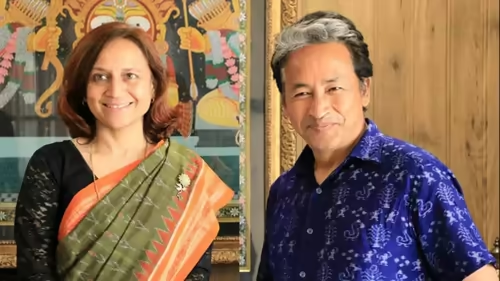
In a quiet room far from the icy peaks of Ladakh, Dr. Gitanjali J. Angmo is fighting a battle of her own. Her husband, the renowned climate activist and educator Sonam Wangchuk, has been locked away for months, and she’s just revealed that his situation inside is growing increasingly desperate. Her words—“conditions are dire”—have sent shockwaves across the nation, transforming a local struggle for autonomy into a critical test of India’s democratic fabric .
Table of Contents
- Who is Sonam Wangchuk?
- The Ladakh Movement and the Sixth Schedule
- Why is Sonam Wangchuk in Jail?
- His Wife’s Dire Revelations
- The National Security Act Controversy
- What’s Next for the Ladakh Struggle?
- Conclusion: A Test for Democracy
- Sources
Who is Sonam Wangchuk?
Before he became a political prisoner, Sonam Wangchuk was celebrated as an innovator and a visionary. He’s the mind behind the famous Ice Stupa artificial glacier project, designed to combat water scarcity in the high desert of Ladakh. His work in education reform, particularly through the Students’ Educational and Cultural Movement of Ladakh (SECMOL), earned him international acclaim and even inspired a character in the Bollywood film 3 Idiots. His journey from educator to activist was driven by a deep love for his homeland and a fear for its fragile ecosystem.
The Ladakh Movement and the Sixth Schedule
The core of Wangchuk’s activism is the demand for constitutional safeguards for Ladakh. After the region was granted Union Territory status in 2019, it lost its statehood and, crucially, its protections under the Sixth Schedule of the Indian Constitution. This schedule is vital because it grants autonomy to tribal areas, allowing them to manage their land, resources, and culture, shielding them from external exploitation. For a place as ecologically sensitive and culturally distinct as Ladakh, this protection is seen as non-negotiable for its survival .
Why is Sonam Wangchuk in Jail?
Wangchuk’s arrest on September 26, 2025, came after a period of intense protest. He had just concluded a 15-day hunger strike in Leh to press for the Sixth Schedule status . While he was advocating for peaceful dialogue, violent protests erupted in the region, resulting in tragic police firings . Authorities detained him under the stringent National Security Act (NSA)—a law that allows for preventive detention without formal charges for up to 12 months .
His supporters argue that his detention was a direct response to his planned march to Delhi, which was thwarted when he and around 120 others were stopped at the city’s border in October 2024 [[19], [21]]. The government’s justification hinges on the claim that his presence could disturb public order, a rationale his wife fiercely contests in the Supreme Court .
Sonam Wangchuk in jail: His Wife’s Dire Revelations
Dr. Gitanjali J. Angmo has become the most powerful voice for her husband’s cause. In her petitions to the Supreme Court, she has painted a harrowing picture of his incarceration. She claims he is being held in isolation, denied basic amenities, and isn’t even allowed a watch to keep track of time—a detail that underscores the psychological toll of his confinement .
Her legal team argues that his detention is not only “illegal, arbitrary, and unconstitutional” but also based on “irrelevant material” and a failure by the detaining authority to properly apply its mind to the case [[6], [8]]. She warns that a climate of “fear, pressure and silence” is replacing healthy democratic dialogue, raising urgent questions about the space for dissent in modern India .
The National Security Act Controversy
The use of the NSA against a globally respected figure like Wangchuk has drawn sharp criticism from human rights organizations. The NSA is often criticized for its potential for misuse, as it bypasses the standard judicial process. In Wangchuk’s case, the Supreme Court has already noted that the “complete grounds” for his detention were not initially provided to his family, a serious procedural flaw .
This case has become a focal point for a broader debate about balancing national security with fundamental rights. Critics argue that using such a draconian law against a peaceful climate activist sets a dangerous precedent for other environmental and social justice movements across the country.
What’s Next for the Ladakh Struggle?
The Leh Apex Body (LAB), a key group leading the movement, has formally demanded a general amnesty for Wangchuk as part of their negotiations with the central government . The Supreme Court has adjourned the hearing on his wife’s plea challenging his detention until January 29, 2026, just days from now . This upcoming hearing is being watched closely by activists, legal experts, and citizens who see Wangchuk’s fate as symbolic of a larger struggle.
The movement for the Sixth Schedule is not just about one man; it’s about the future of an entire region. It’s about protecting indigenous rights, preserving a unique culture, and safeguarding a critical Himalayan ecosystem from unchecked industrial development. As the legal battle unfolds, the people of Ladakh remain steadfast in their demand for self-determination.
Conclusion: A Test for Democracy
The story of Sonam Wangchuk in jail is more than a news headline; it’s a profound test of India’s commitment to its founding principles. Can a nation that champions its democratic credentials simultaneously silence one of its most thoughtful and peaceful voices? The answer will have far-reaching implications, not just for Ladakh, but for every citizen who believes in the right to dissent and the power of non-violent protest. The world is watching as the Supreme Court prepares to weigh in on this critical matter of justice and freedom.
Sources
- Times of India: Sonam Wangchuk in jail: Climate activist’s wife reveals ‘conditions are dire’
- Australian Human Rights Commission: Indian Authorities Unlawfully Detain Himalaya Climate Activist
- [INTERNAL_LINK:ladakh-sixth-schedule-explained]
- [INTERNAL_LINK:history-of-national-security-act-india]