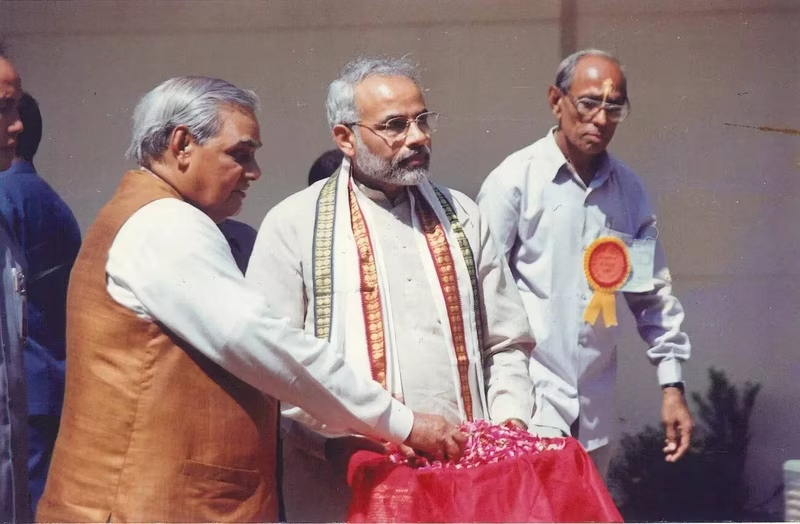
In a poignant reflection on resilience and faith, Prime Minister Narendra Modi has recalled the 1991 terrorist attack on the historic Somnath Temple in Gujarat—a moment he described as one of pain that “could not shake our eternal faith.” Sharing rare throwback photographs on social media, PM Modi not only commemorated the victims but also underscored the temple’s symbolic role as a beacon of India’s enduring civilizational spirit. This recollection, coming amid renewed national focus on cultural heritage and security, has reignited public discourse on the protection of religious sites and the deeper meaning of historical wounds in modern India .
Table of Contents
- What Happened During the Somnath Temple Attack?
- PM Modi’s Message of Faith and Resilience
- The Historical Significance of Somnath Temple
- Why This Memory Matters Today
- Security of Religious Sites in Modern India
- Public Reaction and National Discourse
- Conclusion: More Than a Temple—A Testament to Endurance
- Sources
What Happened During the Somnath Temple Attack?
On the night of November 24, 1991, two militants affiliated with the Pakistan-based terrorist group Lashkar-e-Taiba (LeT) launched a grenade and gunfire assault on the Somnath Temple complex in Gujarat’s Prabhas Patan. The attackers, who had infiltrated from the coastal route, targeted the main shrine during a quiet evening, injuring several pilgrims and security personnel before being neutralized by police.
Though no fatalities were reported among civilians, the psychological impact was profound. The Somnath Temple, one of the twelve sacred Jyotirlingas dedicated to Lord Shiva, has been destroyed and rebuilt multiple times over centuries—most famously by Mahmud of Ghazni in 1026 CE. The 1991 Somnath temple attack was seen not just as a security breach, but as an assault on India’s spiritual identity .
PM Modi’s Message of Faith and Resilience
In his post, PM Modi wrote: “Even in the face of terror, our faith remained unshaken. The Somnath Temple stands not just as a place of worship, but as a symbol of India’s eternal resilience.” Accompanying the message were archival black-and-white photos showing damage to the temple’s outer corridor and security forces responding in the aftermath.
As Gujarat’s Chief Minister from 2001 to 2014, Modi had overseen major renovations and the development of Somnath as a cultural and spiritual tourism hub. His return to this memory as Prime Minister carries both personal and political weight, framing the temple as a metonym for national fortitude.
The Historical Significance of Somnath Temple
Few sites in India embody the interplay of destruction, memory, and rebirth like Somnath. Its history includes:
- 1026 CE: Destroyed by Mahmud of Ghazni, who looted its famed riches.
- 1299 CE: Razed again by Alauddin Khilji’s general.
- 1706 CE: Demolished under Aurangzeb’s orders and a mosque built on its ruins.
- 1951: Reconstructed post-Independence under Sardar Vallabhbhai Patel’s vision, with the first President, Rajendra Prasad, attending its consecration.
This cyclical narrative of ruin and restoration makes Somnath a powerful metaphor for civilizational continuity—precisely the theme PM Modi invoked.
Why This Memory Matters Today
PM Modi’s recollection isn’t merely nostalgic. It arrives at a time when India is actively reasserting its cultural sovereignty—through heritage conservation, temple corridor projects (like Ayodhya and Kashi), and stronger anti-terror laws. By highlighting the 1991 Somnath temple attack, he draws a line from past vulnerabilities to present security capabilities.
Moreover, it serves as a reminder that threats to religious sites are not relics of the past. Recent years have seen plots against other major temples, including the Golden Temple in Amritsar and the Tirupati Balaji Temple—prompting the government to classify “places of worship” as critical infrastructure under national security protocols .
Security of Religious Sites in Modern India
Since the 1991 incident, India has dramatically upgraded temple security:
- Centralized protocols: The Ministry of Home Affairs now oversees security audits for major shrines.
- Smart surveillance: AI-powered CCTV, drone monitoring, and facial recognition are being deployed at high-footfall temples.
- Temple police units: Specialized forces like the Shri Mata Vaishno Devi Shrine Board Police ensure localized, responsive security.
Yet challenges remain—especially for smaller, rural temples lacking resources. Experts argue that physical security must be paired with community intelligence networks to prevent future attacks.
Public Reaction and National Discourse
PM Modi’s post sparked widespread engagement online, with millions sharing messages of solidarity and pride. Historians and spiritual leaders praised the emphasis on resilience, while opposition voices cautioned against politicizing religious trauma. Nevertheless, the consensus leans toward viewing Somnath not as a victim of history but as a victor over it.
Conclusion: More Than a Temple—A Testament to Endurance
The 1991 Somnath temple attack was a dark chapter, but PM Modi’s reflection transforms it into a lesson in collective strength. In recalling the grenade blasts and the broken stones, he doesn’t dwell on victimhood—he celebrates the unwavering faith that rebuilt, remembered, and revered. Somnath stands today not just on the shores of the Arabian Sea, but at the heart of India’s narrative of survival. As the Prime Minister so aptly put it: “They tried to break our spirit. Instead, they revealed our soul.”
Sources
- PM Modi’s Official X (Twitter) Post: @narendramodi
- Historical Records of Somnath Temple: Archaeological Survey of India (ASI)
- National Security Guidelines for Religious Sites: Ministry of Home Affairs, Government of India
- [INTERNAL_LINK:history-of-somnath-temple-reconstruction]
- [INTERNAL_LINK:security-measures-at-indian-temples-post-2000]