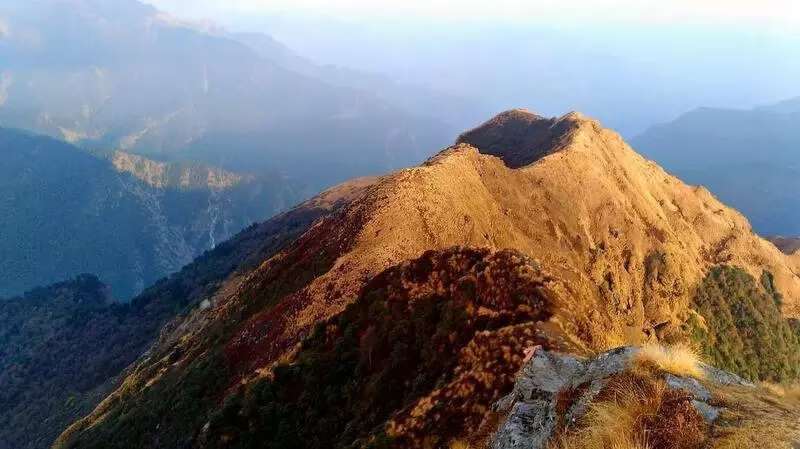
Imagine the mighty peaks of Nanda Devi, Trishul, and Bandarpunch—normally cloaked in glistening white by mid-January—standing stark, brown, and eerily bare against the winter sky. This isn’t a scene from a dystopian film. It’s the reality of the snowless Garhwal Himalayas in January 2026, a phenomenon locals and scientists say hasn’t occurred in over 40 years. The absence of snow isn’t just a visual shock; it’s a dire ecological alarm bell ringing across the fragile roof of the world.
Residents of Chamoli, Rudraprayag, and Pithoragarh districts report unprecedented dryness, unseasonal warmth, and anxious whispers about disappearing springs. For a region where snowmelt feeds rivers like the Ganga and Yamuna, sustains agriculture, and nurtures rare medicinal herbs, this anomaly is more than unusual—it’s potentially catastrophic. What’s causing this historic snow deficit, and what does it mean for millions who depend on the Himalayas?
Table of Contents
- Historic Anomaly: What Makes This Winter Different?
- Why No Snow? Climate Factors Behind the Drought
- Impact on Medicinal Plants: A Traditional Knowledge Crisis
- Water Security and Glacial Health at Risk
- Scientific Response and Long-Term Projections
- Conclusion: A Wake-Up Call from the Mountains
- Sources
Historic Anomaly: What Makes This Winter Different?
According to meteorological records from the India Meteorological Department (IMD) and local observatories in Dehradun and Joshimath, January 2026 recorded the lowest snowfall in the Garhwal region since 1984. Key indicators include:
- Average peak temperatures were 3–5°C above normal for the month.
- Western Disturbances—the primary source of winter snow—were fewer and weaker than usual.
- Soil moisture levels in alpine zones dropped to critically low levels, affecting early spring flora.
“In my 60 years living in Mana village near Badrinath, I’ve never seen the mountains so bare in January,” says Tashi Singh Rawat, a retired forest officer. “Even during drought years, the high ridges held snow. Not this time.”
Why No Snow? Climate Factors Behind the Drought
The root cause lies in a confluence of global and regional climate shifts:
- Weakened Western Disturbances: These low-pressure systems originating in the Mediterranean usually bring snow to the Himalayas. In 2026, they were deflected northward due to an anomalous high-pressure system over Central Asia.
- Rising Regional Temperatures: The Himalayas are warming at nearly twice the global average, according to the International Centre for Integrated Mountain Development (ICIMOD) . Warmer air holds more moisture but reduces snow-to-rain ratios at critical elevations.
- El Niño Influence: The 2025–26 El Niño event disrupted monsoon withdrawal patterns, leading to drier post-monsoon conditions that persisted into winter.
[INTERNAL_LINK:himalayan-climate-change-indicators] Together, these factors created a perfect storm for snowlessness—a trend experts fear may become recurrent.
Not Just Less Snow—But Wrong Timing
Even when snow does fall, its timing is shifting. Late snowfalls in March or April melt too quickly, failing to replenish glaciers or sustain spring-fed streams. This disrupts the entire hydrological cycle that Himalayan life depends on.
Impact on Medicinal Plants: A Traditional Knowledge Crisis
One of the most immediate consequences is on the region’s famed medicinal and aromatic plants (MAPs). Species like Jatamansi (Nardostachys jatamansi), Atish (Aconitum heterophyllum), and Kutki (Picrorhiza kurroa) require specific cold-stratification periods under snow cover to germinate and thrive.
“Without snow insulation, the soil freezes deeper, killing root systems,” explains Dr. Meena Joshi, an ethnobotanist at GB Pant Institute of Himalayan Environment. “We’re already seeing reduced yields and stunted growth in key herb populations.”
This isn’t just an ecological issue—it’s a cultural and economic one. Over 200,000 households in Uttarakhand rely on wild herb collection for income. Ayurvedic pharmaceutical companies sourcing from the region are now facing supply shortages, threatening a $2 billion traditional medicine industry.
Water Security and Glacial Health at Risk
Beyond herbs, the snowless winter jeopardizes long-term water security. Snowpack acts as a natural reservoir, slowly releasing water during summer. With less accumulation:
- River flows in the Alaknanda and Bhagirathi basins could drop by 15–20% in peak summer months.
- Hydropower projects—critical for state revenue—may face reduced generation capacity.
- Glaciers, already retreating at alarming rates, receive less replenishment, accelerating their melt.
The Gangotri Glacier, source of the Ganga, has lost over 1 km in length since 1990. Reduced snowfall only worsens this trend, with implications for over 500 million people downstream.
Scientific Response and Long-Term Projections
In response, the National Institute of Hydrology and Wadia Institute of Himalayan Geology have launched emergency monitoring missions using satellite imagery and ground sensors. Early models suggest that if current warming trends continue, the Garhwal region could see snowless Januaries every 3–5 years by 2040.
Policy recommendations include:
- Establishing community-based snow monitoring networks.
- Promoting ex-situ cultivation of endangered medicinal plants.
- Revising hydropower planning to account for reduced glacial runoff.
Conclusion: A Wake-Up Call from the Mountains
The snowless Garhwal Himalayas in January is more than a weather oddity—it’s a stark manifestation of climate breakdown in one of Earth’s most vital ecosystems. For the people of the Himalayas, it’s a threat to their livelihoods, culture, and very survival. For the rest of India, it’s a warning that the water towers of the subcontinent are faltering. Ignoring this signal isn’t an option. The mountains are speaking. It’s time we listened.
Sources
- Original Report: Times of India – Snowless Garhwal Himalayas in January
- ICIMOD Climate Reports: https://icimod.org/
- India Meteorological Department (IMD) – Uttarakhand Winter Bulletin 2026
- GB Pant National Institute of Himalayan Environment – Medicinal Plant Studies
- Wadia Institute of Himalayan Geology – Glacial Monitoring Data