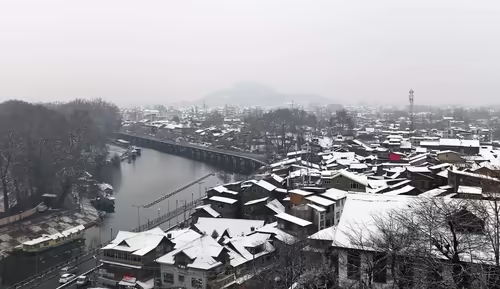
Kashmir woke up to a winter wonderland—but one that’s turned into a logistical nightmare. On January 27, 2026, a powerful western disturbance dumped heavy snow across the Valley, blanketing Srinagar in thick white layers and bringing life to a grinding halt. The iconic Dal Lake is frozen at the edges, roads have vanished under drifts, and for the first time in weeks, the usually bustling city fell into an eerie, snow-muffled silence [[1]].
But this picturesque scene masks a serious crisis. All commercial flights in and out of Srinagar International Airport have been **canceled**, stranding hundreds of tourists and business travelers. More critically, the lifeline **Jammu-Srinagar National Highway—the only all-weather road connecting the Valley to the rest of India—has been shut** due to avalanche threats and deep snow accumulation in the Banihal and Qazigund sectors [[1]].
Table of Contents
- The Impact of Snow in Srinagar on Daily Life
- Transportation Chaos: Flights and Highways Paralyzed
- Emergency Response and Relief Efforts
- Tourism and Economic Fallout
- Climate Context: Is This Normal for January?
- Conclusion: Navigating Kashmir’s Winter Crisis
The Impact of Snow in Srinagar on Daily Life
For residents of Srinagar, the **snow in Srinagar** isn’t just scenic—it’s disruptive. Schools and colleges have been closed indefinitely. Local markets are shuttered, and even essential services like milk and vegetable deliveries have stopped. Power outages are being reported in several neighborhoods as snow-laden branches snap electrical lines.
“We’re used to snow, but this intensity in late January is unusual,” said Ghulam Nabi, a shopkeeper in Lal Chowk. “My family has enough food for two days, but if the highway doesn’t open soon, prices will skyrocket.”
Temperatures have plummeted to -5°C in the city and below -10°C in higher reaches like Gulmarg and Pahalgam. The cold wave index issued by the Meteorological Department warns of “severe” conditions persisting for the next 72 hours [[2]].
Transportation Chaos: Flights and Highways Paralyzed
The transportation breakdown is the most immediate concern:
- Air Travel: Srinagar Airport canceled all 14 scheduled flights on January 27. Passengers are being accommodated in hotels, but rebooking is difficult due to limited winter capacity.
- Road Connectivity: The Jammu-Srinagar NH-44 remains closed at both Sinthan Top and Mughal Road. The Border Roads Organisation (BRO) has deployed over 200 snow-clearing machines, but avalanche risks in the Pir Panjal range are delaying reopening.
- Local Transit: Even within Srinagar, private vehicles and public buses are off the roads. Only emergency vehicles with snow chains are permitted.
This isolation cuts off access to medical supplies, fuel, and fresh produce—raising concerns about shortages if the blockade extends beyond 3–4 days.
Emergency Response and Relief Efforts
State authorities have activated disaster protocols. The Jammu & Kashmir administration has set up emergency control rooms in all districts. The State Disaster Response Force (SDRF) is conducting door-to-door checks in vulnerable areas, especially for elderly residents.
“We’ve pre-positioned food packets, kerosene, and medicines in all 10 districts of the Valley,” said a senior official from the Relief Commissioner’s office. Community kitchens have also been opened in Srinagar’s low-income neighborhoods.
[INTERNAL_LINK:winter-safety-tips-kashmir] Residents are urged to stay indoors, avoid using heaters unattended, and keep emergency numbers handy—including the SDRF helpline (1077) and Power Development Department (1912).
Tourism and Economic Fallout
January is peak season for Kashmir’s tourism industry, with thousands flocking to ski in Gulmarg or enjoy snow-laden shikara rides. This sudden shutdown is a massive blow.
“I’ve had 80% cancellations in the last 24 hours,” said Aijaz Malik, a houseboat owner on Dal Lake. “Guests are stranded, and new bookings are frozen.” The estimated daily loss to the tourism sector is over ₹15 crore ($1.8 million).
Beyond tourism, the apple and walnut supply chains—critical to Kashmir’s agrarian economy—are also disrupted, as transporters can’t move goods to markets in Jammu or Delhi.
Climate Context: Is This Normal for January?
While Kashmir regularly experiences snowfall in winter, meteorologists note that the **timing and intensity** of this event are noteworthy. After a relatively dry December, this late-January storm is part of a shifting pattern linked to climate change.
According to the India Meteorological Department (IMD), western disturbances—the primary source of winter rain and snow in North India—are becoming more erratic. “We’re seeing fewer but more intense snow events,” explains Dr. R.K. Jenamani, Senior Scientist at IMD [[2]]. This increases the risk of avalanches and flash floods during melt periods.
Conclusion: Navigating Kashmir’s Winter Crisis
The current **snow in Srinagar** is a stark reminder of nature’s power—and the fragility of infrastructure in mountainous regions. While locals display remarkable resilience, the incident underscores the urgent need for better avalanche forecasting, diversified transport links (like the proposed Anantnag-Bijbehara railway), and climate-resilient planning.
For now, Kashmir waits—for the snow to stop, the skies to clear, and the roads to reopen. Until then, the Valley remains a beautiful, frozen island, cut off from the world.
Sources
- [[1]] Times of India: Srinagar wakes to white as snow shuts Kashmir’s highways, grounds flights
- [[2]] India Meteorological Department (IMD): Special Weather Bulletin – Western Disturbance Over J&K