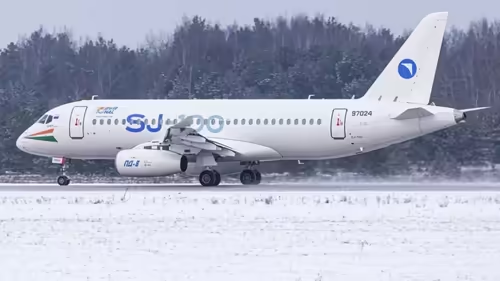
India is about to roll out its own version of a Russian regional jet—and it could transform both civil aviation and defence manufacturing in the country.
Hindustan Aeronautics Limited (HAL), India’s premier aerospace and defence PSU, has officially signed a partnership with Russia’s United Aircraft Corporation (UAC) to manufacture the Sukhoi Superjet 100 (SJ-100) in India. Announced in late January 2026, this deal isn’t just about assembling planes—it’s a bold statement of intent under the ‘Make in India’ and ‘Atmanirbhar Bharat’ initiatives.
But beyond the fanfare lies a complex mix of opportunity and risk. Can India successfully localize a high-tech civilian aircraft amid global sanctions on Russia? And could this civilian project pave the way for deeper defence-industrial collaboration? The SJ-100 aircraft India venture is more than an industrial milestone—it’s a geopolitical chess move.
Table of Contents
- What Is the SJ-100 Aircraft?
- HAL and Russia: The Partnership Details
- Why India Wants the SJ-100
- Geopolitical Challenges and Sanctions Risk
- Impact on Indian Civil Aviation
- Broader Defence Manufacturing Implications
- Conclusion
- Sources
What Is the SJ-100 Aircraft?
The Sukhoi Superjet 100 is a modern, twin-engine regional jet designed to carry 87–108 passengers. First flown in 2008, it was Russia’s answer to Western rivals like the Embraer E-Jet and Bombardier CRJ series. While it faced early reliability issues, recent upgrades—including the SJ-100R variant with improved avionics and fuel efficiency—have revived interest, especially in markets seeking alternatives to Boeing and Airbus.
Key features include:
- Range: Up to 3,000 km (ideal for domestic and short-haul international routes)
- Engines: PowerJet SaM146 (a joint venture between France’s Safran and Russia’s NPO Saturn)
- Cockpit: Advanced fly-by-wire system with Western-style instrumentation
Over 200 units have been delivered globally, with operators in Mexico, Laos, and Armenia—but notably, none in Western Europe or North America due to certification and sanction hurdles [[1]].
HAL and Russia: The Partnership Details
Under the new agreement, HAL will establish a final assembly line for the SJ-100 at its Nasik or Bengaluru facility. The initial phase involves semi-knocked-down (SKD) kits shipped from Russia, with progressive indigenization targeting 50%+ local content within five years.
The collaboration includes:
- Technology transfer for airframe assembly and systems integration
- Joint training programs for Indian engineers and technicians
- Potential co-development of a maritime patrol or utility variant for Indian armed forces
While not a defence platform per se, the SJ-100’s airframe and systems could be adapted—much like how the Dornier 228 evolved into India’s tactical surveillance aircraft [INTERNAL_LINK:india-military-utility-aircraft].
Why India Wants the SJ-100
India’s civil aviation sector is booming—passenger traffic is projected to double by 2030—but the country lacks a domestically produced regional jet. The SJ-100 fills a critical gap:
- Affordability: Priced at ~$35 million, it’s significantly cheaper than Western equivalents.
- Regional Connectivity: Perfect for UDAN scheme routes connecting tier-2 and tier-3 cities.
- Industrial Upskilling: Builds HAL’s civilian aerospace capabilities beyond military projects.
- Strategic Autonomy: Reduces reliance on U.S. and EU suppliers amid growing tech decoupling.
As one senior HAL executive noted, “This isn’t just about building jets—it’s about building an ecosystem.”
Geopolitical Challenges and Sanctions Risk
Here’s the elephant in the hangar: Russia is under sweeping Western sanctions due to the Ukraine conflict. While India maintains a neutral stance, deepening aerospace ties carries risks:
- Engine Supply Chain: The SaM146 engine relies on French components. Sanctions could disrupt deliveries.
- Certification Hurdles: Without EASA or FAA approval, the Indian-assembled SJ-100 may only serve domestic and friendly-nation markets.
- Secondary Sanctions: U.S. CAATSA provisions could theoretically target entities aiding Russian defence-industrial base—even via civilian projects.
However, experts argue that since the SJ-100 is a civilian aircraft and India isn’t importing weapons, the risk is manageable—especially as New Delhi diversifies its partnerships [[2]].
Impact on Indian Civil Aviation
If successful, the SJ-100 could become the backbone of India’s regional air network. Airlines like Alliance Air (Air India’s subsidiary) and new UDAN operators have already expressed interest.
Benefits include:
- Lower operating costs for short-haul routes
- Reduced maintenance turnaround (with local MRO facilities)
- Job creation in aerospace manufacturing and supply chains
Still, challenges remain—building passenger trust in a Russian-branded jet and ensuring long-term spare parts availability.
Broader Defence Manufacturing Implications
This deal signals a strategic shift. HAL, traditionally focused on fighters like the Tejas and helicopters like the Dhruv, is now venturing into civilian aerospace—a necessary evolution for sustainability.
More importantly, it strengthens India-Russia industrial ties beyond arms deals (like S-400 or AK-203). As defence analyst Dr. Ajey Lele notes, “Civilian projects can serve as bridges to maintain technological dialogue when defence cooperation faces headwinds” [[3]].
Future possibilities include co-developing a next-gen regional transport or even leveraging SJ-100 avionics for indigenous platforms.
Conclusion
The SJ-100 aircraft India initiative is a high-stakes gamble with high rewards. It advances self-reliance, boosts regional connectivity, and keeps a vital strategic partnership alive. But success hinges on navigating sanctions, ensuring quality, and winning public confidence. If HAL pulls it off, India won’t just be flying its own jets—it’ll be engineering its aerospace future.