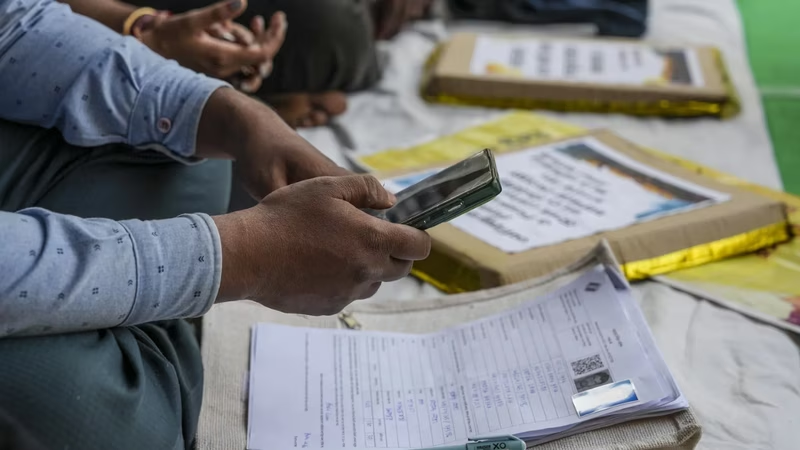
The ongoing Special Intensive Revision (SIR) of electoral rolls in West Bengal has taken a dark and tragic turn. In just the past week, two more lives have been lost, with grieving families pointing to the immense pressure and anxiety generated by the process as the direct cause. This brings the grim tally of alleged SIR West Bengal deaths to a concerning number, prompting not just public outcry but also a response from the highest levels of the state government.
The victims include a booth-level officer (BLO) and an elderly citizen, representing two vulnerable groups caught in the crossfire of a complex bureaucratic exercise. Their stories are not isolated incidents but part of a disturbing pattern that has emerged across the state, where the fear of being excluded from the voter list is causing severe mental and physical distress .
Table of Contents
- The Latest Tragedies: A Booth Officer and a Senior Citizen
- What is the Special Intensive Revision (SIR)?
- SIR West Bengal Deaths: A Growing Crisis
- Political Fallout and Government Response
- The Human Cost of Bureaucracy
- Conclusion: A Plea for Empathy and Reform
- Sources
The Latest Tragedies: A Booth Officer and a Senior Citizen
The first victim was a dedicated booth-level officer whose job was to facilitate the SIR process at the grassroots level. Already burdened with the immense responsibility of verifying documents and managing local logistics, he reportedly received a notice for his own SIR hearing. The pressure became too much to bear, and his body was found under tragic circumstances, with his family alleging work-related stress as the primary factor .
The second victim was an 82-year-old senior citizen. Having attended the SIR exercise just days before, he suffered a fatal heart attack on a Thursday morning. His family claims the days leading up to his death were filled with unbearable anxiety over the potential loss of his voting rights, a right he held dear for decades . These two cases highlight the dual-edged nature of the SIR—impacting both those who administer it and those who are subject to it.
What is the Special Intensive Revision (SIR)?
The Special Intensive Revision is a nationwide drive by the Election Commission of India (ECI) aimed at cleaning up the electoral rolls. Its primary goal is to remove duplicate, ineligible, or non-existent voters to ensure the integrity of the democratic process. While the objective is noble, the execution on the ground has been fraught with issues, particularly in states like West Bengal.
Citizens are required to appear in person at designated centers with a host of documents to prove their identity and residence. For many, especially the elderly, the poor, and those in remote areas, this process is not just logistically challenging but also deeply intimidating. The fear of being declared a “foreigner” or losing one’s citizenship status, however unfounded, has created a climate of widespread panic .
SIR West Bengal Deaths: A Growing Crisis
The Trinamool Congress (TMC) government has been vocal in its criticism of the SIR, claiming that the exercise has led to over 50 unnatural deaths across the state due to the associated stress and anxiety . While this number is contested, the consistent stream of reports linking fatalities to the SIR process cannot be ignored.
Common health issues being reported include:
- Severe anxiety and panic attacks
- Hypertension and other cardiovascular problems
- Depression and sleep disorders
- Instances of self-harm and suicide among vulnerable populations
The psychological toll is immense. For many, the voter ID is not just a piece of plastic; it’s a symbol of their identity, their belonging, and their voice in the world’s largest democracy. The threat of losing it is a profound existential crisis.
Political Fallout and Government Response
Chief Minister Mamata Banerjee has publicly expressed her deep concern over the situation, calling for a more humane and empathetic approach from the central authorities. The TMC has accused the central government of using the SIR as a tool for political and social engineering, particularly to target minority communities and opposition strongholds .
In response, the state government has set up help desks and legal aid cells to assist citizens navigating the SIR process. However, critics argue that these measures are reactive rather than proactive and fail to address the root cause of the problem: the inherently stressful and exclusionary nature of the current verification system.
The Human Cost of Bureaucracy
This crisis in West Bengal serves as a stark reminder that policy implementation must always consider its human impact. A well-intentioned policy to secure elections can quickly become a source of immense suffering if it lacks adequate safeguards for the most vulnerable. The stories of the BLO and the 82-year-old man are not just statistics; they are personal tragedies that underscore a systemic failure.
For more on the broader implications of voter list revisions in India, see our analysis on [INTERNAL_LINK:voter-id-politics-india]. It’s crucial to balance electoral integrity with the fundamental right to dignity and peace of mind for every citizen.
Conclusion: A Plea for Empathy and Reform
The SIR West Bengal deaths are a national wake-up call. They demand a thorough review of the SIR process to ensure it is not only efficient but also compassionate. The Election Commission and the central government must engage in an urgent dialogue with state governments and civil society to find a solution that protects the electoral roll without sacrificing the well-being of its citizens. In a democracy, the process should never be more important than the people it is meant to serve.