Table of Contents
- A Life Lost in a Queue
- What is the SIR Process and Why is it So Stressful?
- The Human Cost of Bureaucracy: SIR Process Deaths
- Official Response and Political Fallout
- Comparing SIR with NRC: A History of Anxiety
- What Needs to Change to Prevent Future Tragedies?
- Conclusion: A System Under Scrutiny
- Sources
A Life Lost in a Queue
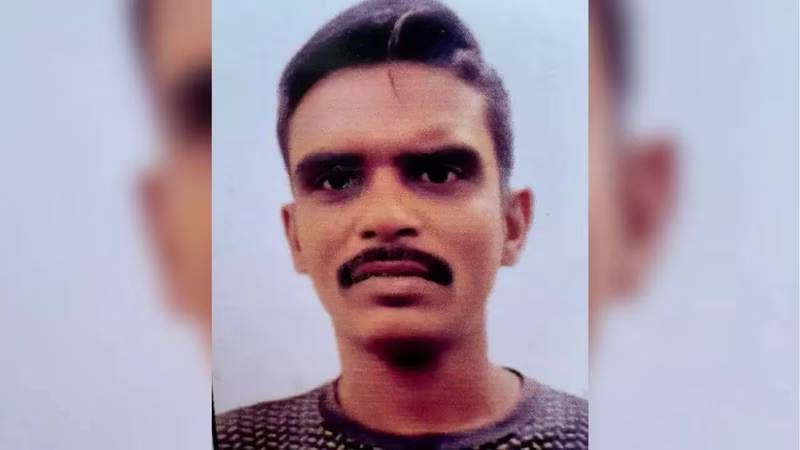
In a heartbreaking incident that has reignited a national debate on administrative cruelty, a 38-year-old man from West Bengal died of a heart attack while waiting in a long, exhausting queue for a hearing related to the Special Intensive Revision (SIR) process . According to his family, he had been standing for hours, overwhelmed by severe anxiety about the possibility of being excluded from the voter list—a fate that could have devastating implications for his citizenship status and future .
The man, whose name has not been widely released, reportedly broke down in tears just before collapsing. His death is not an isolated case but part of a grim and growing statistic that has now forced even government officials to acknowledge a systemic failure.
What is the SIR Process and Why is it So Stressful?
The Special Intensive Revision (SIR) is a process conducted by the Election Commission of India to update and verify the electoral rolls in specific areas deemed to be at high risk of duplicate or fraudulent entries. While the stated goal is to ensure the integrity of the voter list, the process on the ground has become a source of immense fear and uncertainty for millions of residents, particularly in border states like West Bengal .
Citizens flagged for verification are required to appear before special hearing officers to present documentary proof of their identity and residence. For many, especially those from marginalized communities who may lack formal paperwork due to historical or socio-economic reasons, this process is fraught with the terrifying prospect of being declared a “D-voter” (Doubtful voter) or even labeled a foreigner. This single designation can lead to loss of voting rights, detention, and a long, expensive legal battle for recognition [[INTERNAL_LINK:nrc-vs-sir-key-differences]].
The Human Cost of Bureaucracy: SIR Process Deaths
The most chilling aspect of this latest tragedy is the official confirmation of its scale. A West Bengal state minister has publicly stated that there have been **over 50 deaths** directly linked to the stress, anxiety, and physical hardship associated with the SIR process . These are not just numbers; they represent fathers, mothers, and breadwinners whose lives were cut short by a system that prioritizes procedure over human well-being.
The causes of these deaths are varied but interconnected:
- Cardiac Events: The extreme mental stress of potentially losing one’s identity and rights can trigger fatal heart attacks, especially in individuals with pre-existing conditions.
- Physical Exhaustion: Elderly and sick individuals are often forced to stand for hours, sometimes days, in harsh weather conditions with little access to water or medical aid.
- Suicides: In some documented cases, the unbearable pressure and fear of exclusion have driven individuals to take their own lives.
Official Response and Political Fallout
The state minister’s condemnation of the incident is a rare admission of fault from within the government machinery. This acknowledgment comes amid mounting pressure from opposition parties and civil society groups who have long criticized the SIR process as a tool for political disenfranchisement.
Critics argue that the process is being weaponized, much like the National Register of Citizens (NRC) in Assam, to target specific communities. The fact that these deaths are occurring in a state that has been a vocal opponent of the NRC adds a complex layer to the political narrative, suggesting that even local implementations of voter verification can have deadly consequences .
Comparing SIR with NRC: A History of Anxiety
While the SIR is an election-related process and the NRC is a citizenship registry, they share a common thread: the creation of a climate of fear. Both processes place the burden of proof on the individual, forcing them to navigate a labyrinthine bureaucracy to prove their very existence in their own country.
The trauma experienced by families in Assam during the NRC process—where nearly 2 million people were left off the final list—is now being echoed in West Bengal through the SIR. The psychological toll is immense, creating a permanent state of insecurity among vulnerable populations.
What Needs to Change to Prevent Future Tragedies?
To prevent more lives from being lost, immediate and systemic reforms are necessary:
- Humane Queue Management: Implement a proper appointment system to eliminate the need for long, unmanaged queues. Provide seating, water, and medical personnel at hearing centers.
- Presumption of Innocence: Shift the burden of proof. Instead of citizens proving they belong, authorities should need strong evidence to challenge a person’s inclusion.
- Transparency and Oversight: An independent body should monitor the SIR process to ensure it is not being misused for political ends.
- Mental Health Support: Recognize the psychological impact and provide counseling services for those undergoing the verification process.
Conclusion: A System Under Scrutiny
The death of a young man in a SIR process queue is a stark and tragic reminder that administrative efficiency should never come at the cost of human life. With over 50 confirmed SIR process deaths, this is no longer just a local issue but a national crisis of empathy and governance. The system must be reformed to protect its most vulnerable citizens, ensuring that the right to be recognized is not a privilege that costs you your life.