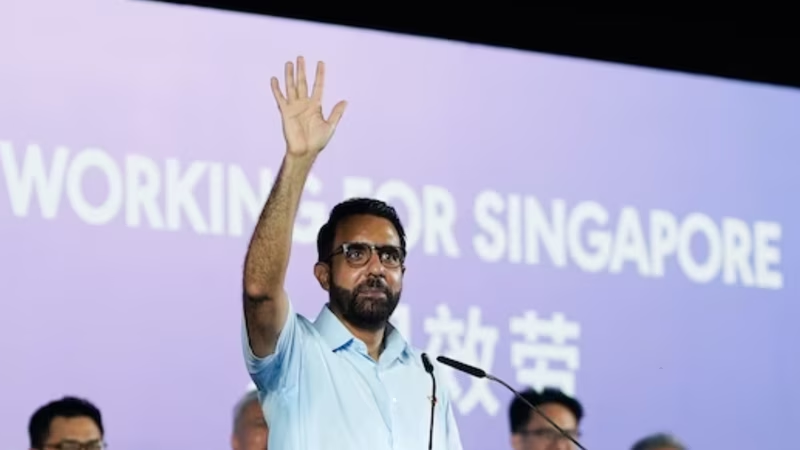
In a rare moment of high-stakes political drama, Singapore’s usually buttoned-up parliamentary decorum has been shattered by explosive accusations against its most prominent opposition figure. Pritam Singh, Secretary-General of the Workers’ Party (WP) and the de facto Leader of the Opposition, has been publicly accused of lying to Parliament—a charge so grave in Singapore’s political culture that it prompted a senior minister to call his conduct “dishonourable.” The controversy centers on statements Singh made during a debate over foreign interference, and it has ignited fierce debate about accountability, transparency, and the fragile balance between dissent and decorum in one of Asia’s most tightly governed democracies.
Table of Contents
- What Did Pritam Singh Allegedly Lie About?
- Why Lying in Parliament Is a Big Deal in Singapore
- Singapore Opposition Leader Lying: The Political Fallout
- Public and Media Reaction to the Scandal
- Historical Context: Opposition in Singapore’s Political Arena
- What Happens Next? Legal and Procedural Implications
- Conclusion: A Test for Singapore’s Democratic Maturity
- Sources
What Did Pritam Singh Allegedly Lie About?
The controversy stems from a parliamentary exchange in late 2025 regarding the government’s Foreign Interference (Countermeasures) Act (FICA). During a heated debate, Singh claimed he had not been shown certain classified intelligence documents that the government said justified its actions against alleged foreign influence operations .
However, Deputy Prime Minister Lawrence Wong later produced evidence—including signed acknowledgments—that Singh had, in fact, been briefed on the very documents in question under strict confidentiality protocols. This discrepancy led Wong to accuse Singh of deliberately misleading Parliament. In unusually sharp language, Wong stated, “It is dishonourable for a Member of Parliament to deny having seen documents when he has signed for them” .
While Singh maintains he was referring to a different set of materials and insists there was no intent to deceive, the damage to his credibility—and by extension, the Workers’ Party’s reputation—has been significant.
Why Lying in Parliament Is a Big Deal in Singapore
In many democracies, political spin and evasive answers are par for the course. But Singapore operates under a distinct political ethos rooted in meritocracy, rule of law, and personal integrity. Members of Parliament are expected to uphold the highest standards of truthfulness because parliamentary proceedings form the bedrock of national policy and public trust .
Deliberately misleading Parliament isn’t just frowned upon—it can trigger formal censure, loss of privileges, or even legal consequences. The People’s Action Party (PAP), which has governed Singapore since independence, has long positioned itself as the guardian of this ethical standard. Accusing an opposition leader of dishonesty is thus both a procedural and deeply symbolic act.
Singapore Opposition Leader Lying: The Political Fallout
The fallout has been swift and severe. Within days, online forums and social media exploded with polarized reactions. Supporters of the Workers’ Party argue that Singh was caught in a technicality and that the PAP is weaponizing procedure to silence dissent. Critics, however, see this as a legitimate challenge to Singh’s fitness for office—especially given his role as the official Leader of the Opposition, a title formally recognized by the Prime Minister in 2020 .
This incident also risks undermining years of careful bridge-building by the WP, which has worked to position itself as a credible, responsible alternative to the PAP. A loss of trust could alienate moderate voters who support a stronger opposition but demand unwavering integrity .
Impact on Workers’ Party and Future Elections
The stakes are especially high ahead of the next general election, expected by 2029. The WP currently holds 10 elected seats—the largest opposition bloc in Singapore’s history. Any erosion of public confidence could stall their momentum. Key considerations include:
- Whether the party issues a formal clarification or apology.
- How independent media and civil society groups frame the narrative.
- Whether younger voters view this as a partisan attack or a genuine breach of ethics.
Public and Media Reaction to the Scandal
State-linked media like The Straits Times have covered the story factually but prominently, quoting ministers’ strong rebukes. Independent outlets such as Mothership.sg and Today Online have published opinion pieces both defending Singh’s intent and condemning the alleged misrepresentation .
On Reddit and Telegram channels—key platforms for Singaporean political discourse—the debate rages. One user wrote, “If you’re the face of the opposition, you can’t afford even the appearance of dishonesty.” Another countered, “This is how the PAP crushes dissent—by turning minor ambiguities into moral failings.” [INTERNAL_LINK:singapore-politics-explained] could help readers understand the unique dynamics of the city-state’s political system.
Historical Context: Opposition in Singapore’s Political Arena
For decades, Singapore’s opposition was fragmented and marginalized. The rise of the Workers’ Party under leaders like Low Thia Khiang and now Pritam Singh marks a historic shift. Their 2020 electoral gains—including winning a Group Representation Constituency (GRC)—signaled growing public appetite for checks and balances .
Yet the PAP remains dominant, controlling 80+ of 93 elected seats. In this context, every misstep by opposition figures is magnified. Past leaders have faced defamation lawsuits, bankruptcies, and disqualifications. Singh’s current predicament is the latest chapter in this tense, high-stakes relationship.
What Happens Next? Legal and Procedural Implications
While no formal motion of censure has been filed yet, the Speaker of Parliament could initiate a review if sufficient MPs deem it necessary. Additionally, if evidence shows Singh knowingly misled the House, it could theoretically lead to a finding of contempt—though this is unprecedented for an elected MP in recent history .
More immediately, Singh may be pressured to issue a clarifying statement or seek reconciliation through private channels. His ability to navigate this crisis will define not only his leadership but the trajectory of Singapore’s democratic evolution.
Conclusion: A Test for Singapore’s Democratic Maturity
The accusation that the Singapore opposition leader lied in Parliament is more than a personal scandal—it’s a stress test for the nation’s political culture. Can Singapore foster robust debate without resorting to character assassination? Can the opposition hold power to account while maintaining impeccable integrity? And can the public distinguish between political strategy and ethical breach? How this episode resolves will reveal much about whether Singapore’s democracy is maturing—or merely tightening its grip.
Sources
- [1] Times of India: ‘Dishonourable’: Singapore’s Indian-origin opposition leader under fire for ‘lying’
- [2] Parliament of Singapore: Parliamentary Privileges and Conduct
- [3] Prime Minister’s Office, Singapore: Recognition of Leader of the Opposition (2020)
- [4] Institute of Policy Studies (NUS): Public Trust in Political Institutions (2025 Report)
- [5] Mothership.sg: Coverage of Pritam Singh Controversy
- [6] Electoral Department Singapore: General Election 2020 Results