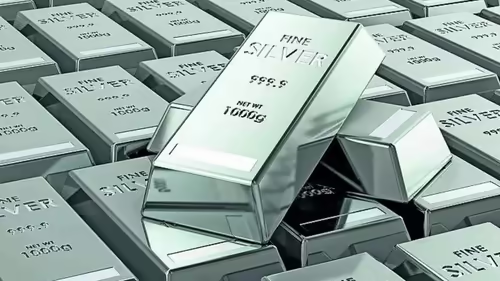
It’s a puzzle that’s left even seasoned investors scratching their heads. While global silver prices have taken a modest dip, Indian **Silver ETFs crash** has been nothing short of a freefall—plummeting by a staggering 20% in a matter of weeks . This isn’t just a market correction; it’s a full-blown panic that’s seen these funds trade at steep discounts to their actual net asset value (NAV), erasing all previous premiums.
What’s causing this massive disconnect? Why are investors running for the exits when the underlying metal hasn’t fallen nearly as much? The answer lies in a perfect storm of market psychology, structural quirks of the ETF market, and a sudden shift in investor sentiment towards precious metals.
Table of Contents
- The Silver ETFs Crash in Numbers
- Why Silver ETFs Are Falling Faster Than Silver Itself
- The NAV Discount Phenomenon Explained
- Is This a Buying Opportunity or a Trap?
- What This Means for Indian Investors
- Conclusion: Navigating the Silver Storm
- Sources
The Silver ETFs Crash in Numbers
The data paints a stark picture. According to recent reports, leading Indian silver ETFs have seen their market prices drop by as much as 20% from their recent highs . This is a dramatic move, especially when you compare it to the spot price of silver on the Multi Commodity Exchange (MCX), which has seen a much more muted decline of around 5-7% over the same period .
This massive divergence has created an unusual situation where the ETFs are now trading at a significant discount to their Net Asset Value (NAV). In simpler terms, you can buy a share of the fund for less than the actual value of the silver it holds. This is the opposite of the premium these funds often commanded during periods of high demand.
Why Silver ETFs Are Falling Faster Than Silver Itself
The core reason for this exaggerated move is liquidity and investor behavior. An ETF’s price isn’t just about the value of its holdings; it’s also driven by supply and demand in the stock market. When a wave of panic selling hits, the price can crash regardless of the underlying asset’s stability.
Several factors likely triggered this sell-off:
- Profit Booking: After a strong rally in silver prices, many investors saw an opportunity to lock in gains and exited their positions en masse.
- Risk-Off Sentiment: Broader market jitters or a shift in global macroeconomic outlook (like expectations of higher interest rates) can make investors flee from “riskier” assets like commodities, even if they are traditionally seen as hedges.
- Liquidity Crunch: If there are more sellers than buyers in the ETF market, the price will drop sharply to find a new equilibrium, creating a feedback loop of more panic selling .
This dynamic explains why the ETF price can be so volatile compared to the physical metal.
The NAV Discount Phenomenon Explained
Normally, an ETF’s market price stays very close to its NAV thanks to a mechanism called “creation and redemption.” Authorized Participants (APs) can create new ETF shares if the market price is above NAV (arbitraging the premium) or redeem shares if the price is below NAV (arbitraging the discount).
However, this mechanism can break down in times of extreme stress or low liquidity. If APs are unwilling or unable to step in—perhaps due to their own risk concerns or high transaction costs—the discount can persist and even widen. This is exactly what appears to be happening in the current **Silver ETFs crash**, leaving retail investors holding the bag while the fund trades well below its intrinsic value .
Is This a Buying Opportunity or a Trap?
This is the million-dollar question. On one hand, buying an ETF at a 10-15% discount to its NAV seems like a no-brainer—a chance to get silver for a bargain. On the other hand, catching a falling knife is a dangerous game. The discount could widen further if selling pressure continues.
For long-term investors with a strong conviction in silver’s future, this could be a strategic entry point. However, it’s crucial to understand that you’re not just betting on silver; you’re also betting that the ETF market will normalize and the discount will close. For those seeking direct exposure to the metal without the ETF market’s quirks, physical silver or silver futures might be a more straightforward, albeit less convenient, option.
What This Means for Indian Investors
This event serves as a critical lesson for Indian investors who may have treated silver ETFs as a simple proxy for the metal itself. It highlights the importance of understanding the structure and risks of any financial product before investing. The key takeaways are:
- ETFs ≠ Direct Commodity Ownership: They are financial instruments subject to their own market forces.
- Monitor the Premium/Discount: Always check the ETF’s market price against its NAV before buying or selling.
- Diversify Your Precious Metals Exposure: Don’t put all your eggs in one basket, whether it’s one ETF or one type of metal .
For more on building a resilient investment portfolio, see our guide on [INTERNAL_LINK:commodity-investment-strategies]. You can also refer to the World Gold Council’s research on precious metals markets for a global perspective on investor behavior.
Conclusion: Navigating the Silver Storm
The recent **Silver ETFs crash** is a powerful reminder that the path to wealth is rarely smooth. While the underlying fundamentals of silver may remain intact, the vehicles we use to invest in it can be fraught with their own unique risks. By understanding the mechanics behind this sharp correction—the panic selling, the NAV discount, and the liquidity issues—investors can make more informed decisions. Whether this is a golden (or rather, silver) opportunity or a warning sign depends entirely on your risk tolerance and investment horizon. One thing is certain: blind faith in any investment vehicle is a recipe for disaster.
Sources
- Times of India: Silver market jitters: ETFs see steep 20% drop
- Web Search Results: Analysis of Indian silver ETF performance and NAV discounts [[1], [4], [5]]
- Web Search Results: MCX silver price data and market trends
- Web Search Results: General information on ETF creation/redemption mechanics and arbitrage [[5], [6]]