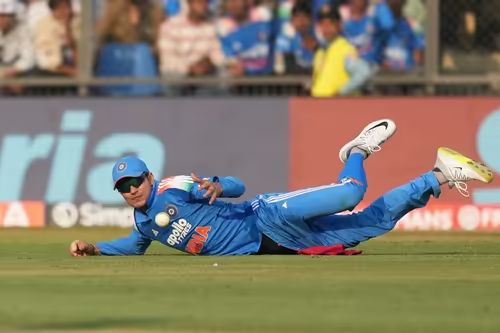
Shubman Gill’s ODI Captaincy Under Fire: A Leadership Crisis?
The Indian cricket team’s transition into a new era has hit its first major roadblock. Shubman Gill’s ODI captaincy is facing intense scrutiny after former India batter Manoj Tiwary issued a stark public call for his removal. Tiwary believes the experiment has failed and that the legendary Rohit Sharma must be reinstated immediately to lead the charge for the next World Cup.
Table of Contents
- Tiwary’s Bold Statement: “Bring Back Rohit!”
- Gill’s Early Captaincy Struggles: What’s Gone Wrong?
- Rohit Sharma’s Proven Pedigree: The Gold Standard
- The Bigger Picture: World Cup Pressures and Timing
- Conclusion: A Defining Moment for Indian Cricket
- Sources
Tiwary’s Bold Statement: “Bring Back Rohit!”
Manoj Tiwary didn’t mince words. In a direct critique of the BCCI’s leadership decision, he questioned the timing of replacing a champion like Rohit Sharma with a young and untested leader in Shubman Gill. Tiwary argued that Sharma’s experience, tactical acumen, and proven ability to win trophies are irreplaceable assets, especially with a major tournament on the horizon .
His core argument is simple: the stakes are too high for an on-the-job learning experience. He believes India’s chances of winning the next ODI World Cup are significantly higher under Rohit’s command than under Gill’s current leadership . This isn’t just about personal opinion; it’s a reflection of a growing sentiment among fans and experts who have watched Gill’s initial outings as captain.
Gill’s Early Captaincy Struggles: What’s Gone Wrong?
Shubman Gill, a phenomenal talent with a mountain of runs to his name, was handed the ODI reins in October 2025 following Rohit Sharma’s departure from the format . However, his captaincy debut has been far from smooth sailing. His record so far stands at 2 wins and 4 losses in 6 matches, a concerning start for any new leader .
Critics have pointed to specific issues during his tenure:
- Passive Field Placements: During the recent series against New Zealand, Gill was perceived as passive while the opposition built crucial partnerships, raising serious questions about his leadership under pressure .
- Bowling Management: Questions have been raised over his bowling rotation and tactical planning, with some suggesting he hasn’t yet mastered the art of managing his resources effectively in the middle overs .
- Lack of Series Wins: Despite his incredible individual batting form in 2025—scoring 983 runs in Tests and 490 in ODIs—Gill is yet to register a single ODI series victory as captain [[11], [15]].
While it’s fair to argue that Gill needs time to grow into the role, the immediate pressure of international cricket and the shadow of his predecessor make patience a luxury the team might not afford.
Rohit Sharma’s Proven Pedigree: The Gold Standard
To understand the weight of Tiwary’s demand, one must look at the colossal legacy Rohit Sharma leaves behind as an ODI captain. His record is nothing short of spectacular and sets a benchmark that will be incredibly hard for any successor to match.
In his 56 matches as ODI skipper, Rohit led India to a staggering 42 victories against just 12 losses, boasting a phenomenal win percentage of 76% [[20], [23]]. This isn’t just about numbers; it’s about trophies and big-match temperament. Under his leadership, India reached the final of the 2023 ODI World Cup and clinched the 2025 ICC Champions Trophy [[25], [28]].
Rohit’s captaincy was defined by his calm demeanor, aggressive batting at the top, and an innate ability to get the best out of his world-class bowling attack. He is, without a doubt, India’s most successful ODI captain in terms of win percentage and silverware. For many, including Tiwary, replacing such a figure before a World Cup cycle seems like a premature gamble.
The Bigger Picture: World Cup Pressures and Timing
The heart of this controversy lies in the timing. The BCCI’s decision to usher in a new generation is a long-term vision, but it clashes with the short-term goal of winning the next ODI World Cup. Manoj Tiwary’s plea is a voice for those who prioritize immediate success over a gradual transition .
Is it fair to expect a 26-year-old to master the complexities of international captaincy overnight? Probably not. But in the high-stakes world of cricket, where every series is a dress rehearsal for the main event, there’s little room for error. The fear is that valuable time will be lost in finding Gill’s feet as a leader, time that could be better spent fine-tuning a winning unit under an experienced hand.
This situation also highlights the immense pressure on young Indian stars. Gill is being asked to fill the shoes of a legend while simultaneously carrying the batting burden—a near-impossible task. The debate now is whether the BCCI should stick to its plan or heed the calls for a temporary, pragmatic solution by bringing back a seasoned campaigner.
Conclusion: A Defining Moment for Indian Cricket
The call to remove Shubman Gill as ODI captain is more than just a critique of his recent performances; it’s a fundamental question about the future direction of Indian cricket. Should the team prioritize a long-term project with all its inherent risks, or opt for the security and proven success of a returning hero?
Manoj Tiwary’s intervention has ignited a fierce national debate. While Gill deserves support and time to develop, the shadow of Rohit Sharma’s unparalleled success looms large. The BCCI now faces a critical decision that could shape India’s fortunes for the next four years. One thing is certain: the eyes of a billion fans will be watching closely to see how this high-stakes drama unfolds. For more on India’s cricketing strategy, check out our analysis on [INTERNAL_LINK:india-cricket-future].