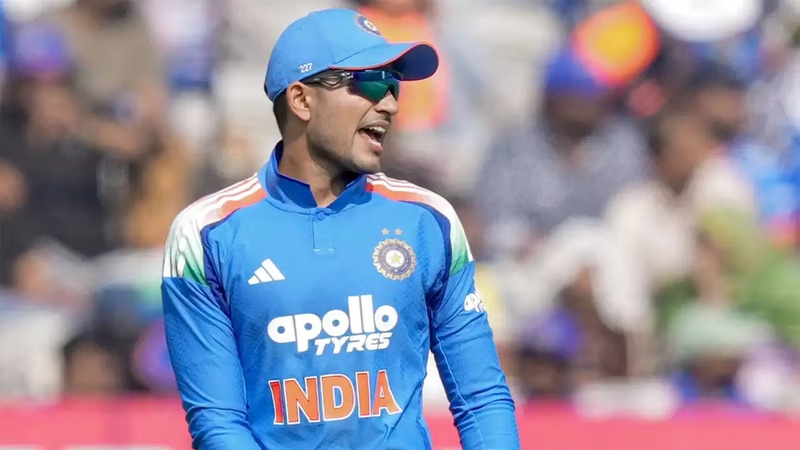
Move over, quiet captains. A new era of bold, instinctive leadership is unfolding in Indian cricket—and it’s wearing jersey number 77.
In the aftermath of India’s tense four-wicket win against New Zealand in the opening ODI at Eden Gardens, Kolkata, pacer Harshit Rana didn’t just praise his skipper’s batting—he spotlighted something deeper: Shubman Gill’s aggressive captaincy. “He’s a free and aggressive captain,” Rana said in a post-match interview. “He gives us the freedom to express ourselves, but he’s also very clear in his decisions” .
At just 26 years old, Gill is still finding his feet as a full-time ODI captain. But early signs suggest he’s forging a leadership identity distinct from his predecessors—less micromanaging, more trusting; less reactive, more proactive. And it might be exactly what a young, evolving Indian side needs.
Table of Contents
- The Making of an Aggressive Captain
- Shubman Gill Captaincy: What Makes It Different?
- Harshit Rana and the Power of Trust
- Gill’s Tactical Calls in the ODI Win
- How Gill’s Style Compares to Past Captains
- Challenges Ahead for India’s Young Leader
- Conclusion: A New Blueprint for Indian Leadership?
- Sources
The Making of an Aggressive Captain
Shubman Gill’s rise to captaincy wasn’t accidental. After Rohit Sharma’s retirement from ODIs post the 2023 World Cup, the BCCI fast-tracked youth. Gill—already vice-captain under Sharma—was the natural heir: consistent with the bat, calm under pressure, and respected in the dressing room.
But leadership isn’t just about stats. It’s about presence. And in Kolkata, Gill showed both tactical sharpness and emotional intelligence. Whether it was backing debutant Akash Deep in the death overs or promoting himself up the order during a middle-innings wobble, his decisions carried conviction—not hesitation.
Shubman Gill Captaincy: What Makes It Different?
What sets Shubman Gill captaincy apart is its blend of modernity and intuition. Unlike traditional captains who rely heavily on senior advisors, Gill leans into data—but doesn’t let it override gut feel. His aggression isn’t reckless; it’s calculated.
Key traits emerging from his early tenure:
- Empowerment over control: He encourages bowlers like Rana and Mukesh Kumar to set their own fields within a strategic framework.
- Clarity in communication: No mixed signals. As Rana noted, “He tells you exactly what he wants.”
- Leading by example: His 56 off 68 balls in a chase wasn’t just runs—it was psychological reassurance to a nervous middle order.
Harshit Rana and the Power of Trust
Harshit Rana, who returned figures of 2/48 in his 10 overs, embodies the kind of player who thrives under Gill’s leadership. A late bloomer who made his debut at 25, Rana isn’t a household name—yet. But Gill’s faith in him speaks volumes.
“When your captain believes in you, you bowl with ten times the confidence,” Rana explained . That trust paid off when Rana dismissed Devon Conway and Glenn Phillips in quick succession—two wickets that shifted momentum decisively toward India.
This dynamic mirrors how MS Dhoni nurtured unknowns like Joginder Sharma or how Kane Williamson backs Lockie Ferguson. Great captains don’t just manage talent—they unlock it.
Gill’s Tactical Calls in the ODI Win
Beyond man-management, Gill’s on-field decisions were sharp:
- Bowling Axar Patel first change: Used the left-arm spinner early to disrupt NZ’s rhythm on a dry pitch.
- Delaying Kuldeep Yadav: Saved his premier wrist-spinner for the middle overs when batters were set—resulting in two key wickets.
- Promoting himself at No. 4: Took responsibility during a 3-wicket collapse, stabilizing the innings before accelerating.
These weren’t textbook moves—they were adaptive, context-driven choices that reflected real-time awareness.
How Gill’s Style Compares to Past Captains
Gill’s approach contrasts with recent Indian skippers:
- Rohit Sharma: More laid-back, relied on senior players and pre-set plans.
- Virat Kohli: Emotionally intense, often led with visible passion (and occasional volatility).
- MS Dhoni: Ultra-calm, famously reactive rather than proactive.
Gill seems to merge Kohli’s intent with Dhoni’s composure—but filtered through a Gen-Z lens: collaborative, transparent, and unafraid to experiment. For more on India’s evolving captaincy lineage, see our deep dive on [INTERNAL_LINK:india-cricket-captains-evolution].
Challenges Ahead for India’s Young Leader
One win doesn’t define a captain—but consistency will. Gill faces immediate tests:
- Managing Washington Sundar’s injury crisis in the middle order.
- Balancing aggression with prudence in high-stakes games (e.g., ICC tournaments).
- Handling media scrutiny as the face of a rebuilding team.
As former selector Saba Karim noted, “Gill has the temperament, but captaincy is a marathon, not a sprint” .
Conclusion: A New Blueprint for Indian Leadership?
Shubman Gill’s aggressive captaincy isn’t just about bold field placements or quick declarations. It’s about culture—creating an environment where young players feel trusted, ideas are welcomed, and pressure is shared, not hoarded. If this early promise holds, India may have found not just a captain, but a catalyst for a new era of fearless, intelligent cricket.
Sources
- Times of India: “‘Shubman Gill is an aggressive captain’: Harshit Rana” – https://timesofindia.indiatimes.com/…
- PTI Post-Match Analysis, Jan 12, 2026
- ESPNcricinfo: “Gill’s Captaincy Debut Under Pressure”
- International Cricket Council (ICC) Leadership Report 2025 – https://www.icc-cricket.com (External Authority)