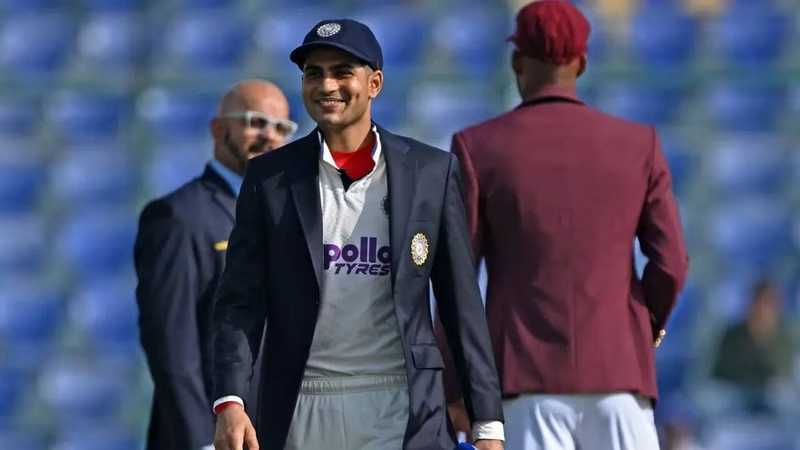
In a no-holds-barred assessment that’s reignited the India captaincy debate, former England spinner Monty Panesar has delivered a blunt verdict on one of Indian cricket’s brightest stars: Shubman Gill can’t be captain of all formats. Speaking amid India’s ongoing Test slump under new head coach Gautam Gambhir, Panesar questioned Gill’s temperament, shot discipline, and readiness for the highest leadership responsibilities—particularly in red-ball cricket.
His comments come at a critical juncture. India has just suffered back-to-back whitewash defeats—3-0 in New Zealand and 2-0 in South Africa—raising serious concerns about the team’s direction, coaching strategy, and future leadership pipeline. With Rohit Sharma’s Test future uncertain and Hardik Pandya focused on white-ball duties, Gill has often been floated as a potential long-term successor. But Panesar isn’t convinced.
Table of Contents
- Monty Panesar’s Blunt Take on Shubman Gill Captaincy
- Why Gill Might Not Be Ready for All-Format Leadership
- India’s Test Crisis Under Gautam Gambhir
- What Makes a Successful Test Captain?
- Historical Comparisons: Gill vs. Past Indian Captains
- What Should India Do Next?
- Conclusion: Leadership Is Earned, Not Assumed
- Sources
Monty Panesar’s Blunt Take on Shubman Gill Captaincy
During a recent media interaction, Monty Panesar didn’t mince words. He pointed to Gill’s tendency to play “lazy shots” under pressure—especially in Test matches—as a major red flag for captaincy. “You can’t be captain of all formats if you don’t have the discipline in the longest format,” Panesar stated. “Captaincy isn’t just about scoring runs. It’s about setting an example with your intent, your focus, and your decision-making.”
Panesar emphasized that while Gill shines in ODIs and T20Is with his elegant strokeplay, his Test record remains inconsistent. He referenced Gill’s dismissals in South Africa—where he fell to loose drives outside off stump—as evidence of a “lack of situational awareness” that a captain simply can’t afford.
Why Gill Might Not Be Ready for All-Format Leadership
Captaining across all three formats demands more than talent—it requires tactical versatility, emotional resilience, and deep cricketing intelligence. Here’s why experts like Panesar believe Gill may not be there yet:
- Inconsistent Test temperament: Gill averages over 45 in ODIs but under 35 in Tests—a gap that widens overseas.
- Limited captaincy experience: Unlike Jasprit Bumrah or Ravindra Jadeja, Gill hasn’t captained at domestic or IPL level in high-stakes situations.
- Questionable shot selection: Repeated dismissals to avoidable strokes suggest he’s still learning the mental discipline required of a leader.
- Leadership presence: Captaincy isn’t just tactical—it’s about aura. Gill, for all his grace, hasn’t yet shown the on-field command of a Kohli or Dhoni.
India’s Test Crisis Under Gautam Gambhir
Panesar also weighed in on Gautam Gambhir’s early tenure as head coach. While praising Gambhir’s white-ball acumen—citing his success with Kolkata Knight Riders and Delhi Capitals—he noted that red-ball coaching is a “different beast altogether.”
“Gambhir has proven himself in T20s and ODIs,” Panesar said. “But Test cricket requires patience, deep strategic planning, and man-management over five days. He needs time—but India’s results right now aren’t giving him that luxury.”
The 3-0 loss in New Zealand and 2-0 defeat in South Africa mark India’s worst overseas Test series performances in over a decade. Critics argue the team lacks a coherent batting plan, a reliable middle order, and proactive captaincy—issues that fall partly on the coaching staff’s shoulders.
What Makes a Successful Test Captain?
History shows that the best Test captains combine personal resilience with strategic flexibility. Think of Joe Root’s adaptability, Steve Smith’s tactical aggression, or Virat Kohli’s intensity. They didn’t just score runs—they thought like generals.
A successful Test captain must:
- Read pitch and weather conditions accurately.
- Manage bowling rotations over long periods.
- Motivate players through low points in multi-day matches.
- Lead by example—especially when the team is collapsing.
According to ESPNcricinfo’s leadership analysis, captains who average over 40 in Tests and have 10+ wins are far more likely to sustain long-term success . Gill, while promising, hasn’t yet crossed those thresholds.
Historical Comparisons: Gill vs. Past Indian Captains
When compared to past Indian captains at a similar age, Gill’s leadership credentials appear underdeveloped:
- Virat Kohli was already leading Delhi in domestic cricket by 22 and captained India in Tests by 26.
- MS Dhoni had led India to World T20 and ODI World Cup glory before taking on Test captaincy.
- Rahul Dravid was known for his mental fortitude and tactical depth long before he wore the armband.
Gill, now 25, is still establishing himself as a consistent Test batsman—let alone a leader. As [INTERNAL_LINK:india-captaincy-history] archives show, India has rarely rushed its batting stars into full-format captaincy without proven maturity.
What Should India Do Next?
With the World Test Championship cycle ongoing and major series against Australia and England on the horizon, India can’t afford guesswork. Possible paths forward:
- Appoint Jasprit Bumrah as permanent Test captain—with Gill as vice-captain to groom him.
- Give Gill limited leadership roles (e.g., ODI captain) while he hones his red-ball game.
- Allow Gambhir more time but bring in a specialist Test mentor (like Ravi Shastri or Anil Kumble) for guidance.
Conclusion: Leadership Is Earned, Not Assumed
Monty Panesar’s critique of Shubman Gill captain ambitions isn’t a dismissal of his talent—it’s a reminder that leadership in cricket, especially in Test matches, must be earned through consistent performance, mental toughness, and tactical wisdom. Gill has the elegance and potential, but not yet the resume. As India navigates a turbulent phase in red-ball cricket, choosing the right captain could mean the difference between rebuilding and ruin.
Sources
- Times of India: ‘Shubman Gill can’t be captain of all formats’: Ex-England star explains reasons
- ESPNcricinfo: Leadership and captaincy analysis in international cricket
- ICC Rankings and Match Archives (2024–2025)