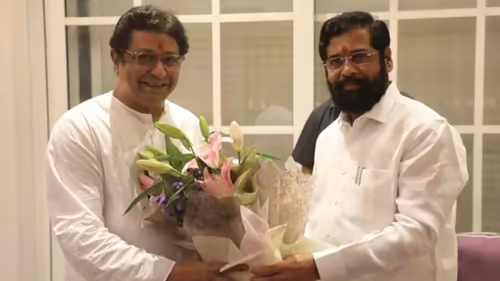
The political chessboard of Maharashtra has just witnessed a masterstroke. In the fiercely contested Kalyan-Dombivli Municipal Corporation (KDMC) elections, Eknath Shinde’s Shiv Sena Kalyan-Dombivli faction emerged as the single largest party but fell short of a clear majority. The plot twist? A surprise ‘helping hand’ from an old rival: the Maharashtra Navnirman Sena (MNS). This unexpected alliance has not only secured the civic body for Shinde but also sent shockwaves through the state’s political landscape.
Table of Contents
- The Numbers Game: Breaking Down the KDMC Seat Count
- Shiv Sena Kalyan-Dombivli: The Path to Power
- Why Did MNS Extend a Helping Hand?
- Political Implications for Maharashtra
- What This Means for Civic Governance
- Conclusion: A New Chapter in Maharashtra Politics
- Sources
The Numbers Game: Breaking Down the KDMC Seat Count
The Kalyan-Dombivli Municipal Corporation is a 122-member house. To stake a claim to form the government, a party or alliance needs a simple majority, which is 62 seats.
Here’s how the final tally shook out:
- Eknath Shinde-led Shiv Sena: 53 seats .
- Bharatiya Janata Party (BJP): 51 seats .
- Maharashtra Navnirman Sena (MNS): 5 seats .
- Others (including Uddhav Thackeray’s UBT and independents): The remaining seats.
With 53 seats, the Shiv Sena Kalyan-Dombivli was tantalizingly close but still 9 seats short of the magic number. This is where the MNS’s decision to extend outside support became the decisive factor, pushing their combined strength to 58. While this is still technically below the 62-mark, it positions them as the largest bloc by a significant margin over the BJP, making them the natural choice to form the administration, especially with potential support from smaller factions or independents.
Shiv Sena Kalyan-Dombivli: The Path to Power
Kalyan-Dombivli is considered a stronghold of Deputy Chief Minister Eknath Shinde. His son, Shrikant Shinde, is also the sitting MP from the Kalyan constituency. A loss here would have been a massive blow to his political standing. The fact that his faction of the Shiv Sena managed to outperform its ally, the BJP, by one seat in this crucial civic body is a testament to their local organizational strength .
This victory isn’t just about numbers; it’s about narrative. It allows the Shinde camp to project itself as a formidable force in its own right, capable of winning key urban centers without being entirely dependent on its senior partner in the Mahayuti alliance, the BJP. This win solidifies Shinde’s position within the ruling coalition and gives him greater leverage in future negotiations.
Why Did MNS Extend a Helping Hand?
The MNS’s move is a fascinating piece of realpolitik. Historically, the MNS and the Shiv Sena have been bitter rivals, often clashing over the same Marathi voter base. So why support a former enemy?
Several strategic factors are likely at play:
- Relevance and Bargaining Power: By backing the largest party, the MNS ensures it remains a relevant player in the state’s politics. This support gives them a direct line to the corridors of power in KDMC, allowing them to influence decisions and secure benefits for their voters.
- Countering Uddhav Thackeray: The MNS has recently formed an alliance with Uddhav Thackeray’s Shiv Sena (UBT) for the upcoming Brihanmumbai Municipal Corporation (BMC) elections . However, in Kalyan-Dombivli, the UBT was a distant third. Supporting Shinde might be a tactical move to prevent the BJP from gaining full control, or it could simply be a hyper-local decision based on ground-level dynamics and personal relationships between corporators.
- Local-Level Pragmatism: At the civic level, issues like infrastructure, water supply, and local development often trump high-octane state-level rivalries. The MNS corporators may have decided that aligning with the Shinde Sena offers the best chance to get things done for their wards.
Political Implications for Maharashtra
This development has far-reaching consequences beyond the KDMC headquarters.
For the Mahayuti alliance (BJP-Shinde Sena-NCP(Ajit Pawar)), it demonstrates internal complexity. While they present a united front at the state level, their constituent parties are still competing fiercely at the local level. The Shinde Sena’s ability to win more seats than the BJP in Kalyan-Dombivli shows that the alliance is not a monolith.
For the opposition Maha Vikas Aghadi (MVA), led by Uddhav Thackeray, this is another setback. Losing ground in a key urban center like Kalyan-Dombivli, especially when their new ally MNS chose to support their rival, is a significant blow to their momentum ahead of the BMC elections.
This event underscores a new reality in Maharashtra politics: fluid, issue-based, and highly pragmatic alliances are becoming the norm, even between historical adversaries.
What This Means for Civic Governance
For the residents of Kalyan-Dombivli, this political maneuvering translates into who will be responsible for their city’s development. With the Shinde Sena at the helm and MNS support, we can expect a focus on projects that align with their shared base.
The stability of this arrangement will be key. An alliance born out of convenience can be just as easily undone. The pressure will be on the new civic leadership to deliver tangible results quickly to justify this unusual partnership. Their success or failure will be a litmus test for this new brand of pragmatic politics in Maharashtra.
Conclusion: A New Chapter in Maharashtra Politics
The MNS’s ‘helping hand’ to the Shiv Sena Kalyan-Dombivli is more than just a post-poll adjustment; it’s a symbol of the evolving and increasingly complex nature of Maharashtra’s political ecosystem. Ideological lines are blurring, and pragmatic calculations are taking precedence. As the dust settles in Kalyan-Dombivli, all eyes will be on how this new coalition governs and what it portends for the high-stakes battle for Mumbai’s civic body. One thing is certain: the old rules no longer apply.
Sources
- Times of India: Maharashtra civic polls: Eknath Shinde’s Shiv Sena gets ‘helping hand’ from MNS in Kalyan-Dombivli Corporation
- Pune Mirror: KDMC drama: In post-poll surprise, Raj Thackeray’s MNS backs Shinde Sena [[4], [9]].
- Hindustan Times: Shinde Sena trumps ally BJP by one seat in Kalyan-Dombivli civic polls .
- The Hindu: Uddhav Sena, Raj Thackeray’s MNS announce alliance for BMC polls .
- [INTERNAL_LINK:maharashtra-civic-elections-2026-results]
- [INTERNAL_LINK:eknath-shinde-political-strategy]