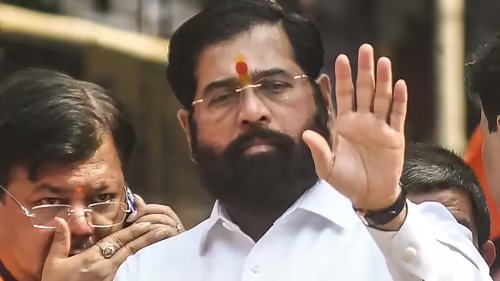
The final results of the 2026 Brihanmumbai Municipal Corporation (BMC) elections have painted a complex picture of Maharashtra’s new political reality. While the BJP celebrated a historic win, securing 89 seats and breaking the Thackeray clan’s decades-long stranglehold on India’s richest civic body , the performance of its key ally, the Shinde Sena, tells a more nuanced story.
Eknath Shinde’s faction managed to win 29 seats . On paper, that makes it a significant player in the ruling Mahayuti alliance. But in the context of the fierce battle for the Marathi manoos identity—the very soul of the original Shiv Sena—this tally feels like a missed opportunity. The party made a dent in the combined tally of Uddhav Thackeray’s UBT and Raj Thackeray’s MNS, but only just, failing to establish itself as the undisputed heir to the Sena legacy in its home city.
Table of Contents
- The Numbers Game: Shinde Sena’s Underwhelming Strike Rate
- Why the Marathi Heartland Remained Elusive
- The Strategic Value of Shinde Sena in the Mahayuti Alliance
- What Does This Mean for Eknath Shinde’s Future?
- Conclusion: A Junior Partner with a Critical Role
- Sources
The Numbers Game: Shinde Sena’s Underwhelming Strike Rate
In a 227-member house, the Shinde Sena BMC 2026 result of 29 seats is a far cry from the dominance once enjoyed by the undivided Shiv Sena. To put it in perspective, the BJP alone won nearly three times as many seats . Even more telling is the comparison with its rival, the Uddhav Thackeray-led Shiv Sena (UBT), which is projected to have won around 60 seats .
This stark contrast highlights a critical weakness in Shinde’s strategy. His party was expected to be the primary vehicle for consolidating the anti-UBT Marathi vote. Instead, it appears that a significant portion of that vote either stayed loyal to Uddhav Thackeray or drifted towards other parties. The Shinde Sena’s inability to decisively outperform the UBT in their direct contest raises serious questions about its long-term viability as an independent political force.
Why the Marathi Heartland Remained Elusive
Several factors contributed to the Shinde Sena’s struggle to capture the imagination of the traditional Shiv Sainik:
- The Legacy Question: For many loyalists, Uddhav Thackeray remains the legitimate heir to Bal Thackeray’s legacy. Shinde’s rebellion in 2022, while politically successful at the state level, was seen by a core section of the cadre as a betrayal of the party’s founding principles.
- Lack of a Distinct Identity: The Shinde Sena has largely functioned as a BJP proxy in Mumbai, struggling to articulate a unique political vision that differentiates it from both its parent party and its main rival. Its campaign often felt like an extension of the BJP’s, lacking the emotive, street-level connect that defined the original Sena.
- Organizational Weakness: Building a new party from scratch takes time. The UBT retained much of the old party’s grassroots network and booth-level workers, giving it a significant organizational advantage in a hyper-local election like the BMC polls.
The Strategic Value of Shinde Sena in the Mahayuti Alliance
Despite its modest seat count, the Shinde Sena’s role in the overall BMC election results 2026 cannot be understated. Its 29 seats were absolutely crucial for the Mahayuti alliance to cross the majority mark of 114. Without them, the BJP’s 89 seats would have been insufficient to form a stable administration .
In this sense, Shinde’s party acts as the essential glue holding the alliance together. It provides the Mahayuti with a vital Marathi credential, helping the BJP counter accusations of being an ‘outsider’ party. For the BJP, Shinde Sena is less about its own electoral strength and more about its strategic utility in neutralizing the UBT’s biggest weapon: its claim to be the sole representative of Marathi interests.
[INTERNAL_LINK:maharashtra-political-alliances-explained] This dynamic creates a fascinating, albeit precarious, power balance within the ruling coalition.
What Does This Mean for Eknath Shinde’s Future?
The 2026 results present Eknath Shinde with a clear challenge. He has proven he can be a kingmaker at the state level, but can he build a durable political base of his own in Mumbai? The current trajectory suggests he is heavily dependent on the BJP’s machinery and resources.
To survive and grow, Shinde must now focus on two things: first, delivering tangible governance outcomes through his councilors to build a track record of performance; and second, developing a second-rung leadership that can connect with the youth and the next generation of voters. If he fails to do so, his party risks becoming permanently relegated to the status of a junior partner, its relevance tied entirely to the BJP’s need for a Marathi face.
Conclusion: A Junior Partner with a Critical Role
The Shinde Sena BMC 2026 performance is a study in contradictions. It was simultaneously a failure and a success. A failure in its ambition to replace the UBT as the dominant Marathi voice in Mumbai, but a success in its indispensable role as the BJP’s key ally in forming the new civic government. Its future hinges on whether it can leverage this critical, albeit limited, power to build a genuine political identity beyond just being a faction of convenience.
Sources
- Times of India: BMC polls: Shinde Sena makes dent in UBT-MNS tally, but only just
- Times of India (Web Search): BMC Election 2026: SEC declares results for 227 seats
- Times of India (Web Search): BMC poll 2026: Sena (UBT) leads in around 60 seats
- Election Commission of India: Official Election Results Portal