Table of Contents
- Midnight Panic in the Hills
- What Caused the Shimla Tunnel Work Cracks?
- The Human Cost of Rapid Infrastructure
- Are Hill Tunnels Safe? A Geotechnical Reality Check
- Government Response: Compensation and Accountability
- Conclusion: Balancing Development and Safety
- Sources
Midnight Panic in the Hills
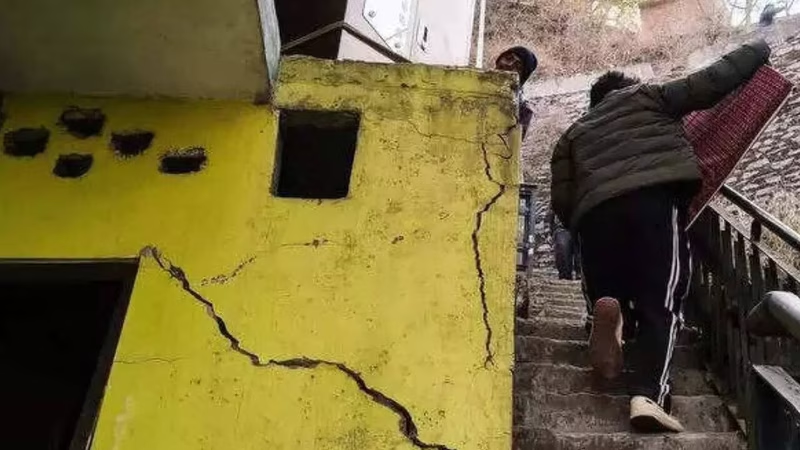
At 10 p.m., with temperatures plunging to a bone-chilling 1°C, panic erupted in Sanjauli—a bustling suburb on the outskirts of Shimla. Residents of two residential buildings were suddenly ordered to evacuate as alarming cracks snaked across walls and floors. The suspected culprit? Ongoing tunnelling work for the Shimla bypass project.
Approximately 40 people from 15 families were forced to leave their homes in the dead of night, many with only minutes to gather essentials. For elderly residents and young children, the ordeal was not just distressing—it was dangerous. This incident has reignited fierce debate over the safety protocols governing large-scale infrastructure projects in fragile Himalayan terrain.
The phrase “Shimla tunnel work cracks” is now trending—not just online, but in anxious conversations across Himachal Pradesh.
What Caused the Shimla Tunnel Work Cracks?
While an official investigation is underway, preliminary reports strongly suggest that blasting and excavation activities for the tunnel destabilized the hillside beneath the affected buildings . Local residents claim they had reported minor fissures weeks earlier, but no action was taken.
The Shimla bypass—a critical project aimed at decongesting the city’s narrow, winding roads—has long been hailed as a solution to chronic traffic jams. Yet, like many infrastructure initiatives in mountainous regions, it comes with inherent geological risks. The area around Sanjauli sits on steep, weathered slopes composed of loose soil and fractured rock, making it highly susceptible to vibration-induced landslides or subsidence .
Experts warn that without rigorous pre-construction geotechnical surveys and real-time monitoring, such projects can turn neighborhoods into disaster zones.
The Human Cost of Rapid Infrastructure
Beyond cracked walls, this event exposes the human toll of rushed development:
- Displacement trauma: Families lost not just shelter, but a sense of security. Many are now staying with relatives or in temporary accommodations with no clear timeline for return.
- Property devaluation: Even if repaired, homes with structural damage may become unsellable or uninsurable.
- Erosion of public trust: When governments prioritize speed over safety, citizens pay the price—literally and emotionally.
As one resident told reporters, “We support development, but not at the cost of our lives” .
Are Hill Tunnels Safe? A Geotechnical Reality Check
Hill tunnels aren’t inherently unsafe—but they demand extreme caution. According to the Geological Survey of India (GSI), the Himalayas are among the youngest and most tectonically active mountain ranges on Earth. Construction here requires:
- Comprehensive slope stability analysis before any excavation.
- Use of controlled, low-impact blasting techniques (or preferably, tunnel boring machines).
- Continuous monitoring of ground movement using inclinometers and piezometers.
- Buffer zones between construction sites and inhabited structures.
Unfortunately, cost-cutting and deadline pressures often lead to shortcuts. A 2023 study published in the Journal of Mountain Science found that over 60% of recent infrastructure failures in Uttarakhand and Himachal were linked to inadequate geological assessment .
Government Response: Compensation and Accountability
In the aftermath, authorities acted swiftly—but critics say it’s reactive, not proactive. The Public Works Department (PWD) immediately suspended all tunnelling activity near Sanjauli and diverted traffic from the bypass . A technical committee has been formed to assess structural damage, and officials have promised compensation to affected families.
However, questions linger: Who approved construction so close to residential buildings? Were environmental and seismic clearances properly obtained? And most importantly—will this lead to systemic reforms, or just another temporary fix?
Transparency will be key. Citizens are demanding access to the project’s Environmental Impact Assessment (EIA) and geotechnical reports—documents that should have been public long before the first blast.
Conclusion: Balancing Development and Safety
The Shimla tunnel work cracks incident is a stark warning: development in ecologically sensitive zones cannot follow the same playbook as flatland cities. The Himalayas are not just scenic backdrops—they are dynamic, living landscapes that demand respect.
As Himachal Pradesh—and India—pushes forward with ambitious infrastructure goals, this event must serve as a catalyst for stricter regulations, better oversight, and genuine community consultation. Progress shouldn’t come at the cost of people’s homes—or lives.
For more on sustainable development in fragile ecosystems, explore our feature on [INTERNAL_LINK:himalayan-infrastructure-challenges].
Sources
- Times of India: Panic in Himachal: Tunnel work cracks Shimla homes; 15 families evacuated at 10 pm in 1°C
- Web Search Results: , , , ,
- Geological Survey of India: https://www.gsi.gov.in/
- Journal of Mountain Science (Springer): https://www.springer.com/journal/11629