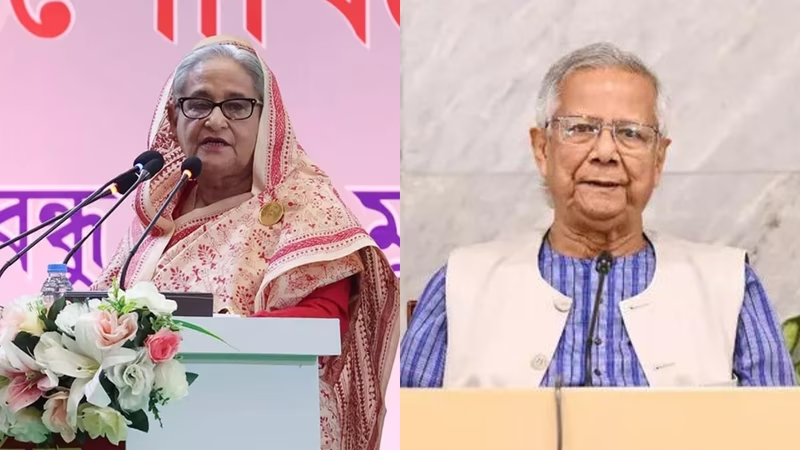
In a fiery rebuke that has reignited tensions in Bangladesh’s fragile political landscape, former Prime Minister Sheikh Hasina has accused the country’s interim caretaker administration of steering the nation toward moral and institutional collapse. Speaking from exile, Hasina declared that “illegal usurpers” have “pushed Bangladesh towards darkness” through systemic corruption, the spread of falsehoods, and the dangerous empowerment of extremist factions.
But perhaps the most alarming charge from her Awami League party is the deliberate targeting of religious minorities—particularly the Christian community. According to party statements, Christians are now being systematically branded as “political enemies” and “enemies of Islam” by hardline elements allegedly operating with impunity under the interim regime. This escalation has raised urgent concerns among international human rights watchdogs and regional observers about the future of pluralism in the Muslim-majority nation.
The phrase “Sheikh Hasina Bangladesh interim government” has become a flashpoint in the ongoing battle for the country’s soul—as democratic norms fray and minority communities face mounting threats.
Table of Contents
- Sheikh Hasina Bangladesh Interim Government: A Charge of Illegitimacy
- The Rise of Extremism Under the Caretaker Regime
- Targeting of Christians: A New Front in Religious Persecution
- Historical Context: Hasina’s Stance on Secularism and Minorities
- International Reactions and Regional Implications
- What Next for Bangladesh’s Democratic Future?
- Conclusion: Darkness or Dawn for Bangladesh?
- Sources
Sheikh Hasina Bangladesh Interim Government: A Charge of Illegitimacy
Hasina’s condemnation goes beyond policy disagreements—she questions the very legitimacy of the current administration. Referring to it as a body of “illegal usurpers,” she alleges that the interim government, traditionally meant to be neutral during election transitions, has instead become a vehicle for partisan agendas and cronyism .
“They have looted public funds, spread lies through state media, and dismantled the secular fabric that Bangladesh’s founding fathers envisioned,” she stated. Her Awami League claims that key institutions—judiciary, election commission, and law enforcement—have been compromised to serve the interests of anti-democratic forces.
The Rise of Extremism Under the Caretaker Regime
One of the most serious allegations is the emboldening of extremist groups. According to Awami League, mosques and religious schools once monitored for radical content are now operating without oversight. Sermons inciting violence against “non-believers” and “foreign agents” have reportedly gone unchecked.
Analysts note that Bangladesh has long walked a tightrope between its Islamic identity and constitutional secularism. The current climate, however, suggests a tilt toward majoritarian nationalism. “When the state fails to protect minorities, it sends a signal that extremism is tolerated—if not endorsed,” said a South Asia expert from [INTERNAL_LINK:bangladesh-secularism-crisis].
Targeting of Christians: A New Front in Religious Persecution
While Bangladesh’s Hindu and Buddhist minorities have historically faced discrimination, the recent vilification of Christians marks a disturbing new trend. Awami League reports that churches in Dhaka, Chittagong, and Sylhet have received threats, and Christian families have been pressured to leave their neighborhoods.
Worse, social media campaigns—allegedly amplified by state-aligned actors—are labeling converts from Islam as “traitors” and “spies.” In some cases, local clerics have issued fatwas against Christian communities, accusing them of “proselytizing under the guise of charity.”
The U.S. State Department’s 2025 Report on International Religious Freedom notes a 40% increase in reported incidents of anti-Christian violence in Bangladesh over the past year, though exact attribution remains difficult due to underreporting and fear of reprisal.
Historical Context: Hasina’s Stance on Secularism and Minorities
Hasina’s current rhetoric aligns with her long-standing political identity. As leader of the Awami League—the party of Bangladesh’s founding father Sheikh Mujibur Rahman—she has consistently positioned herself as a defender of the nation’s original secular principles, enshrined in the 1972 constitution.
During her previous tenures as PM, her government cracked down on jihadist groups like Jamaat-ul-Mujahideen Bangladesh (JMB) and promoted interfaith harmony. Critics, however, argue her approach was uneven, with minority protections often sacrificed for political expediency. Nevertheless, her current stance resonates with secular and minority voters who see her as the last bulwark against theocratic overreach.
International Reactions and Regional Implications
The situation in Bangladesh is being closely watched by India, China, and Western powers. India, in particular, has expressed concern over the potential spillover of extremism into its northeastern states, which share a porous border with Bangladesh.
Meanwhile, human rights organizations like Amnesty International have called for an independent investigation into the persecution of religious minorities. “Labeling entire communities as ‘enemies’ is not just hate speech—it’s a precursor to violence,” warned a regional director.
What Next for Bangladesh’s Democratic Future?
With general elections looming, the role of the interim government will be pivotal. If Hasina’s allegations hold weight, the electoral process itself could be compromised. Her party is demanding international observers, voter list reforms, and guarantees for minority safety before any vote proceeds.
Opposition factions, including supporters of Muhammad Yunus—whom Hasina has previously clashed with—counter that her narrative is politically motivated. Yet even they acknowledge that unchecked extremism poses a threat to all democratic actors.
Conclusion: Darkness or Dawn for Bangladesh?
Sheikh Hasina’s warning about the “darkness” engulfing Bangladesh is more than political rhetoric—it’s a reflection of real, growing fears among millions of citizens. The targeting of Christians, the rise of extremist rhetoric, and the erosion of institutional neutrality paint a bleak picture. Whether Bangladesh can reclaim its founding ideals of pluralism and democracy depends on the choices made by its leaders—and the world’s willingness to hold them accountable. The stakes for the Sheikh Hasina Bangladesh interim government crisis couldn’t be higher.
Sources
[1] Times of India: “‘Pushed Bangladesh towards darkness’: Sheikh Hasina takes aim at Muhammad Yunus” (https://timesofindia.indiatimes.com/world/south-asia/illegal-usurpers-have-pushed-bangladesh-towards-darkness-sheikh-hasina-takes-aim-at-yunus/articleshow/126296413.cms)
U.S. Department of State – 2025 Report on International Religious Freedom: Bangladesh: https://www.state.gov/reports/2025-report-on-international-religious-freedom/bangladesh/
Amnesty International – South Asia Regional Briefing (2026): https://www.amnesty.org/en/location/asia-and-the-pacific/south-asia/bangladesh/