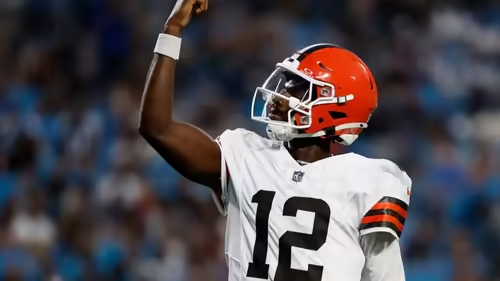
Shedeur Sanders Pro Bowl: The Controversial Call-Up
The 2026 Pro Bowl rosters are set, but one name is causing more debate than celebration: Cleveland Browns quarterback Shedeur Sanders. On the surface, it’s a feel-good story—a rookie from a famous football family making the all-star game. But a quick look at the stats tells a different tale. So, how did a player with a 7-to-10 touchdown-to-interception ratio land in Las Vegas for the Pro Bowl Games? The answer lies not in his on-field heroics, but in the NFL’s intricate system of alternates.
Table of Contents
- The Real Reason: A Super Bowl Vacancy
- Shedeur Sanders’ Rookie Season: A Statistical Reality Check
- The Pro Bowl Alternate System: How It Really Works
- Is This a Meaningful Honor or Just a Participation Trophy?
- Conclusion: The Complexity of a Pro Bowl Invite
- Sources
The Real Reason: A Super Bowl Vacancy
Let’s cut to the chase. Shedeur Sanders was not an original selection for the 2026 Pro Bowl. His inclusion is purely a result of the NFL’s standard operating procedure for its all-star event. When a player selected for the Pro Bowl advances to the Super Bowl, they are automatically removed from the Pro Bowl roster to focus on the league’s championship game [[5]].
In this case, New England Patriots rookie quarterback Drake Maye, who was voted onto the initial Pro Bowl team, is heading to Super Bowl 60. This created a vacancy that needed to be filled. The league then turns to its pre-determined list of alternates—the next players in line based on the combined voting from fans, coaches, and fellow players [[19]]. Sanders, for reasons we’ll explore, was the next quarterback up on that list [[6]].
Shedeur Sanders’ Rookie Season: A Statistical Reality Check
To understand why this selection feels so jarring to many fans and analysts, you need to look at the numbers. Drafted in the fifth round (144th overall) by the Browns, Sanders’ rookie campaign was a classic tale of highs and lows, but heavily weighted toward the latter.
Over eight games, he threw for 1,400 yards with just 7 touchdowns against 10 interceptions, posting a passer rating of 68.1 and a QBR of 18.9 [[8], [9]]. While he showed flashes of potential—most notably in a Week 14 performance where he threw for 364 yards and 3 TDs to earn NFL Rookie of the Week honors [[13]]—his overall body of work was far from Pro Bowl caliber, especially when compared to other rookie quarterbacks and the league’s elite passers.
His season was a stark reminder of the steep learning curve in the NFL, a reality that makes his Pro Bowl nod seem more like a logistical necessity than a performance-based reward.
The Pro Bowl Alternate System: How It Really Works
The confusion and controversy often stem from a lack of understanding about how the Pro Bowl selection process functions. It’s not simply the “best” players; it’s a blend of popularity, peer respect, and a rigid system for handling absences.
Here’s a breakdown of the process:
- Voting: The initial rosters are determined by a consensus vote. One-third of the vote comes from fans, one-third from NFL coaches, and one-third from the players themselves [[19], [24]].
- Alternate List: Simultaneously, a ranked list of alternates is created for each position. These are the players who received the next highest number of votes after the initial selections.
- Replacement Protocol: When a selected player cannot participate—whether due to a Super Bowl berth, injury, or personal choice—the first alternate at their position is offered the spot. If they decline, the offer moves to the next alternate, and so on [[20]].
This system explains Sanders’ presence. He wasn’t voted in as a top-tier quarterback; he was the next man up on a list that likely included other young, popular, or well-regarded players who may have had similarly modest statistical seasons.
Is This a Meaningful Honor or Just a Participation Trophy?
This is where the debate gets philosophical. For the Sanders family and the Browns organization, having his name associated with the Pro Bowl is a significant resume builder for a fifth-round rookie. It’s a national platform and a mark of recognition, however it was achieved. From a marketing and future contract perspective, it’s a win.
However, for purists and stat-driven analysts, this dilutes the value of the Pro Bowl itself. The event is already criticized for its flag-football format and lack of competitive intensity. Adding a player whose primary qualification is “availability” rather than “excellence” can feel like a hollow gesture. As one analyst put it, it’s less a celebration of a great season and more a testament to being in the right place on an alternate list at the right time.
Conclusion: The Complexity of a Pro Bowl Invite
So, is the Shedeur Sanders Pro Bowl selection deserved? The answer is nuanced. He didn’t earn it through a stellar rookie season—that much is clear from the stats. But he did earn his spot on the alternate list through a combination of his famous last name, his potential, and the respect he garnered from peers and coaches during a tough year. In the end, his selection is a perfect case study in the modern Pro Bowl: a mix of genuine talent, fan service, and procedural necessity. It’s a unique honor for Sanders, but it’s one that comes with a very specific asterisk.
Sources
- Times of India: Why Shedeur Sanders is in the Pro Bowl as a replacement quarterback explained [[1]]
- USA Today: Shedeur Sanders has been selected for the Pro Bowl [[5]]
- Yahoo Sports: Shedeur Sanders reportedly named to the Pro Bowl after 7-TD, 10-INT season [[4]]
- ESPN: Shedeur Sanders 2025 Stats per Game [[8]]
- Cleveland Browns: Shedeur Sanders named NFL Rookie of the Week for Week 14 [[13]]
- FanSided: How are Pro Bowl alternates selected? Explaining Shedeur Sanders’ shocking inclusion [[20]]
- DraftKings Network: How are Pro Bowl alternates determined? [[19]]
- ESPN: How does NFL Pro Bowl voting work? [[24]]