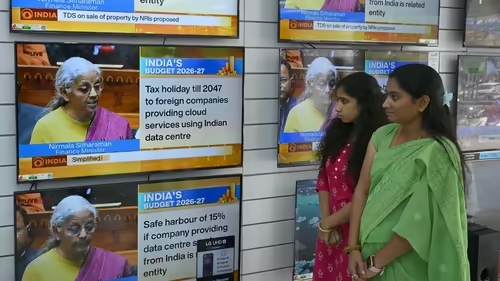
Finance Minister Nirmala Sitharaman’s ninth budget wasn’t just about big infrastructure numbers; it had a clear, targeted message for half the population. In a move that directly builds on the popular Lakhpati Didi scheme, the government announced the creation of SHE Marts—a new initiative designed to catapult rural women from self-help groups (SHGs) into the realm of full-fledged entrepreneurs. But is this a genuine leap forward, or just another layer of bureaucracy? Let’s dive deep.
Table of Contents
- What Are SHE Marts and How Do They Work?
- Building on the Lakhpati Didi Foundation
- Beyond SHE Marts: Other Key Women-Centric Announcements
- The Real Challenge: From SHG Member to CEO
- Conclusion: A Bold Step Towards Economic Parity?
- Sources
What Are SHE Marts and How Do They Work?
The acronym SHE stands for Self-Help Entrepreneur. The core idea behind SHE Marts is simple yet powerful: to create a dedicated, community-owned retail platform for products made by women-led enterprises, primarily those emerging from the vast network of Self-Help Groups across rural India [[3]].
These won’t be standalone stores in a mall. Instead, they are envisioned as community-owned retail outlets set up within existing cluster-level federations of SHGs [[6]]. This structure is crucial because it leverages the already established trust and organizational framework of the SHG ecosystem, which has been a cornerstone of rural finance and social development for decades.
The primary goal is threefold:
- Market Access: To solve the perennial problem of market linkage. Many SHGs produce high-quality goods—from pickles and handicrafts to textiles—but struggle to find consistent, profitable buyers beyond their local village.
- Branding & Value Addition: To help these women move beyond being mere producers to becoming brand owners. A SHE Mart provides a unified, recognizable storefront that can build consumer trust and allow for better pricing [[5]].
- Sustainable Income: By creating a direct channel to consumers, the initiative aims to ensure that a larger share of the final sale price goes directly back to the women producers, boosting their household incomes sustainably [[5]].
Building on the Lakhpati Didi Foundation
The SHE Marts initiative isn’t coming out of thin air. It’s a strategic evolution of the government’s flagship Lakhpati Didi program, which aims to create 3 crore women millionaires (in rupees) from the SHG network by providing them with financial support, skill development, and market access [[7]].
Think of it this way: Lakhpati Didi was about empowering the individual entrepreneur. SHE Marts is about building the collective infrastructure—the marketplace—that allows these empowered individuals to thrive at scale. It’s a move from micro-finance to micro-retail, creating an entire ecosystem for women-led businesses to flourish [[1]].
Beyond SHE Marts: Other Key Women-Centric Announcements
While SHE Marts are the headline act, the budget included other significant measures aimed at women’s welfare and opportunity:
One Girls’ Hostel in Every District
Recognizing that education is the bedrock of empowerment, the government has promised to establish at least one girls’ hostel in every district of the country [[2]]. This is a direct intervention to improve female literacy and higher education rates, especially in remote areas where families are often reluctant to send their daughters away for studies due to safety and logistical concerns.
Focus on Fisheries and Agriculture
The budget also allocated specific funds to raise the incomes of rural women engaged in fisheries and agriculture, sectors where they form a significant but often invisible part of the workforce [[1]]. This includes promoting AI in agriculture and strengthening value chains, which will directly benefit women farmers.
The Real Challenge: From SHG Member to CEO
The vision for SHE Marts is undeniably ambitious and well-intentioned. However, the road from policy announcement to on-the-ground success is fraught with challenges. The key hurdles will be:
- Operational Efficiency: Who will manage these marts? Will the women themselves be trained in inventory management, accounting, and digital payments, or will external managers be hired, potentially diluting their control and profits?
- Supply Chain Consistency: Can thousands of disparate SHGs consistently produce goods of uniform quality and quantity to keep the shelves of a SHE Mart stocked?
- Consumer Pull: Will urban and semi-urban consumers actively seek out and buy from SHE Marts, or will they remain a niche, government-supported project?
The success of this initiative will depend less on the budgetary allocation and more on meticulous execution, continuous hand-holding, and a robust feedback mechanism that listens to the women it aims to serve.
Conclusion: A Bold Step Towards Economic Parity?
The introduction of SHE Marts in the Union Budget 2026 is a clear signal that the government is doubling down on its commitment to women-led economic development. By moving beyond credit provision to creating market infrastructure, it addresses a critical gap in the entrepreneurial journey of millions of rural women.
It’s a bold step that has the potential to transform the lives of countless families and inject a powerful new dynamic into India’s rural economy. Whether it becomes a transformative success story or fades into obscurity will be the ultimate test of its design and, more importantly, its delivery. For now, the blueprint is on the table, and the nation’s women entrepreneurs are watching closely.
Sources
- The New Indian Express. “Union Budget 2026 focuses on farmers, rural women with push for fisheries and AI in agriculture.” https://www.newindianexpress.com/nation/2026/Feb/01/union-budget-2026-focuses-on-farmers-rural-women-with-push-for-fisheries-and-ai-in-agriculture [[1]]
- Down To Earth. “Union Budget 2026: Centre pitches enterprise, education and livelihoods boost for women.” https://www.downtoearth.org.in/governance/union-budget-2026-centre-pitches-enterprise-education-and-livelihoods-boost-for-women [[2]]
- Economic Times. “Budget 2026: Community-owned SHE Marts to be set up for women SHG entrepreneurs, says FM Sitharaman.” https://m.economictimes.com/news/economy/policy/budget-2026-community-owned-she-marts-to-be-set-up-for-women-shg-entrepreneurs-says-fm-sitharaman/articleshow/127837507.cms [[3]]
- Ministry of Finance, Government of India. “Budget Speech 2026-2027.” https://www.indiabudget.gov.in/doc/budget_speech.pdf [[4]]
- Live Mint. “Union Budget 2026-27: What is ‘SHE-Mart’ announced by Nirmala Sitharaman? Govt levels up from Lakhpati Didi programme.” https://www.livemint.com/budget/news/union-budget-2026-27-what-is-she-mart-announced-by-nirmala-sitharaman-govt-levels-up-from-lakhpati-didi-programme-11769932581067.html [[5]]
- Open Magazine. “Union Budget 2026: SHE Marts, Women’s Hostels in Every District.” https://openthemagazine.com/india/union-budget-2026-she-marts-womens-hostels-in-every-district [[6]]
- CNBC TV18. “Budget 2026 reaches out to women — From ‘She Marts’ to girls’ hostel in every district.” https://www.cnbctv18.com/budget/budget-2026-reaches-out-to-women-from-she-marts-to-girls-hostel-in-every-district-ws-l-19838787.htm [[7]]