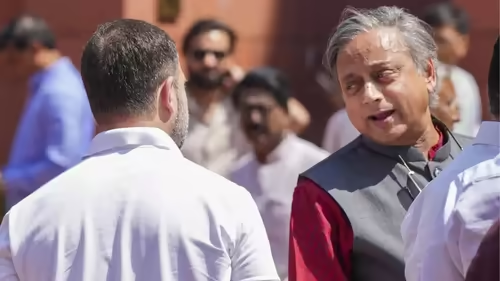
Shashi Tharoor’s Literary Escape Sparks Political Firestorm
In a dramatic turn of events that has laid bare the simmering tensions within the Indian National Congress, senior leader and Member of Parliament Shashi Tharoor has decided to skip a crucial high-level meeting focused on the upcoming Kerala elections. Instead, he will be gracing the ninth edition of the Kerala Literature Festival (KLF) in Kozhikode. This decision, coming on the heels of a perceived snub by Rahul Gandhi, has ignited a fierce debate about Tharoor’s standing and relevance within the grand old party.
Table of Contents
- The Kochi Incident: The Spark
- Shashi Tharoor Chooses Literature Over Politics
- The Sandeep Dikshit Comment: Fanning the Flames
- What This Means for Congress and Kerala
- Conclusion: Is Tharoor Still Relevant?
- Sources
The Kochi Incident: The Spark
The roots of this latest controversy can be traced back to Rahul Gandhi’s recent visit to Kochi. Multiple sources close to Tharoor have confirmed that the MP was deeply upset by what he perceived as an intentional slight during this visit. Reports suggest that despite being a prominent local leader and a key figure from the state, Tharoor was not granted a private meeting with the former party president . This incident is widely seen as the catalyst for his current discontent, signaling a growing distance between him and the party’s top brass .
Shashi Tharoor Chooses Literature Over Politics
In a clear statement of his priorities—or perhaps his protest—Shashi Tharoor has officially declined to attend the Congress high command’s strategic conclave on the Kerala elections. His office has confirmed his schedule is firmly booked at the Kerala Literature Festival 2026, where he is a featured speaker for multiple sessions, including one titled “Undressing Desire: Why India” on January 23rd [[1], [4]]. The KLF, running from January 22nd to 25th at the Kozhikode beachfront, is a prestigious event that draws global literary figures, making it a fitting platform for the author-politician [[3], [8]]. While his literary commitments are legitimate, the timing of his absence from such a critical political meeting is what has raised eyebrows across the political spectrum .
The Sandeep Dikshit Comment: Fanning the Flames
The situation was further inflamed by comments from another senior Congress leader, Sandeep Dikshit. While the exact phrase “relevant people” in the original report appears to be a misattribution or taken out of a broader context, Dikshit has been a vocal critic of Tharoor in recent months. Their public feud escalated in late 2025 when Dikshit openly questioned Tharoor’s loyalty to the party after he made complimentary remarks about Prime Minister Narendra Modi, even calling him a “hypocrite” and bluntly asking, “Why are you in Congress?” [[18], [19], [21]]. This history of friction adds significant weight to the current narrative of a deep internal rift, painting a picture of a party struggling to manage its diverse and often conflicting voices.
What This Means for Congress and Kerala
This public display of disunity comes at a terrible time for the Congress party, which is already grappling with its identity and strategy ahead of key state elections. In Kerala, where the party leads the ruling United Democratic Front (UDF), a united front is paramount. Tharoor’s absence from a core strategy meeting sends a dangerous signal of fragmentation to both allies and voters. It raises several critical questions:
- Can the Congress effectively manage its internal egos and ambitions to present a cohesive campaign?
- How will this visible rift impact the party’s credibility among the electorate in Kerala?
- Is the party’s leadership structure creating an environment where experienced leaders like Tharoor feel sidelined?
For Tharoor, this move is a high-stakes gamble. While it asserts his independence and intellectual stature on a global stage, it risks further isolating him from the party’s central decision-making power. It’s a delicate balance between maintaining his personal brand and his political future within the Congress framework.
Conclusion: Is Tharoor Still Relevant?
The question of Shashi Tharoor‘s relevance is less about his intellectual or public standing—he remains a towering figure in Indian public discourse—and more about his influence within the Congress party’s current power structure. By choosing the serene halls of a literature festival over the heated war room of a political strategy session, Tharoor has made a powerful, albeit silent, statement. Whether this is a temporary protest or a sign of a more permanent drift remains to be seen. However, one thing is certain: this episode has exposed the fragile fault lines within the Congress, and how they navigate this internal crisis will be a major test of their resilience and unity in the run-up to the elections. For more on the internal dynamics of the Congress party, see our analysis on [INTERNAL_LINK:congress-party-leadership-crisis].
Sources
- Times of India: Congress vs Tharoor again: Kerala MP to skip key poll meet
- Kerala Literature Festival Official Website: KLF 2026 Programme
- The Hindu: Sandeep Dikshit slams Shashi Tharoor over PM Modi praise