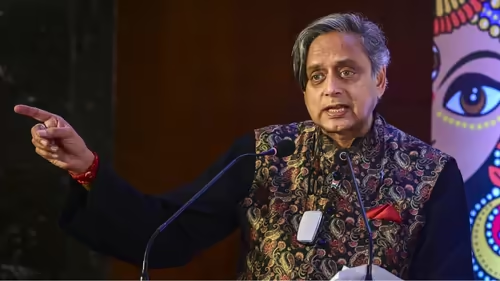
In a world where headlines are dominated by war, occupation, and geopolitical brinkmanship, a rare note of cautious optimism has emerged—from an unexpected quarter. Congress MP and seasoned diplomat Shashi Tharoor recently suggested that the volatile situation around Iran tensions might finally be cooling down.
Speaking with measured hope, Tharoor pointed to two key developments: reports of cancelled executions inside Iran and a noticeably toned-down military posture from the United States . “We may have turned a corner,” he said—a phrase that carries immense weight given the region’s recent spiral toward potential conflict.
Yet, even as he sees light on the Iranian horizon, Tharoor draws a sharp contrast with Gaza, where he believes peace remains a distant dream amid relentless violence and political deadlock.
Table of Contents
- Why Iran Tensions Might Be Easing
- The US Shift: A Calculated De-escalation?
- Regional Desire for Stability
- But Gaza Tells a Different Story
- Shashi Tharoor’s Diplomatic Perspective
- What This Means for India
- Conclusion: Cautious Hope in a Fractured World
- Sources
Why Iran Tensions Might Be Easing
For months, the specter of direct military confrontation between Iran and Western powers loomed large. From drone strikes to nuclear enrichment spikes and tit-for-tat sanctions, the region felt like a tinderbox.
But recent signals suggest a shift:
- Halted executions: Multiple human rights monitors reported that several high-profile death sentences—particularly those tied to anti-government protests—have been suspended or commuted .
- Diplomatic backchannels: Quiet talks between Tehran and European envoys have reportedly resumed in Oman and Qatar.
- Economic pragmatism: With inflation soaring and youth unrest simmering, Iran’s leadership may be prioritizing internal stability over external posturing.
Tharoor interprets these not as concessions, but as pragmatic recalibrations—a sign that even hardliners recognize the cost of perpetual crisis.
The US Shift: A Calculated De-escalation?
Equally telling is Washington’s recent restraint. After months of deploying aircraft carriers and issuing stern warnings, the Biden administration has notably softened its rhetoric.
There’s been no major new sanction rollout in early 2026. Public statements from the State Department now emphasize “diplomatic solutions” over “maximum pressure.” Even Defense Secretary Lloyd Austin has refrained from saber-rattling in recent briefings.
Experts at the Council on Foreign Relations suggest this reflects a strategic pivot: with elections looming and global attention on Ukraine and Gaza, the US may be seeking to avoid opening a third front in the Middle East .
Regional Desire for Stability
Crucially, Tharoor notes that neighboring countries—including Saudi Arabia, UAE, and even Iraq—are actively pushing for calm. The Saudi-Iran détente brokered in 2023 hasn’t collapsed; if anything, it’s being quietly reinforced through trade and security dialogues.
“No one in the region wants another war,” Tharoor observed. “Not when oil prices are volatile, tourism is recovering, and youth unemployment remains critical.” This shared interest in stability could be the invisible hand guiding current de-escalation efforts.
But Gaza Tells a Different Story
While offering hope on Iran, Tharoor was starkly pessimistic about Gaza. “The violence continues unabated,” he said, referencing ongoing Israeli bombardments and humanitarian blockades .
Unlike the Iran-US dynamic—which involves state actors capable of backchannel diplomacy—the Gaza conflict is entangled in deeper ideological, territorial, and historical wounds. With Hamas still in control of parts of Gaza and Israel’s government leaning further right, Tharoor sees little room for negotiation.
“Peace requires two willing partners,” he noted. “Right now, both sides appear locked in a cycle of retaliation with no off-ramp in sight.”
Shashi Tharoor’s Diplomatic Perspective
As a former UN Under-Secretary-General and longtime parliamentarian, Tharoor brings a unique lens to global crises. His analysis blends realpolitik with moral clarity—a rarity in today’s polarized discourse.
He cautions against over-optimism: “We have limited information access from inside Iran. What we’re seeing could be tactical, not strategic.” Yet, he insists that even small openings should be seized. “Diplomacy works in inches, not miles.”
What This Means for India
For New Delhi, a calmer Persian Gulf is more than just good news—it’s a strategic necessity. India relies on the region for over 60% of its oil imports and hosts nearly 9 million expatriate workers there.
A reduction in Iran tensions could:
- Stabilize energy prices
- Improve maritime security in the Strait of Hormuz
- Create space for India to deepen Chabahar Port cooperation without fear of escalation
However, Tharoor warns India must tread carefully—balancing ties with both Iran and the US-led coalition without alienating either.
Conclusion: Cautious Hope in a Fractured World
Shashi Tharoor’s assessment offers a nuanced take in an era of binary narratives. Yes, Iran tensions may be easing—not because of grand peace deals, but due to quiet pragmatism among weary powers. But in Gaza, the path to peace remains blocked by pain, politics, and power imbalances.
His message is clear: celebrate small steps, but never mistake them for final destinations. In global diplomacy, turning a corner doesn’t mean you’ve reached safety—you’ve just avoided a crash. For now, that might be enough.
Sources
- Times of India: ‘We may have turned a corner’: Shashi Tharoor sees Iran tensions easing
- Council on Foreign Relations: Iran Update
- Al Jazeera: Iran Halts Executions Amid International Pressure
- [INTERNAL_LINK:india-middle-east-policy]
- [INTERNAL_LINK:gaza-humanitarian-crisis-explained]