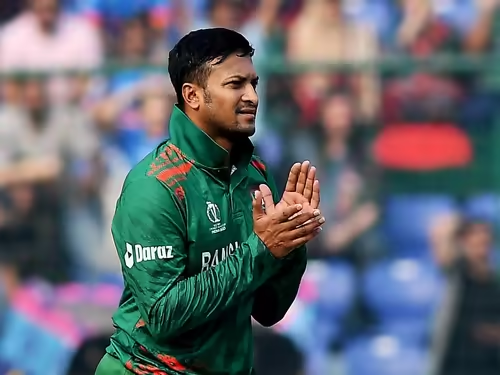
The cricketing world has been waiting with bated breath—and now, it seems, the wait is nearly over. Following Bangladesh’s early exit from the T20 World Cup 2026, the Bangladesh Cricket Board (BCB) has officially unveiled a structured roadmap for the return of its most iconic player: Shakib Al Hasan. This isn’t just about filling a spot in the XI; it’s a carefully calibrated mission to bring back a legend whose presence could redefine the Tigers’ fortunes in the next ICC cycle—culminating in the 2027 ODI World Cup [[1]].
But this comeback comes with layers: unresolved legal concerns, personal security considerations, and the ticking clock of a 38-year-old athlete’s career. Yet, as BCB officials and former stars like Mohammad Ashraful affirm, if anyone can defy time and turmoil, it’s Shakib.
Table of Contents
- The Shakib Al Hasan Comeback Strategy Revealed by BCB
- Why the Pakistan Series Is a Critical Test
- Batting Coach Mohammad Ashraful’s Vision for Shakib
- Addressing the Elephant in the Room: Security and Legal Issues
- Shakib’s Legacy and What His Return Means for Bangladesh Cricket
- Challenges Ahead: Age, Form, and Team Dynamics
- Conclusion: A Calculated Return, Not a Nostalgic Gesture
- Sources
The Shakib Al Hasan Comeback Strategy Revealed by BCB
In a significant development, BCB has confirmed that Shakib Al Hasan is being actively considered for selection in the upcoming home series against Pakistan—a crucial litmus test before bigger commitments [[1]]. The board’s high-performance committee, in consultation with the national selectors, has outlined a phased reintegration plan:
- Phase 1: Participation in domestic practice sessions under BCB supervision.
- Phase 2: Potential inclusion in the ODI and T20I squads for the Pakistan series (scheduled for March–April 2026).
- Phase 3: Full focus on ODI cricket with an eye on the 2027 World Cup in South Africa.
This structured approach signals that BCB views Shakib not as a stopgap solution but as a cornerstone for their next World Cup campaign.
Why the Pakistan Series Is a Critical Test
The home series against Pakistan offers the perfect low-pressure environment for Shakib’s return. Unlike high-stakes ICC events, bilateral series allow room for experimentation and rhythm-building. More importantly, playing at home in front of supportive crowds in Dhaka or Chattogram could provide the psychological boost he needs after months of uncertainty.
For fans, it’s more than just cricket—it’s a homecoming. And for the team, having Shakib’s tactical acumen in the middle order and his left-arm spin could be the X-factor against a formidable Pakistani side.
Batting Coach Mohammad Ashraful’s Vision for Shakib
Former captain and current batting coach Mohammad Ashraful has been one of the most vocal advocates for Shakib’s return. In a recent interview, Ashraful stated, “Shakib should absolutely aim for the 2027 ODI World Cup. His experience, game sense, and leadership are irreplaceable. We don’t have another player who can control a match like he can” [[1]].
Ashraful emphasized that while younger players like Towhid Hridoy and Tanzid Hasan are emerging, they lack the big-match temperament that Shakib brings. “He’s not just a player—he’s a mentor on the field,” Ashraful added, underscoring the dual role Shakib could play in nurturing the next generation.
Addressing the Elephant in the Room: Security and Legal Issues
Shakib’s absence from international cricket wasn’t purely performance-based. He faced serious legal challenges, including a defamation case and threats to his personal security, which led him to withdraw from public life temporarily [[1]].
BCB has now stepped in to mediate and resolve these issues. According to sources, the board is coordinating with law enforcement to ensure enhanced security protocols for Shakib and his family. Additionally, legal advisors are working to expedite court proceedings so they don’t interfere with his cricketing schedule. This holistic support system is critical—if Shakib is to focus on cricket, off-field distractions must be minimized.
Shakib’s Legacy and What His Return Means for Bangladesh Cricket
Let’s be clear: Shakib Al Hasan is Bangladesh’s greatest cricketer. With over 14,000 international runs and 600+ wickets across formats, he’s a once-in-a-generation all-rounder [[4]]. His return isn’t just symbolic—it’s strategic.
In ODIs, his ability to break partnerships with his economical spin and accelerate the innings with the bat makes him invaluable in subcontinental conditions. For more on his statistical dominance, see [INTERNAL_LINK:shakib-al-hasan-career-stats].
His presence also boosts team morale and global credibility. When Shakib plays, Bangladesh is taken seriously. Broadcasters pay attention. Sponsors engage. Youngsters dream bigger.
Challenges Ahead: Age, Form, and Team Dynamics
Of course, realism is essential. At 38, Shakib faces physical limitations. Can he maintain peak fitness across a grueling ODI series? Will his strike rate hold up in today’s hyper-aggressive limited-overs landscape?
Moreover, integrating a veteran into a squad increasingly built around youth requires delicate man-management. Captain Najmul Hossain Shanto and coach Chandika Hathurusingha will need to balance respect for legacy with the demands of modern team dynamics.
Conclusion: A Calculated Return, Not a Nostalgic Gesture
The Shakib Al Hasan comeback is not a sentimental reunion—it’s a high-stakes strategic move by BCB. If successful, it could propel Bangladesh to its best-ever World Cup performance in 2027. If it falters, it risks disrupting a promising generational transition. But one thing is certain: when Shakib steps onto the field again, the entire cricketing world will be watching. And for Bangladesh, that spotlight is exactly where they want to be.