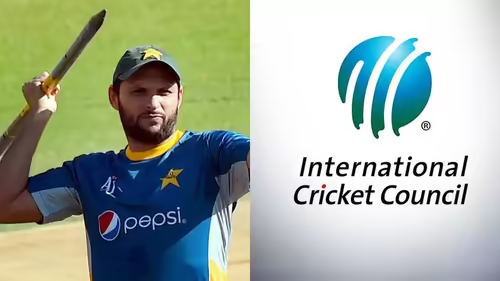
When Shahid Afridi speaks, the cricket world listens. And this time, his words have ignited a firestorm across the sport’s corridors of power. The legendary Pakistani all-rounder has accused the International Cricket Council (ICC) of **blatant double standards**—a charge that cuts to the core of fairness, geopolitics, and the future of global cricket.
The controversy erupted after the ICC announced that Bangladesh would be removed from the 2026 T20 World Cup due to its failure to meet governance and performance benchmarks. But Afridi didn’t stop there. He pointedly contrasted this harsh penalty with the ICC’s recent decision to accommodate India’s security concerns by relocating the 2025 Champions Trophy away from Pakistan—despite no formal withdrawal or breach of protocol from the host nation .
This isn’t just about one team’s exclusion. It’s about who gets a second chance—and who doesn’t. And for many fans across South Asia, it’s yet another chapter in the long, tangled saga of **India–Pakistan cricket politics**.
Table of Contents
- Afridi’s Explosive Accusation: “Build Bridges, Not Burn Them”
- Why Was Bangladesh Removed from the 2026 T20 World Cup?
- India’s Security Concerns and the 2025 Champions Trophy Shift
- The Double Standards Debate: Fair Play or Favoritism?
- How Geopolitics Continues to Shape Global Cricket
- Fan and Expert Reactions Across the Cricketing World
- Conclusion: A Crisis of Credibility for the ICC?
- Sources
Afridi’s Explosive Accusation: “Build Bridges, Not Burn Them”
In a passionate public statement, Afridi didn’t mince words. “The ICC should be building bridges, not burning them,” he declared, directly referencing the body’s handling of Bangladesh’s exclusion versus its flexibility with India .
His message was clear: if the ICC can bend over backwards to ensure India’s participation in a tournament—even at the cost of stripping Pakistan of hosting rights—then why is it so rigid with Bangladesh, a nation with a passionate fanbase and a competitive team?
This rhetorical question has struck a chord far beyond Pakistan, resonating with fans in Sri Lanka, Afghanistan, and the West Indies who often feel marginalized in ICC decision-making.
Why Was Bangladesh Removed from the 2026 T20 World Cup?
According to the ICC, Bangladesh’s removal stems from its failure to meet two key criteria:
- Governance Standards: Ongoing political interference in the Bangladesh Cricket Board (BCB) raised red flags about administrative independence.
- On-Field Performance: Poor results in recent ICC events, including early exits from multiple T20 tournaments, contributed to the decision.
While these reasons may seem objective on paper, critics argue that other nations with similar issues—such as Zimbabwe or even Sri Lanka during past crises—were given grace periods or support rather than outright exclusion.
India’s Security Concerns and the 2025 Champions Trophy Shift
In stark contrast, the ICC’s approach to India’s position ahead of the 2025 Champions Trophy has been described as “accommodating” and “diplomatic.” Despite Pakistan being the official host, India refused to travel due to longstanding security and political tensions.
Rather than risk India’s absence—a move that would have massive financial and viewership consequences—the ICC quietly moved the tournament to a neutral venue (widely reported to be the UAE or South Africa). Notably, Pakistan wasn’t penalized for “failing to provide security”; instead, the narrative framed it as a mutual adjustment for “greater good.”
For Afridi and many observers, this discrepancy is the epitome of **Shahid Afridi ICC double standards**.
The Double Standards Debate: Fair Play or Favoritism?
The heart of the controversy lies in perception—and perception shapes trust. When the ICC applies rules inconsistently, it erodes its moral authority. Consider this comparison:
| Scenario | Action Taken | Outcome |
|---|---|---|
| Bangladesh fails governance & performance checks | Removed from T20 World Cup 2026 | No appeals, no grace period |
| India refuses to play in Pakistan-hosted event | Tournament relocated to neutral venue | Pakistan loses hosting rights; India participates |
To many, this looks less like impartial governance and more like realpolitik—where commercial interests (driven by India’s massive market) override sporting principles.
How Geopolitics Continues to Shape Global Cricket
Cricket has never been just a game in South Asia. It’s a proxy for national pride, historical grievances, and diplomatic posturing. The India–Pakistan rivalry, frozen since 2012 in bilateral series, continues to influence ICC decisions behind closed doors.
As noted by the BBC Sport, the financial clout of the BCCI (India’s board) gives it outsized influence in global cricket governance—a reality that smaller boards struggle to counter . This dynamic makes true neutrality nearly impossible.
Fan and Expert Reactions Across the Cricketing World
Social media has exploded with reactions. Bangladeshi fans feel betrayed, Pakistani supporters see hypocrisy, and even neutral analysts are calling for an independent review of ICC policies.
Former Sri Lankan captain Kumar Sangakkara tweeted: “Consistency in application of rules is non-negotiable for any global sports body.” Meanwhile, Indian fans argue that security concerns are legitimate and non-comparable to administrative failures.
The divide reflects a deeper crisis: without transparent, consistent standards, the ICC risks fragmenting the sport along regional and economic lines.
Conclusion: A Crisis of Credibility for the ICC?
Shahid Afridi’s intervention is more than just a former player venting—it’s a wake-up call. The **Shahid Afridi ICC double standards** controversy exposes a fundamental tension between cricket as a sport and cricket as a business.
If the ICC wants to maintain its legitimacy, it must apply its rules uniformly—regardless of a nation’s market size or political clout. Otherwise, events like the T20 World Cup risk becoming showcases of inequality rather than celebration of global talent. For more on how politics shapes international sports, explore our deep dive on [INTERNAL_LINK:politics-in-global-sports].
Sources
- Times of India: T20 World Cup row: Shahid Afridi drags India–Pakistan angle
- BBC Sport – Cricket: Global Cricket Governance Analysis