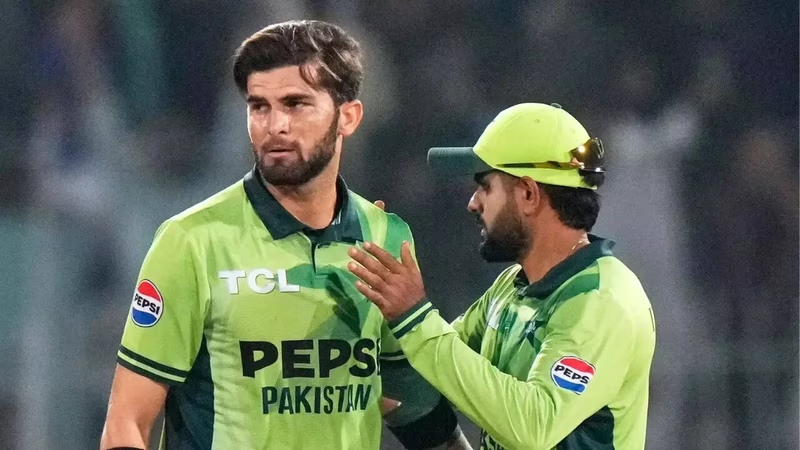
PCB Recalls Shaheen Afridi Mid-BBL After Knee Injury: What Went Wrong in Australia?
It was a moment that sent chills down the spine of every Pakistan cricket fan. During a nerve-wracking final-over thriller between Brisbane Heat and Adelaide Strikers at the Gabba on Saturday night, star left-arm pacer **Shaheen Shah Afridi** crumpled to the ground while chasing a boundary. The diagnosis? A **knee cartilage injury**—serious enough for the Pakistan Cricket Board (PCB) to immediately recall him from the Big Bash League (BBL) mid-season .
This abrupt exit isn’t just a blow to Brisbane Heat’s playoff hopes—it’s a major concern for Pakistan’s upcoming international calendar, including crucial bilateral series and ICC events in 2025. The Shaheen Afridi BBL injury has now become a focal point in discussions about player workload, franchise cricket risks, and national team priorities.
Table of Contents
- The Injury Moment: What Happened at the Gabba?
- Why PCB Decided on an Emergency Recall
- Shaheen Afridi BBL Injury: Medical Details and Recovery Timeline
- Impact on Brisbane Heat and BBL 2025
- Broader Implications for Pakistan Cricket 2025
- Franchise vs. Country: The Ongoing Tension
- Summary and Conclusion
- Sources
The Injury Moment: What Happened at the Gabba?
During the final over of Brisbane Heat’s clash against Adelaide Strikers, Shaheen was fielding near the boundary rope when he sprinted to stop a powerful shot. As he lunged, his left knee buckled awkwardly on the turf. He immediately clutched his leg and had to be stretchered off the field—an unusually grim sight for a player known for his athleticism .
Post-match scans confirmed **cartilage damage in his left knee**, a type of injury that can be deceptively tricky. Unlike ligament tears (like ACL), cartilage injuries don’t always require surgery but can cause persistent pain, swelling, and reduced mobility if not managed carefully—especially for a fast bowler whose entire action hinges on knee stability.
Why PCB Decided on an Emergency Recall
The PCB didn’t hesitate. Within 48 hours, they announced Afridi’s return to Pakistan for “comprehensive assessment and rehabilitation under national medical supervision.” This swift action underscores two key priorities:
- Player Welfare: Protecting their most valuable fast-bowling asset from potential long-term damage.
- International Commitments: With a packed 2025 schedule—including World Test Championship matches and T20Is against top teams—Pakistan cannot afford to risk Shaheen’s availability.
As one PCB insider told ESPNcricinfo, “Franchise leagues are important, but national duty comes first—especially when the player’s future is at stake” .
Shaheen Afridi BBL Injury: Medical Details and Recovery Timeline
Knee cartilage injuries in elite athletes typically follow one of two paths:
- Conservative Management: Rest, physiotherapy, anti-inflammatory treatment, and gradual return to training (6–10 weeks).
- Surgical Intervention: Arthroscopic debridement or repair if the damage is severe (recovery: 3–6 months).
While the PCB hasn’t confirmed surgery, early reports suggest a non-surgical route is being pursued . If all goes well, Shaheen could be back for Pakistan’s home series against New Zealand in April 2025—though selectors may take a cautious approach.
[INTERNAL_LINK:pakistan-fast-bowling-injury-crisis] This isn’t the first time Shaheen’s knee has caused concern; he missed part of the 2023 PSL due to a similar issue, highlighting a recurring vulnerability.
Impact on Brisbane Heat and BBL 2025
For Brisbane Heat, losing Shaheen is a massive setback. He was one of their key death bowlers and had taken 11 wickets in just 7 matches. His ability to swing the new ball and deliver yorkers under pressure made him indispensable in tight finishes .
The Heat are now scrambling to find a replacement, though no overseas player can truly replicate Shaheen’s skill set mid-tournament. His absence could cost them a top-two finish in an already competitive BBL season.
Broader Implications for Pakistan Cricket 2025
Shaheen Afridi isn’t just another bowler—he’s the spearhead of Pakistan’s pace attack across all formats. His absence would force captain Mohammad Rizwan and coach Gary Kirsten to rely more heavily on Naseem Shah and Haris Rauf, increasing their workload and injury risk.
More importantly, 2025 is a critical year for Pakistan’s ICC ambitions. With the Champions Trophy likely to be held in early 2026, every bilateral series in 2025 serves as vital preparation. Losing Shaheen for an extended period could derail Pakistan’s momentum.
Franchise vs. Country: The Ongoing Tension
This incident reignites the long-standing debate: should national boards restrict players from high-intensity T20 leagues?
Countries like India (BCCI) tightly control player participation, while Pakistan has been more permissive—allowing stars like Babar Azam and Shaheen to play in the BBL, CPL, and PSL. But as injuries pile up, the PCB may reconsider its stance.
As noted by the International Cricket Council (ICC), managing player workloads is now a “global priority” in an era of calendar congestion .
Summary and Conclusion
The Shaheen Afridi BBL injury is more than a sports headline—it’s a cautionary tale about the physical toll of modern cricket. While the Big Bash League offers invaluable experience and exposure, it also carries real risks, especially for bowlers. The PCB’s decision to recall him reflects a necessary shift toward prioritizing long-term player health over short-term franchise gains. All eyes are now on Shaheen’s recovery; for Pakistan cricket, his fitness isn’t optional—it’s essential.