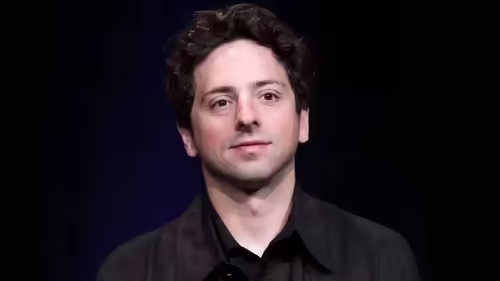
Imagine being told by one of the most influential minds in tech that your prized computer science degree might not be the golden ticket you thought it was—but that studying computer science itself is more vital than ever. That’s the paradoxical yet profound message from Google co-founder Sergey Brin, who recently shared his candid views on education, AI, and what truly matters in the modern tech landscape .
At a time when generative AI can write code, debug software, and even design algorithms, Brin’s insights cut through the noise with clarity and authority. His words aren’t just nostalgic reflections—they’re a strategic roadmap for students, educators, and job seekers navigating an uncertain future.
Table of Contents
- Sergey Brin’s Journey: Passion Over Credentials
- The Evolving Value of a Computer Science Degree
- Google Is Hiring “Self-Taught Stars”—Not Just Graduates
- AI Won’t Replace Coders—But It Will Redefine Them
- What Should Students Do Now? Practical Advice
- Conclusion: Curiosity Is the New Credential
- Sources
Sergey Brin’s Journey: Passion Over Credentials
Brin didn’t mince words when reflecting on his own path. “I chose it out of passion,” he said about his decision to study computer science at Stanford University . This simple statement carries immense weight. For Brin, the drive wasn’t about landing a high-paying job or collecting a prestigious degree—it was about deep intellectual curiosity and a love for problem-solving.
This mindset, he argues, is what separates enduring innovators from those who merely chase trends. In an age where AI tools like GitHub Copilot can generate functional code in seconds, technical knowledge alone is no longer enough. What matters is the ability to ask the right questions, think critically, and adapt—skills often nurtured by genuine interest, not just academic requirement.
The Evolving Value of a Computer Science Degree
So, is a computer science degree still worth it? Brin’s answer is nuanced. He strongly cautions against abandoning the field due to fears of automation. “AI’s capabilities extend far beyond coding,” he noted, implying that while AI may automate routine programming tasks, the foundational logic, systems thinking, and algorithmic understanding taught in CS programs remain irreplaceable .
However, he also acknowledges that the traditional four-year degree is no longer the only—or even the primary—path to success in tech. The focus has shifted from credentials to demonstrable skill. As Brin puts it, “It’s not about where you learned it, but whether you can do it.”
Google Is Hiring “Self-Taught Stars”—Not Just Graduates
In a major policy shift that reflects this philosophy, Google has increasingly opened its doors to non-traditional talent. Brin confirmed that the company now actively seeks out “self-taught stars” who can prove their abilities through portfolios, open-source contributions, or real-world projects—even without a formal degree .
This aligns with broader industry trends. According to a 2023 report by the U.S. Bureau of Labor Statistics, while many tech roles still list a bachelor’s degree as a requirement, nearly 30% of software developers are self-taught or hold alternative credentials like bootcamp certifications .
For aspiring developers, this is liberating—but also demanding. It means you must build a public track record of your work. Here’s what actually matters now:
- A strong GitHub profile with clean, well-documented code.
- Contributions to open-source projects that solve real problems.
- Personal projects that demonstrate creativity and technical depth.
- Problem-solving skills showcased in coding competitions or hackathons.
Check out our guide on [INTERNAL_LINK:how-to-break-into-tech-without-a-degree] for actionable steps.
AI Won’t Replace Coders—But It Will Redefine Them
Brin’s warning is clear: don’t avoid computer science because you think AI will make coders obsolete. On the contrary, AI is creating new layers of complexity that require deeper understanding. The future belongs to those who can use AI as a tool—not those who fear it as a replacement.
For example, prompt engineering, AI system integration, ethical AI auditing, and hybrid human-AI workflows are emerging fields that demand both technical fluency and creative thinking—precisely the kind of synthesis a strong CS foundation enables, whether acquired in a classroom or through disciplined self-study.
What Should Students Do Now? Practical Advice
If you’re a student or career-changer wondering how to proceed, here’s a balanced approach inspired by Brin’s philosophy:
- Follow your curiosity. If you love building things, solving puzzles, or understanding how systems work, dive into computer science—formally or informally.
- Don’t fetishize the degree. A diploma is a means, not an end. Focus on learning outcomes, not just credit hours.
- Build in public. Share your projects, write blogs, contribute to communities. Your reputation becomes your resume.
- Learn to collaborate with AI. Master tools like Copilot, but understand the code they produce. Be the director, not just the typist.
Conclusion: Curiosity Is the New Credential
Sergey Brin’s message isn’t anti-education—it’s pro-purpose. The value of a computer science degree lies not in the paper it produces, but in the mindset it cultivates: logical reasoning, resilience, and relentless curiosity. Whether you earn that mindset in a lecture hall or a late-night coding session at home matters less than your ability to apply it.
In the end, as Brin’s own journey proves, passion beats pedigree every time. And in the age of AI, that passion—paired with proven skill—is the ultimate competitive advantage.
Sources
- Times of India: ‘I chose it out of passion’: Google founder Sergey Brin on studying computer science
- U.S. Bureau of Labor Statistics (BLS): Software Developers – Occupational Outlook
- Google Careers Blog: Trends in non-degree hiring (referenced via TOI report)