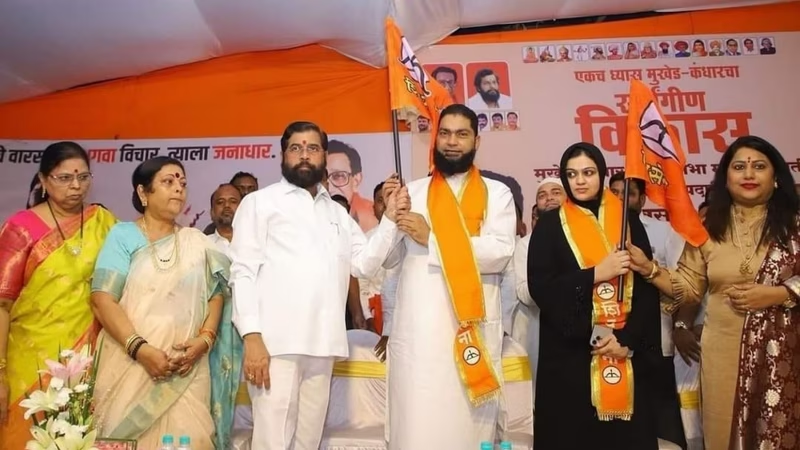
The high-stakes battle for control of India’s richest civic body—the Brihanmumbai Municipal Corporation (BMC)—has taken a dangerous turn. Shiv Sena (UBT) candidate Haji Saalim Qureshi was brutally stabbed four times in the stomach while campaigning in Bandra East, just weeks before the crucial BMC polls. The attack, carried out by an unknown assailant who fled the scene, has sent shockwaves through Mumbai’s political landscape and ignited fears of escalating violence in an already tense election season.
Table of Contents
- The Attack: How It Happened
- Who Is Haji Saalim?
- Police Response and Investigation
- Political Reactions from All Parties
- A History of Violence in BMC Polls?
- What This Means for Mumbai’s Civic Future
- Conclusion
- Sources
The Attack: How It Happened
The incident occurred on a busy afternoon in the Bandra East neighborhood, a key battleground in the upcoming BMC polls. Haji Saalim Qureshi, the 43-year-old Sena (UBT) candidate from the Bandra East (West) ward, was walking door-to-door, interacting with voters as part of his grassroots campaign .
According to eyewitnesses, a man—described as being in his 30s—suddenly emerged from the crowd, pulled out a knife, and stabbed Saalim four times in the abdomen before sprinting away. The entire attack lasted just seconds, leaving the candidate bleeding on the street and his supporters in panic .
He was rushed to a nearby private hospital where he is currently undergoing treatment. Doctors report that his injuries are serious but not life-threatening.
Who Is Haji Saalim?
Haji Saalim Qureshi is not a newcomer to civic politics. A local resident and social worker, he has been active in Bandra’s community affairs for over a decade. He previously contested the 2017 BMC elections and is known for his work on housing rights and sanitation issues in the area.
His candidacy in 2026 is seen as a strategic move by the Shiv Sena (UBT) to consolidate its support in a diverse and competitive ward. The attack, therefore, isn’t just a personal tragedy—it’s a direct assault on the democratic process itself.
Police Response and Investigation
The Mumbai Police have treated the incident with utmost seriousness. An “attempt to murder” case has been registered at the Bandra East police station, and multiple special investigation teams (SITs) have been formed to track down the assailant .
Authorities are not ruling out a political motive. “Given the timing and the target’s profile, we are exploring all angles, including a possible link to rival political outfits or local goons acting on their behalf,” a senior police official stated anonymously .
CCTV footage from nearby shops and buildings is being scoured, and police have appealed to the public for any information that could lead to an arrest.
Political Reactions from All Parties
The attack has drawn unanimous condemnation across the political spectrum—a rare moment of unity in Mumbai’s often-fractious politics.
- Shiv Sena (UBT): Party leaders called it a “cowardly act to muzzle democracy” and demanded enhanced security for all candidates.
- Shiv Sena (Shinde faction): Also condemned the violence, distancing itself from the incident.
- Bharatiya Janata Party (BJP): Mumbai unit chief labeled it “unacceptable in a democracy” and urged a swift investigation.
- Indian National Congress: Accused all major parties of creating a “toxic and violent political culture” in the city.
A History of Violence in BMC Polls?
While Mumbai is generally considered a relatively peaceful electoral ground compared to other Indian metros, the BMC polls have seen their share of intimidation, booth capturing, and even physical assaults in the past .
The stakes are incredibly high: control of the BMC means authority over a ₹50,000+ crore annual budget, urban planning, health services, and property taxes. This translates into immense power and patronage, making the elections a fierce contest where tempers—and sometimes, violence—can flare.
This latest attack, however, stands out for its brazenness: a direct, public stabbing of a declared candidate during a campaign walk. It raises serious questions about the adequacy of security protocols for political workers at the ward level.
What This Means for Mumbai’s Civic Future
The implications go beyond one ward or one election. If candidates can be physically attacked with impunity, it could deter grassroots workers—especially from marginalized communities—from entering politics. This erodes the very foundation of representative democracy.
Moreover, it places immense pressure on the Mumbai Police and the State Election Commission to ensure a free and fair poll. Enhanced security for all candidates, real-time monitoring of campaign events, and swift legal action against perpetrators will be essential to restore public confidence.
Conclusion
The stabbing of Haji Saalim during the BMC polls campaign is more than just a crime—it’s a stark warning about the fragility of democratic norms in high-stakes urban elections. As investigators race to find the attacker, the city’s political class must collectively denounce violence and reaffirm its commitment to a peaceful democratic process. The future of Mumbai’s civic governance depends on it.