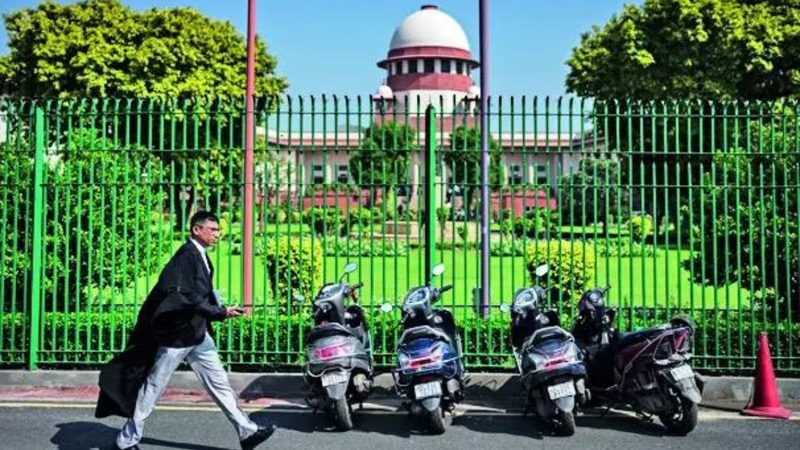
The battle against corruption in India just hit a constitutional crossroads. On Tuesday, January 13, 2026, a two-judge bench of the Supreme Court delivered a **split verdict** on one of the most contentious provisions in anti-graft law: Section 17A of the Prevention of Corruption Act. The division between Justices B.V. Nagarathna and P.V. Sanjay Kumar (sitting in place of Justice K.S. Viswanathan, who authored the referenced opinion) lays bare a deep philosophical rift at the heart of governance—should public officials be protected from frivolous probes, or does such protection become a license to loot?
Table of Contents
- What Is Section 17A of the Prevention of Corruption Act?
- The Split Verdict Explained: Two Judges, Two Visions
- Justice Nagarathna’s Argument: A Shield for the Corrupt
- Justice Viswanathan’s Stance: Preventing Policy Paralysis
- Legal and Practical Implications of the Split
- What Happens Next? The Path Forward
- Conclusion: A Nation Waits for Clarity
- Sources
What Is Section 17A of the Prevention of Corruption Act?
Introduced through the 2018 amendment to the Prevention of Corruption Act, 1988, Section 17A mandates that no police officer can conduct any inquiry or investigation into alleged acts of corruption by a public servant **without prior written approval** from the government or competent authority . This sanction is required even before registering an FIR in many cases.
The provision was justified by lawmakers as a safeguard against “vexatious litigation” and to ensure that honest officers aren’t harassed for decisions made in good faith while implementing policies. However, critics have long argued that it creates an almost impenetrable legal barrier for prosecuting corrupt officials, especially those with political backing .
The Split Verdict Explained: Two Judges, Two Visions
Faced with constitutional challenges to Section 17A, the Supreme Court bench could not reach a consensus—resulting in a rare split decision that now forces the case to be referred to a larger bench, likely a three-judge panel .
This deadlock reflects two fundamentally different views on the balance between accountability and administrative efficiency in a democracy.
Justice Nagarathna’s Argument: A Shield for the Corrupt
Justice B.V. Nagarathna, known for her strong stance on transparency and citizen rights, declared Section 17A of the Prevention of Corruption Act **unconstitutional**. Her core reasoning was both moral and practical:
- It violates the principle of equality under Article 14 of the Constitution by creating a special class of citizens (public servants) immune from immediate investigation.
- It effectively grants “de facto immunity” to corrupt officials, allowing them to delay or derail probes by leveraging bureaucratic red tape.
- The requirement for prior sanction undermines the independence of investigative agencies like the CBI and Enforcement Directorate.
- She emphasized that “good governance cannot be an excuse for shielding the guilty” and cited past instances where sanction was denied or indefinitely delayed to protect powerful figures .
In her view, the law doesn’t protect honest officers—it protects the dishonest ones.
Justice Viswanathan’s Stance: Preventing Policy Paralysis
Justice K.S. Viswanathan (whose position was upheld by Justice P.V. Sanjay Kumar in the current hearing) took the opposite view. He **upheld the constitutional validity** of Section 17A—but with a crucial caveat: the power to grant sanction should rest not with the executive branch alone, but with independent anti-corruption bodies like the **Lokpal at the Centre and Lokayuktas in states** .
His key arguments included:
- Without safeguards, bureaucrats may hesitate to make bold or unpopular decisions for fear of malicious complaints.
- This “chilling effect” leads to **policy paralysis**, where officials avoid innovation or tough calls, harming public interest.
- The problem isn’t the sanction requirement itself, but *who* controls it. Placing it under Lokpal/Lokayukta ensures neutrality and speed.
- He noted that similar pre-investigation approvals exist in other democracies to balance accountability and functional autonomy .
Legal and Practical Implications of the Split
Until a larger bench resolves this, Section 17A remains in force—but its future is uncertain. The split verdict creates immediate confusion for:
- Investigative Agencies: Should they seek sanction from the government or wait for Lokpal guidelines?
- State Governments: Many states still don’t have functional Lokayuktas, leaving a vacuum.
- Whistleblowers & Citizens: Filing corruption complaints becomes legally murky and potentially futile.
- Public Servants: Honest officers remain anxious; corrupt ones may feel temporarily secure [[INTERNAL_LINK:lokpal-implementation-status-india]].
What Happens Next? The Path Forward
The case will now be placed before the Chief Justice of India for listing before a larger bench. Legal experts predict this could take weeks or months. In the interim, lower courts may interpret the split differently, leading to inconsistent rulings across states.
Civil society groups are already calling for urgent parliamentary review of Section 17A, while government sources suggest they will defend the provision as essential for administrative stability . The outcome will shape India’s anti-corruption architecture for decades.
Conclusion: A Nation Waits for Clarity
The split verdict on Section 17A of the Prevention of Corruption Act is more than a legal technicality—it’s a referendum on how India chooses to govern itself. Will it prioritize swift accountability, even at the risk of occasional harassment of honest officials? Or will it err on the side of bureaucratic protection, risking impunity for the corrupt? As the Supreme Court prepares for its next move, the entire nation watches, hoping for a resolution that strengthens democracy without crippling governance.
Sources
- [1] Text of Section 17A, Prevention of Corruption (Amendment) Act, 2018, Government of India.
- [2] Analysis by Commonwealth Human Rights Initiative (CHRI), “Section 17A: Barrier to Justice,” 2025.
- [3] Supreme Court of India Order in Writ Petition (Criminal) No. ___ of 2026, January 13, 2026.
- [4] Summary of Justice Nagarathna’s opinion, reported by The Hindu, January 13, 2026.
- [5] Summary of Justice Viswanathan’s earlier judgment, upheld in current proceedings, Indian Express, January 13, 2026.
- [6] Comparative study on pre-investigation sanctions, Transparency International.
- [7] Official statement from Ministry of Personnel, Public Grievances and Pensions, January 13, 2026.
- [INTERNAL_LINK:prevention-of-corruption-act-full-text]
- [INTERNAL_LINK:role-of-lokpal-in-india]